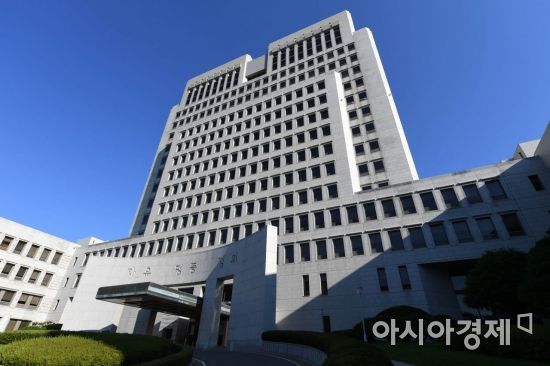
[Asia Economy Reporter Kim Daehyun] As the Supreme Court and the Constitutional Court express conflicting views regarding 'limited unconstitutionality,' concerns are rising that conflicts between the two sides may intensify in the future. Limited unconstitutionality is a modified decision in which the Constitutional Court declares a law unconstitutional only in a specific interpretation by the court, while maintaining the law's overall validity.
On the 6th, the Supreme Court stated in a document titled 'Position on the Constitutional Court's Decision' that "The so-called limited unconstitutionality decision cannot be granted the effect of unconstitutionality as stipulated in Article 47 of the Constitutional Court Act, and as a result, limited unconstitutionality decisions do not bind the courts and cannot be grounds for retrial," emphasizing that "this is an established Supreme Court precedent." This effectively rejects the Constitutional Court's recent stance that "limited unconstitutionality decisions are binding" and its cancellation of court rulings.
The Supreme Court said, "It is not permissible under our Constitution's principle of separation of powers and judicial independence for another state institution to interfere by providing standards for interpreting laws to the courts, thereby compelling the courts to apply the law to specific disputes accordingly."
It added, "If the Constitutional Court can again control the courts' judgments on the interpretation and application of laws, it would effectively control both the legislative actions of the National Assembly and the judicial actions of the courts," and "this could undermine the appellate system with the Supreme Court as the final instance, leading to an unstable situation where disputes remain unresolved even after the Supreme Court's final judgment, a scenario our Constitution never anticipated."
On the 30th of last month, the Constitutional Court ruled unconstitutional the clause prohibiting judicial review that excludes 'court judgments' from the scope of constitutional complaints in principle, specifically regarding 'judgments contrary to the binding effect of unconstitutionality decisions on laws,' and canceled the Supreme Court's ruling that did not follow the limited unconstitutionality decision. This was the second time since 1997 that the Constitutional Court directly canceled a court judgment.
© The Asia Business Daily(www.asiae.co.kr). All rights reserved.
















