Pet Ownership Population Reaches 14.48 Million
"Similar to Raising a Child"... High-End 'Dog Strollers' with Supplements and Handmade Snacks
Pet-Exclusive Services Offered... Hotels and Retailers Targeting 'Petfam' Consumers
Pet Economy Market Expected to Reach 6 Trillion Won by 2027
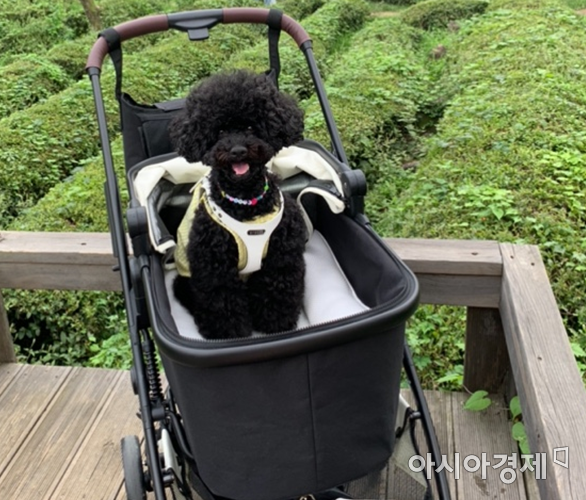
[Asia Economy Reporter Yoon Seul-gi] #. For Kim, a 30-something office worker, his black poodle companion dog 'Cookie' is like a child. He spares no expense for Cookie, who turned seven this year. Kim said, "Since Cookie is entering middle age in human years, health management is essential," adding, "It would be nice to make treats myself, but as a working person pressed for time, I buy handmade snacks and feed them to Cookie. I also made a big decision to purchase a 'gaemoch'a' (dog + stroller) costing about 300,000 won for outings with Cookie."
He continued, "In months when Cookie's grooming, snacks, and supplements pile up, expenses can reach up to 300,000 won, which is relatively low for me," and added, "A friend spends 400,000 won monthly on dog kindergarten fees, and when including health foods like antioxidants and probiotics, some months exceed 1 million won. It's comparable to raising a child."
In the past decade, as the pet population has surged, many people have been spending generously on animals they consider family. According to the '2021 Korea Pet Report' released by KB Financial Group in March (surveying 1,000 adults aged 20 and over nationwide), as of the end of 2020, there were 14.48 million people raising pets in Korea, with 6.04 million pet-owning households, accounting for 29.7% of all households.
Among Korean pet households, 'dog-owning households' make up the largest share at 80.7%, followed by 'cat-owning households' at 25.7%. The estimated number of pet dogs in Korea is 5.86 million, and pet cats number approximately 2.11 million.
The average monthly pet care expenditure per pet dog is 110,000 won, and 70,000 won per pet cat. Among pet care expenses, the largest shares are food costs (33.4%) and snack costs (17.8%), with food-related expenses accounting for more than half. This is followed by purchases of waste pads, cat litter, and other care products (11.1%), and grooming and trimming costs (10.0%).

Unlike before, today's pet households tend to regard animals as family members, reflecting an improved perception of pets as life companions. In the past, people raised cute animals merely as ornaments, but now the focus is on living with animals, leading to an increase in people seeking places where they can spend leisure time with their pets.
As a result, demand for petcations (pet + staycation, hotel stays with pets) has increased, prompting the hotel industry to offer products targeting petfam (pet + family, people who treat pets like family). Major domestic hotels provide pet-only rooms, rent pet carriers and strollers, and supply pet-specific items in rooms, offering services tailored for pet households.
The retail industry has also stepped up to attract petfam. Lotte Department Store opened a cafe allowing dogs, and offers pet-customized services such as kindergarten, grooming, and supplies. Convenience store Emart24 recently began operating a pet dog registration service platform.
The industry's interest in petfam stems from expectations for the 'petconomy' (pet + economy, production and consumption related to pets). According to the Korea Rural Economic Institute, the domestic pet market size grew rapidly from 1.9 trillion won in 2015 to 3.4 trillion won in 2021, with projections reaching 6 trillion won by 2027.
Moreover, as many people express a desire for expanded infrastructure to spend daily life with pets, the growth potential has become even clearer. According to the '2022 Pet Travel Survey' released by the Korea Tourism Organization on the 28th, 74.4% of pet owners intend to travel domestically with their dogs in the future, but face difficulties due to insufficient infrastructure in accommodations, dining facilities, and tourist spots. This indicates that many still experience inconveniences in daily life with animals, and as calls for infrastructure expansion grow, the petconomy is expected to continue its growth trend.
Professor Lee Eun-hee of Inha University's Department of Consumer Studies said, "The pet industry is expected to remain promising," adding, "More people are demanding pet services, and related industries will continue to develop. Even for the same services, there will be trends toward premiumization and diversification."
© The Asia Business Daily(www.asiae.co.kr). All rights reserved.