Infant Accident Prevention... Passenger Protection Airbags
Benefiting from US and Europe Mandatory Sensing Device Regulations
World's Highest Object Recognition Resolution... "Customer Experience Innovation"
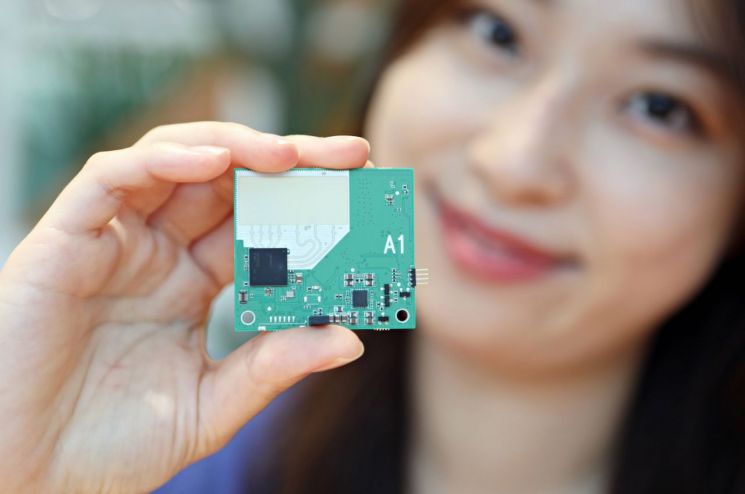
[Asia Economy Reporter Moon Chaeseok] As LG Group joins the competition in the electric and autonomous vehicle markets, its vehicle camera module affiliate LG Innotek announced on the 28th that it has launched a new high-resolution product at the world’s highest level. The product, which raises the resolution by about 40% compared to existing models, is designed to significantly enhance the safety level of drivers in highly growth-potential autonomous vehicles.
The in-vehicle radar module released by LG Innotek is a component that detects the movement of living beings using radio waves and is used to prevent child abandonment accidents and vehicle theft. It is made by combining various components such as radar chips, antennas, and communication chips on a circuit board.
LG Innotek explained that the product launch is significant given the trend of tightening regulations on vehicle sensing devices in major countries such as the United States and Europe. According to LG Innotek, South Korea mandates the installation of safety devices to check whether children have disembarked in passenger vans used for child transportation. Europe plans to add child occupancy detection function tests to the approval criteria for new vehicle sales starting next year. The United States is pushing to mandate the installation of child occupancy detection functions from 2025. The in-vehicle radar module is a high-performance component among sensing devices. Due to the radar’s characteristic of penetrating objects, it can accurately detect the presence of living beings even if there are obstacles such as clothes or blankets. Since it uses radio waves instead of images, there is no concern about privacy invasion. Another advantage is that installing only one or two units in a vehicle can achieve accurate detection. Other components like pressure sensors or ultrasonic sensors require at least five units to deliver the same performance.
Above all, it has the advantage of being useful in autonomous vehicles. It can perform roles such as checking whether passengers are wearing seat belts and notifying the disembarkation timing, effectively substituting for the driver. For this reason, global automakers and vehicle parts companies are actively considering adopting the module. It also meets the safety requirements suitable for autonomous vehicles. The vehicle will not start if all passengers do not fasten their seat belts. When passengers fall asleep and fail to disembark upon arrival at the destination, the seat vibrates to wake them up.
The feature of having about 40% higher resolution than existing products cannot be overlooked. It boasts world-class performance. The module’s signal processing time has also been reduced by about 30% compared to previous models, enabling faster detection. LG Innotek’s proprietary vehicle communication antenna design technology and fine signal detection algorithms have been applied. The algorithm’s principle is to eliminate noise and select only accurate signals for detection. Thanks to digital transformation (DX) using computer programs to optimize antenna placement structure, the same number of antennas as existing products can deliver 1.3 times higher performance. It also has the advantage of being installable anywhere in the vehicle, requiring only minor antenna design changes. Yoo Byung-guk, Executive Director of LG Innotek’s automotive components division, said, “There were difficulties in accurately distinguishing objects with existing products, but we have overcome these limitations. LG Innotek’s in-vehicle radar module will make a significant impact on the market,” expressing confidence.
It also has high safety. It can identify the seating position, number of passengers, biometric signals, and movements of all occupants inside the vehicle. Currently commercialized products only detect the presence of living beings such as people or animals in the rear seats. This greatly enhances the prevention of child abandonment accidents inside vehicles. It can detect even the subtle breathing of infants as young as three months old. By adjusting airbag pressure, it allows installation of customized airbags for adults and children, ensuring driver safety as well.
LG Innotek plans to actively target the global vehicle radar module market. Aiming for commercialization in 2024, it is conducting vigorous promotions targeting global automakers and vehicle parts companies in South Korea, the United States, Europe, and Japan. Executive Director Yoo said, “LG Innotek will continue to introduce future vehicle components that can innovate customer experiences ahead of others and accelerate the era of fully autonomous driving.”
According to global market research firms Yole D?veloppement and Fuji Chimera Research Institute, the global vehicle radar module market is expected to grow from 2.7 trillion KRW in 2020 to 22.3 trillion KRW in 2040, with an average annual growth rate of nearly 11%. In particular, demand for in-vehicle radar modules is projected to increase rapidly from 150,000 units to 87 million units during the same period, with an average annual growth rate of about 37%.
© The Asia Business Daily(www.asiae.co.kr). All rights reserved.












