Dongwon F&B Lightweighting PET Bottle Weight
Lotte Confectionery Changes Paper Cushioning Material
CJ CheilJedang Removes Spam Lid
[Asia Economy Reporter Eunmo Koo] The domestic food industry is strengthening its distancing from plastic. About one-third of the world's plastic production is used for packaging and containers, and this move is in response to consumers' increased interest in eco-friendly products following COVID-19.
According to the Korea Agro-Fisheries & Food Trade Corporation on the 22nd, the leading sector reducing plastic through package improvements is the bottled water industry. Dongwon F&B has lightened the weight of the PET bottles for its 'Dongwon Saemmul' 500ml and 2L products by 15.7% and 8.4%, respectively, and lowered the height of the caps. The company expects this to reduce about 1,200 tons of plastic annually.
Jeju Samdasoo plans to reduce plastic usage by 50% by 2030 by applying chemically recyclable PET (CR-PET) that can be reused repeatedly. Hite Jinro also plans to enhance convenience in separation and recycling value by changing package design to omit labels on individual containers and instead placing essential information such as barcodes only on the neck label of bottles.
The food industry is also attempting to reduce plastic in food packaging by removing unnecessary cushioning materials and changing repackaging methods. Lotte Confectionery has stopped producing products containing plastic cushioning materials and replaced all previously used ones with paper, expecting to reduce plastic use by about 576 tons annually.
CJ CheilJedang has reduced 267 tons of polypropylene (PP) plastic by launching gift sets of Spam products without the yellow lids, and Nongshim expects to reduce annual plastic film usage by 27 tons by simplifying ramen packaging and changing bundle packaging from vinyl to paper bands.
Cases of reducing the use of conventional PET or vinyl derived from petroleum and applying biodegradable components or highly recyclable packaging materials are also increasing. CJ Freshway applied PLA material, which is biodegradable by microorganisms, to eco-friendly leafy vegetable packaging. Pulmuone uses eco-friendly containers containing 30% sugarcane-derived extracts for salad products, which can reduce carbon dioxide emissions by about 20% throughout manufacturing, distribution, and incineration processes.
Recently, the food industry's distancing from plastic is due to comprehensive interest in environmental issues triggered by COVID-19. Experiencing the unprecedented crisis of COVID-19 has raised global awareness of environmental issues, and consumers purchasing eco-friendly products known as 'greensumers' and proactive consumers leading social innovation to solve social problems called 'innosumers' have rapidly emerged.
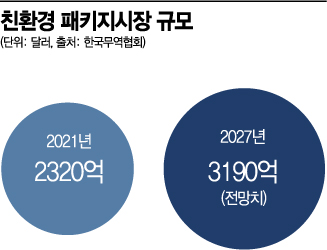
With growing interest in eco-friendly consumption, competition among companies to secure an eco-friendly image has intensified. The food industry is actively enhancing brand image by reducing unnecessary excessive packaging and developing eco-friendly materials instead of plastic. According to the Korea International Trade Association, the global eco-friendly packaging market was estimated at $232 billion (about 300 trillion 920 billion KRW) last year and is expected to grow at an average annual rate of 5.5%, reaching $319 billion (about 412 trillion 6.265 billion KRW) by 2027.
© The Asia Business Daily(www.asiae.co.kr). All rights reserved.

![Clutching a Stolen Dior Bag, Saying "I Hate Being Poor but Real"... The Grotesque Con of a "Human Knockoff" [Slate]](https://cwcontent.asiae.co.kr/asiaresize/183/2026021902243444107_1771435474.jpg)














