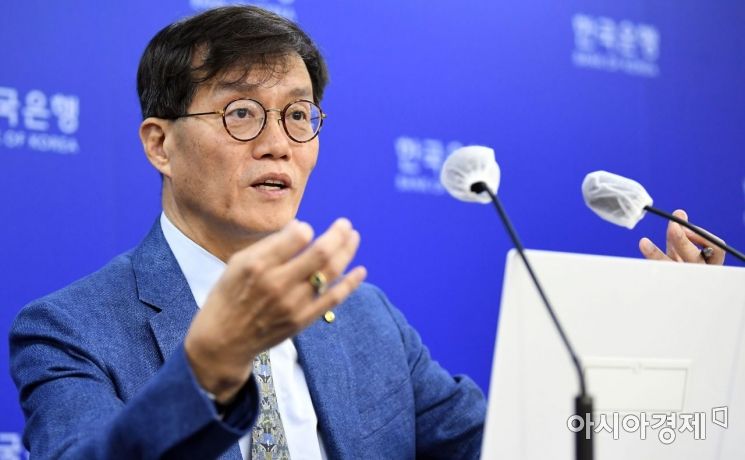
 Lee Chang-yong, Governor of the Bank of Korea, holds a briefing on the status of inflation targeting operations at the Bank of Korea press room in Jung-gu, Seoul, on the 21st. Photo by Moon Ho-nam munonam@
[Asia Economy Reporter Seo So-jung] Amid the ongoing high inflation situation, Lee Chang-yong, Governor of the Bank of Korea, expressed the view that it is desirable to operate monetary policy with a focus on inflation until the steep inflation trend changes.
At a press conference on the 21st explaining the 'Inflation Target Operation Status Review' report, Governor Lee stated, "We judge that the domestic consumer price increase is likely to exceed the forecast path (annual increase rate of 4.5%) made last month."
Governor Lee assessed, "Although there is significant uncertainty related to the future inflation trend, such as the developments in the Ukraine situation, trends in international raw material prices, and the extent of wage increases due to inflation, overall, upward risks seem to dominate."
He added, "Only four weeks have passed since last month's Monetary Policy Board meeting, but there have been considerable changes in inflation conditions. Expectations for the peak of U.S. inflation have been delayed more than initially anticipated, increasing financial market volatility. Additionally, concerns over supply disruptions have grown due to the European Union's restrictions on Russian oil imports, causing international oil prices to rise sharply from around $109 just before the last Monetary Policy Board meeting to an average of about $120 in June, significantly exceeding the assumptions made in the previous forecast."
Accordingly, he judged that the domestic consumer price increase is also likely to exceed last month's forecast path. He said, "The impact of overseas supply shocks may be prolonged. According to major global forecasting institutions, the high oil price situation is unlikely to be resolved easily, and elevated international food prices are also expected to persist."
He explained that the agflation phenomenon caused by rising international food prices has characteristics of downward rigidity and high persistence, making its effects likely to last long, while the recovery of global supply chains is also being delayed.
Governor Lee expressed concern that if inflation expectations are not properly controlled amid the possibility of prolonged domestic and international inflationary pressures, the high inflation situation could become entrenched. He pointed out, "Short-term expected inflation has exceeded the inflation target of 2%, surpassing 3%, while long-term expected inflation has risen to around 2%. The inflation expectations indicator (BEI), which reflects market expectations, is also showing high volatility and steadily increasing."
He emphasized, "Going forward, monetary policy needs to be conducted flexibly and data-dependently by comprehensively considering upcoming economic indicators such as inflation, the economy, financial stability, and foreign exchange market conditions. However, in the current phase where inflation is continuously rising, it is desirable to operate monetary policy focusing on inflation until the steep inflation trend changes."
He added, "It is important to protect vulnerable groups who are facing difficulties due to increased interest payment burdens amid rising prices and interest rates. We will strive to prepare more sophisticated and micro-level support measures through policy coordination in this regard."
© The Asia Business Daily(www.asiae.co.kr). All rights reserved.












