Research Team at Institute for Basic Science
Attention on Whether Development of Treatments for Cancer, Dementia, etc. Will Follow
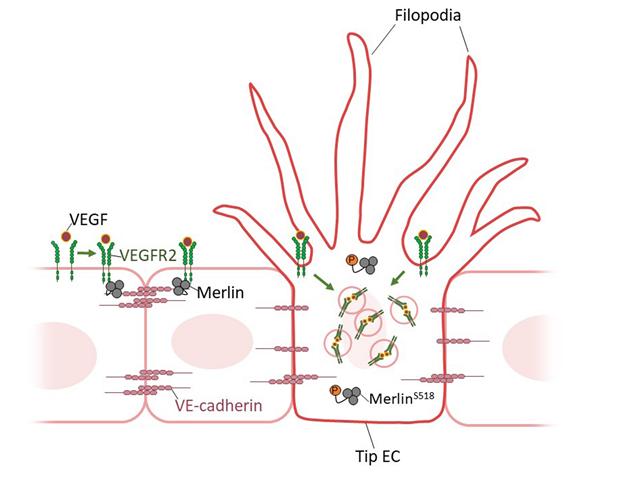 Schematic diagram of Merlin's gatekeeper role in regulating tip cell activation during angiogenesis.
[Asia Economy Reporter Kim Bong-su] A protein involved in creating new blood vessels for wound healing and fetal growth within the human body has been discovered. This finding is attracting attention for its potential connection to the development of treatments for diseases such as cancer, macular degeneration, ischemic heart disease, and vascular dementia.
The Institute for Basic Science (IBS) announced on the 13th that a research team led by Kyuyoung Ko, head of the Vascular Research Center (Distinguished Professor at KAIST Graduate School of Medical Science and Engineering), and postdoctoral researcher Jeonghyun Bae confirmed through animal experiments that a protein called Merlin, present in vascular cells, is a key substance that suppressively regulates angiogenesis. While much research has focused on factors promoting angiogenesis, this study is the first to elucidate the process that regulates it in the opposite direction.
.
During angiogenesis, Vascular Endothelial Growth Factor (VEGF) secreted around blood vessels and its receptor (VEGF Receptor, VEGFR) activate tip cells, promoting new blood vessel formation. Upon VEGF stimulation, certain endothelial cells form filopodia and differentiate into tip cells, while surrounding cells differentiate into stalk cells, which proliferate to form the lumen of the blood vessel. Subsequently, endothelial cells stabilize through VE-Cadherin, a cell-cell junction protein, completing the angiogenic differentiation process.
The research team created an experimental group of mice with specific suppression of Merlin expression in blood vessels. Observing changes in retinal blood vessels, they found an increase in tip cells with filopodia compared to the control group, but a decrease in stalk cells forming the vessel trunk. This demonstrated that Merlin binds to VEGF receptors on the cell membrane and inhibits tip cell activation by regulating the intracellular movement of VEGF receptors. Furthermore, Merlin acts as a gatekeeper controlling the intracellular trafficking of VEGF receptors depending on the density of VE-Cadherin during angiogenesis, thereby elucidating the mechanism by which specific endothelial cells are induced to differentiate into tip cells.
In endothelial cells with high VE-Cadherin density, Merlin, VEGF receptors, and VE-Cadherin bind to each other, suppressing the intracellular movement of VEGF receptors. Conversely, when VE-Cadherin density is low, the binding affinity weakens, increasing VEGF receptor trafficking and activating VEGF signaling, which promotes tip cell growth. This phenomenon was observed not only in retinal vessels but also in the thyroid and intestinal villi where VEGF is overexpressed, and was confirmed in mouse tumor models. When Merlin was selectively removed from tumor blood vessels, the number of tip cells increased while stalk cells decreased. Consequently, tumor vessels became abnormally formed with excessive nonfunctional vessels that impaired blood flow, leading to a significant reduction in tumor growth due to decreased blood oxygen levels.
This indicates that Merlin, contrary to its known tumor suppressor role in other tissues, plays a differentiated role in vascular development by promoting tumor growth. This discovery opens the possibility for developing therapies targeting Merlin.
Dr. Bae stated, “We confirmed in experimental animals and cultured new blood vessels that Merlin binds to VEGF receptors and inhibits rather than promotes angiogenesis,” adding, “Further research is needed to understand how Merlin interacts with physiological substances that promote angiogenesis.”
Director Ko also commented, “Research has mainly focused on identifying bioactive substances that promote angiogenesis, but this discovery reveals a new substance that inhibits angiogenesis,” and added, “The homeostasis of angiogenesis is maintained through the interaction between activating substances and regulatory molecules like Merlin, but disruption of this balance could cause various vascular diseases.”
The research results were published online on the 11th in the international journal Science Advances (IF 14.136).
© The Asia Business Daily(www.asiae.co.kr). All rights reserved.












