Demand Surged but Number of Taxi Drivers Decreased
Labor Shortage in Taxi Industry Is Not a Recent Issue
30,000 Drivers Lost Over 10 Years Even Before COVID-19
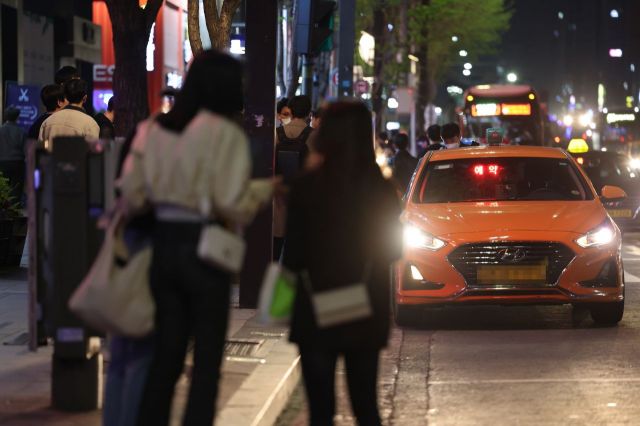 On April 19th, citizens were standing near Gangnam Station in Seoul to catch a taxi. / Photo by Yonhap News
[Asia Economy Reporter Lim Juhyung, Intern Reporter Song Hyundo] Recently, as the 'taxi crisis'?where it is extremely difficult to catch a taxi no matter how long one waits?has intensified, citizens are facing hardships. After the lifting of COVID-19 social distancing restrictions, the taxi industry's supply has failed to keep up with the surging demand. Over the past two years, taxi calls have more than tripled, while the number of taxi drivers has decreased by over 8%. Even before COVID-19, the taxi industry had been experiencing a steady decline in workforce due to low wages, long working hours, and difficult working conditions.
The taxi crisis appears to have emerged as taxi demand significantly outpaced supply following the full lifting of COVID-19 social distancing measures. According to Kakao Mobility, which operates the taxi-hailing application 'KakaoT,' domestic taxi calls in April?when social distancing was fully lifted?surged by an astonishing 312% compared to 2020, two years prior. On the other hand, the number of taxi drivers has actually decreased compared to pre-COVID-19 levels. According to statistics from the National Taxi Transport Business Association Federation (Taxi Association), as of February this year, the number of individual and corporate taxi drivers nationwide was 239,434, down 8.4% from 261,634 two years ago.
Due to the severe shortage of taxis operating in the city compared to passengers, some citizens are reportedly resorting to paying a premium to call luxury taxis as a last resort. University student Yoo (25) said, "I waited for over an hour but couldn't get a taxi, so I had no choice but to call a luxury taxi that was 2 to 3 times more expensive," adding, "The transportation cost burden is significant." Office worker Kim (28) also said, "These days, I can't even think about taking a taxi, so I use public transportation or 'Ddareungi' even if it's inconvenient."
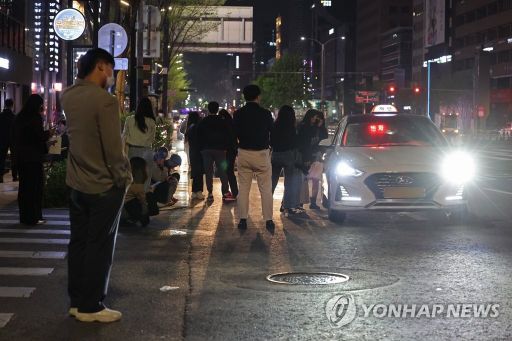 After the full lifting of social distancing measures, the demand for late-night taxis surged as citizens' mobility increased, but the number of domestic taxi drivers has actually decreased compared to before COVID-19. / Photo by Yonhap News
The decrease in the number of taxi drivers is believed to be due to the sluggish taxi business caused by social distancing measures over the past two years. At that time, government restrictions such as nighttime operation limits and gathering bans reduced domestic mobility, leading to decreased taxi demand. Consequently, some taxi drivers switched to other industries such as parcel delivery and food delivery.
The lack of smooth inflow of new personnel into the taxi industry and the outflow of existing personnel are also cited as problems. In fact, the shortage of taxi drivers is not a recent issue. According to Taxi Association data, the number of taxi drivers nationwide peaked at 301,103 in 2009 and has steadily declined since then. Ten years later, in 2019, the number had dropped by more than 30,000 to 267,189. Driver numbers had been decreasing even before COVID-19.
In the past, the taxi industry also showed a high turnover intention among drivers due to poor working conditions. A 2016 survey conducted by the Seoul Labor Rights Center targeting 704 corporate taxi drivers in Seoul found that 75.2% of respondents wanted to change jobs. The main reasons for drivers' desire to leave were "low wages (95%)" and "long working hours (77.5%)."
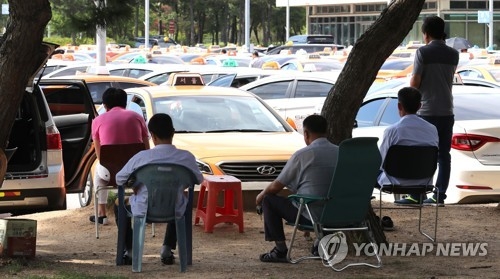
Meanwhile, in recent years, transportation income has deteriorated due to social distancing restrictions, and this year, the taxi industry's business outlook is expected to darken further due to the sharp rise in fuel prices such as diesel and liquefied petroleum gas (LPG). This suggests that even more taxi drivers may leave in the future.
Experts have suggested that introducing new types of operators, such as mobility platforms, into the market could help resolve the labor shortage.
Professor Kim Taegi of Dankook University's Department of Economics stated, "The attractiveness of the job itself, including salary, has declined, so young new workers are not entering the industry, worsening the labor shortage in the taxi sector," and added, "Shared transportation services using platforms could be a solution."
He continued, "If transportation platforms like the U.S. 'Uber' are authorized, it seems possible to sufficiently supply (taxi drivers). In the U.S., shared transportation is so active that it is common for ordinary people to have side jobs through Uber without being professional taxi drivers with separate qualifications," he explained.
© The Asia Business Daily(www.asiae.co.kr). All rights reserved.














