Total Strike Starting at Midnight on the 7th... "Abolish the Safety Freight Sunset Clause"
Possibility of Law Enforcement Intervention Raised... "Reluctant to Take Aggressive Actions"
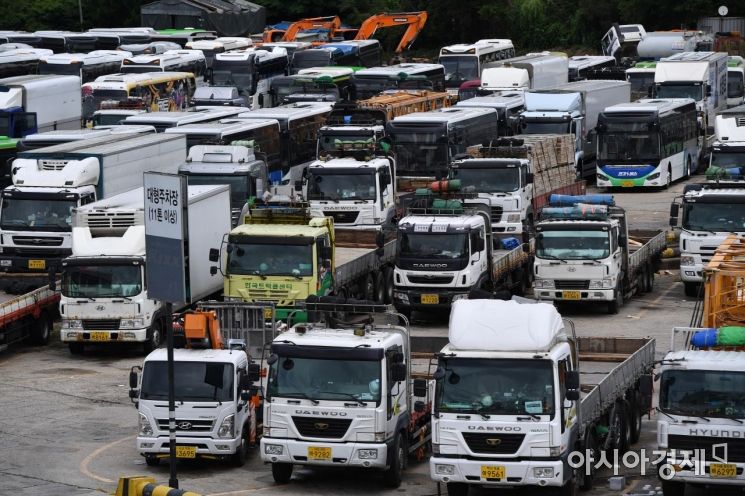 On the 6th, trucks are parked at the Western Truck Terminal in Yangcheon-gu, Seoul, as the Cargo Solidarity announces an indefinite general strike starting tomorrow, demanding the abolition of the sunset clause on the truck safety freight rate system, its expansion, and an increase in transportation fees. Photo by Kang Jin-hyung aymsdream@
The Cargo Solidarity Headquarters of the Public Transport Union under the Korean Confederation of Trade Unions (KCTU) has launched a full-scale, indefinite general strike demanding the abolition of the sunset clause on the safe freight rate system. This move has put the current government's labor policies to the test, with the possibility of law enforcement intervention also being raised.
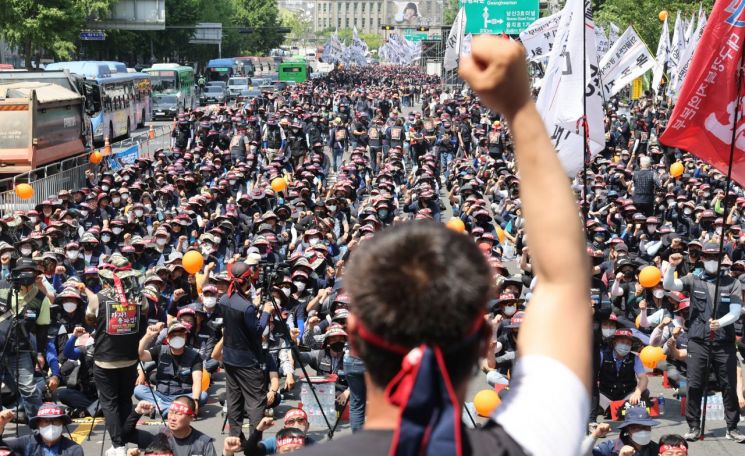
Starting at midnight on the 7th, the Cargo Solidarity began an indefinite full general strike. The day before, they disseminated strike action guidelines to 25,000 union members and are expected to occupy key port and logistics terminal facilities and disrupt operations. At 10 a.m. on the same day, a send-off rally for the strike will be held at 16 regional headquarters nationwide. However, no large-scale rallies or protest schedules have been set yet.
The reason for the Cargo Solidarity's strike, following one in November last year, is the sunset clause on the safe freight rate system. The safe freight rate system guaranteed wages for cargo workers but is scheduled to be abolished this year due to the sunset clause. Meanwhile, diesel prices recently surpassed 2,000 won per liter, increasing fuel expenses for cargo workers. The workers argue that if the system disappears without relevant legal amendments, appropriate wage guarantees will not be ensured.
They also criticized the government for only proposing temporary measures. The government introduced a fuel price-linked subsidy system that supports 50% of the excess amount when diesel prices exceed a reference price, but the Cargo Solidarity criticized it as grossly insufficient. On the 2nd, the Cargo Solidarity held the first round of negotiations with the Ministry of Land, Infrastructure and Transport (MOLIT), demanding the abolition of the sunset clause on the safe freight rate system, but it is reported that no substantial discussions took place. The Cargo Solidarity stated, “MOLIT is not making efforts to resolve the situation and is instead working with shipper and transport company groups to publicize the unfairness of the Cargo Solidarity's collective actions,” adding, “The safe freight rate system is not only for cargo workers but also for the safety of the public on the roads.”
The strike by the Cargo Solidarity inevitably causes logistics disruptions. Although Cargo Solidarity members make up about 6% of the total 420,000 cargo workers, the items handled by these members are concentrated in cement and container trucks, which are subject to the safe freight rate system. Already, the domestic soju company HiteJinro is facing restrictions on soju orders due to the Cargo Solidarity strike.
Logistics Disruptions Inevitable Due to General Strike... Possibility of Law Enforcement Intervention
In this situation, the government's labor policies are being put to the test. For now, the government is signaling a tough response. On the 5th, Prime Minister Han Duck-soo stated, “We will strive for a smooth resolution,” but also said, “Illegal acts will be strictly punished.” The Ministry of Land, Infrastructure and Transport also expressed its position to respond strictly according to law and principles.
The possibility of law enforcement intervention is also being raised. The Gyeonggi Nambu Provincial Police Agency announced the day before that if the Cargo Solidarity's strike shows illegality, they will respond strictly, including on-site arrests. The police plan to deploy about 1,200 officers from 16 companies to the Inland Container Depot (ICD), Pyeongtaek Port, and other workplaces on the day.
However, the prevailing view is that active measures such as forced dispersal will be difficult. This is because it is not easy to immediately change the previous administration’s policy of extreme restraint in deploying law enforcement. Professor Kim Do-woo of the Department of Police Science at Gyeongnam National University said, “The various responses from the current government should be seen as warning statements,” adding, “It will be burdensome to take active measures like forced dispersal just because of minor illegalities.” However, he added, “Unlike the previous pro-labor administration, the current government will gradually show a stance emphasizing order maintenance.”
© The Asia Business Daily(www.asiae.co.kr). All rights reserved.













