Installation of the 'Special Self-Governing Province Public Deliberation Committee' and Promise to Conduct 'Resident Voting'
Promotion of Legal Amendments for the Establishment of a 'Cultural Content Economic Special Zone'
Ruling and Opposition Parties in Northern Gyeonggi Politically Pledge "Active Cooperation for the Establishment of Gyeonggibuk-do"
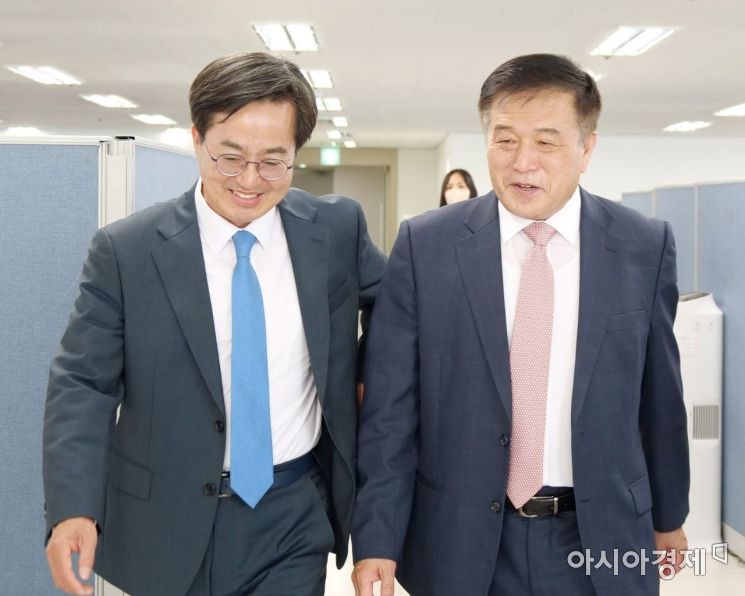 On the afternoon of the 2nd, Kim Dong-yeon, the governor-elect of Gyeonggi Province, received a congratulatory flower arrangement from President Yoon Seok-yeol through Lee Jin-bok, Senior Secretary for Political Affairs at the Presidential Office, at the election office located in Paldal-gu, Suwon. [Kim Dong-yeon Governor-elect Election Camp]
[Asia Economy Reporter Ra Young-cheol] In the 8th nationwide simultaneous local elections, Kim Dong-yeon, the Democratic Party candidate for governor of Gyeonggi Province, won by writing a dramatic last-minute comeback, drawing attention to whether his pledge of the 'Gyeonggi Province division theory' will put an end to the debate.
In particular, the 'Gyeonggi Bukdo' pledge, which has appeared like a staple menu in every election, has long been a 40-year-old issue, hindered by the 'opposition' and 'cautious views' of past Gyeonggi governors.
The Gyeonggi Province division theory has been raised since the 1992 presidential election. The population of 3.9 million in northern Gyeonggi ranks third nationwide after Seoul and southern Gyeonggi.
However, as of 2020, the financial independence rate of northern Gyeonggi was about 28.2%, lower than southern Gyeonggi's 42.9%.
Accordingly, every election season, political circles have raised the claim that "Gyeonggi Province should be divided into north and south to create a foundation for balanced development."
Even before this election, the candidates for Gyeonggi governor from both ruling and opposition parties were still divided between 'support' and 'cautious views.'
Kim Eun-hye, the People Power Party candidate for Gyeonggi governor, expressed opposition in practice by emphasizing 'development theory' rather than the 'division theory.'
On the other hand, since his declaration of candidacy, Kim, the elected candidate, has consistently stated, "Meeting with residents of northern Gyeonggi and local government workers has clarified my thoughts on division," revealing specific plans to promote division.
He confidently pledged to establish Gyeonggi Bukdo within his term. He promised to form a 'Gyeonggi Bukdo Special Committee' within his campaign. If elected, he also pledged to complete the establishment of a special autonomous province within his term.
There are also reactions that Kim's division theory might be an 'unrealizable pledge (空約).' However, his promises to establish a 'Gyeonggi Bukdo Special Autonomous Province Public Deliberation Committee' and to conduct a 'resident referendum' are gaining credibility.
In addition, in the short term, he pointed to investments in transportation and infrastructure in northern Gyeonggi. The mid- to long-term plan includes promoting legal revisions and the enactment of special laws focusing on establishing a 'cultural content economic special zone' and deregulation.
In pre-election opinion polls, the approval rate for 'Gyeonggi Bukdo' among residents of 11 cities and counties in northern Gyeonggi was overwhelmingly high at 58.4%, about twice the opposition rate of 28.8%.
Kim Min-chul, a Democratic Party member of the National Assembly, stated, "Going forward, the National Assembly, along with residents, will take concrete actions so that the government, including the Ministry of the Interior and Safety, and Gyeonggi Province can proceed with the procedures for establishing Gyeonggi Bukdo."
This clearly indicates the position that northern Gyeonggi, with its economic power and living area potential, should take the path of 'independent development.'
There are also many voices expressing concerns about the 'division theory.' The reason is that if division is promoted without resolving military and metropolitan area regulation issues, the financial conditions of northern Gyeonggi could worsen further.
However, the 'Gyeonggi Bukdo Establishment Bill' is currently under discussion in the National Assembly's Administrative and Security Committee's bill review subcommittee, and the movement for division is more active than in the past.
Political circles from both ruling and opposition parties in northern Gyeonggi have also expressed unanimous support for the pledge to establish Gyeonggi Bukdo, stating, "We will actively cooperate in the establishment of Gyeonggi Bukdo."
© The Asia Business Daily(www.asiae.co.kr). All rights reserved.












