Rising Grocery Prices and Interest Rate Hikes
May Inflation Rate Expected to Hit 5% for the First Time in 14 Years
Food and Dining Prices Soar Continuously
Experts Urge "Tailored Policies for Ordinary Citizens"
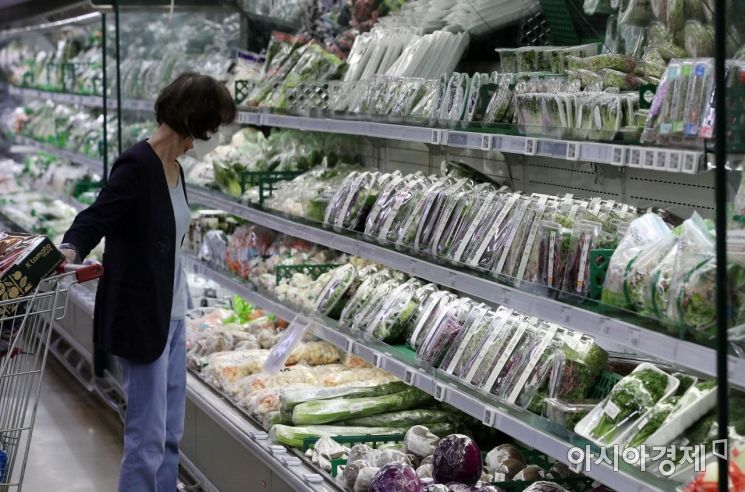 Recently, following the sharp rise in prices of meat, flour, and cooking oil, the cost of vegetables has also surged, causing dining table prices to continue soaring. With the early arrival of the heatwave and forecasts predicting the worst heatwave this summer, there are expectations that vegetable prices will skyrocket even further. The photo shows a large supermarket in Seoul on the 25th. Photo by Kim Hyun-min kimhyun81@
[Asia Economy Reporter Song Seung-yoon] "My income stays the same, but my expenses just keep increasing..."
Yoo Ji-young (34, pseudonym), a housewife living in Incheon, sighs every time she looks at her refrigerator these days. It's not just the worry about meal preparation, but the recent surge in grocery prices is a major factor. Just a year ago, 200,000 won was enough to buy a week's worth of groceries for her family of four, but now she has to visit the supermarket again after only five days. There are many cases where buying home meal replacements (HMR) feels cheaper than purchasing ingredients and cooking. For this reason, she recently changed her lunch meals to mostly simple dishes that can be eaten quickly.
Self-employed people are struggling just as much. Kim Hyung-soo (44, pseudonym), who runs a snack-focused restaurant in Changwon, Gyeongnam, raised the prices of all menu items by 1,000 won starting this month. Usually, price increases are done in 500 won increments when there is a reason, but due to the sharp rise in ingredient costs, it became impossible to maintain any profit margin. Kim said, "Last year, the grocery wholesaler raised prices at most twice a year, but recently some items have increased prices three times within one or two months," adding, "Even after raising menu prices like this, I only make about the average monthly salary of office workers, so I worry about how to survive if ingredient costs rise further."
As food prices continue to soar daily, sighs are growing louder everywhere from self-employed people to ordinary citizens. On top of this, the burden on households is expected to increase further due to the rise in the base interest rate. On the 26th, the Bank of Korea raised the base rate by 0.25 percentage points to 1.50%, marking the second consecutive monthly increase. This means that in addition to the sharp rise in food prices, household interest burdens will also increase.
There are also expectations that the consumer price inflation rate for May, to be announced next week, will reach the 5% range. If this happens, it will be the first time in nearly 14 years since the 2008 financial crisis that the consumer price inflation rate enters the 5% range. The April consumer price inflation rate recorded 4.8%, the highest in 13 years and 6 months.
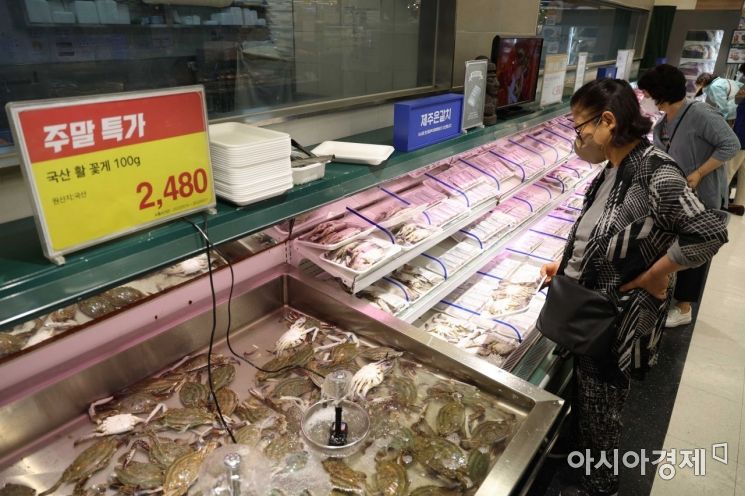 As consumer prices continue to rise, there is an emergency alert on grocery prices. On the 19th, citizens are shopping at a large supermarket in Seoul. Photo by Mun Ho-nam munonam@
In fact, the upward trend in prices of processed foods, agricultural and marine products, and dining out continues. According to the Korea Consumer Agency's Chamgagaek, among 28 high-consumption processed food items in the first quarter of this year, prices of 18 items increased. Doenjang (fermented soybean paste) rose the most at 21.1%, followed by curry (14.7%), cola (9.8%), coffee mix (8.6%), and soju (6.4%).
Meat prices are also on the rise. According to statistics from the Livestock Products Quality Evaluation Service's Livestock Distribution Information, as of the 18th of this month, the average consumer price of 100g of domestic pork neck was 2,661 won, up 18.5% compared to a year ago. Samgyeopsal (pork belly) at 100g was 2,829 won, up 19.2%. For U.S. beef (ribs), the same weight was 4,403 won, soaring 77.8%, and Australian beef was 4,385 won, up 81%.
Dining out prices show a similar trend. As of April, the price of naengmyeon (cold noodles) in Seoul rose 9.5% from a year ago to an average of 10,192 won, surpassing 10,000 won for the first time. Jajangmyeon (black bean noodles) increased 14.1% to 6,146 won. Kalguksu (knife-cut noodles) also rose 10.8% to 8,269 won, exceeding the 8,000 won range. In addition, prices of vegetables, fruits, eggs, and seafood?all essential items on the dining table?are also rising together.
Given this situation, many people have increased purchasing ingredients on the day they need them, and hoarding some items in anticipation of further price increases continues. Since the causes of inflation are largely external factors such as COVID-19 and Russia's invasion of Ukraine, finding appropriate solutions is difficult. As the situation shows signs of prolonging, inflation is expected to continue for the time being, further increasing the burden on the ordinary economy.
Kang Sung-jin, a professor of economics at Korea University, said, "COVID-19 is not completely over yet, and even if the Russia-Ukraine war ends, it will take considerable time to recover, so this situation is expected to continue through this year," adding, "When inflation and interest rates rise together, the low-income class suffers the most, so ultimately, the government has no choice but to implement tailored policies such as interest rate reductions or loan repayment deferrals."
© The Asia Business Daily(www.asiae.co.kr). All rights reserved.












