Surge in Overseas Travel Demand Amid Daily Life Recovery
June International Flight Fuel Surcharge Hits Record High
Rising Airfare Costs Cause Burden
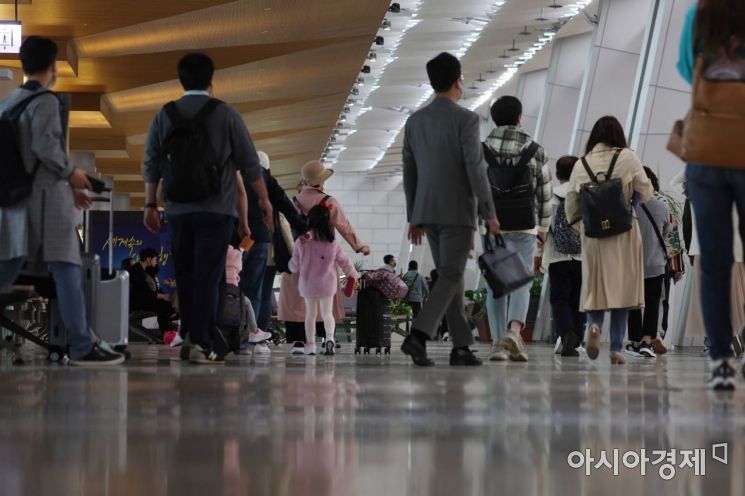 The domestic terminal of Gimpo Airport in Gangseo-gu, Seoul is bustling with travelers. Photo by Mun Ho-nam munonam@
[Asia Economy Reporter Heo Midam] Consumers are facing increasing burdens due to soaring airfares. As the skies, which had been closed due to COVID-19, have reopened, travel demand has exploded, but the supply of flights has not kept up with demand, causing airfare prices to rise. On top of this, the sharp increase in international oil prices has pushed up fuel surcharges, further increasing the burden on consumers.
On the 25th, posts expressing dissatisfaction with the rising airfare prices have been continuously appearing on travel-related online communities. One netizen said, "I had planned a trip to Singapore in March 2020. But due to COVID-19, I ended up canceling all flights and accommodations. After not being able to travel abroad even once during the COVID period, I tried to find flights to Singapore again this July. But the prices were enormous," adding, "Compared to March 2020, prices have more than doubled. I'm wondering if I should travel even if I have to bear this cost."
Another netizen said, "I was planning to go to Paris at the end of June, but the airfare prices have risen so much it's scary," adding, "While I was debating whether to travel or not, the airfare prices went up even more. The saying 'airfares are cheapest now' is true. Prices jump significantly even after half a day."
The cause of the airfare price increase is attributed to supply-demand imbalance. Due to the impact of COVID-19, the number of international flights has decreased, while suppressed travel demand has exploded, resulting in high airfare prices.
Based on summer 2019, before COVID-19, round-trip airfare prices for Incheon~Paris and Incheon~London were between 1.5 million and 2 million KRW. However, currently, prices have risen to 2.2 million to 3.5 million KRW. Airfares to Hawaii are also trading at 1.7 million to 1.9 million KRW, twice as high as before COVID-19.
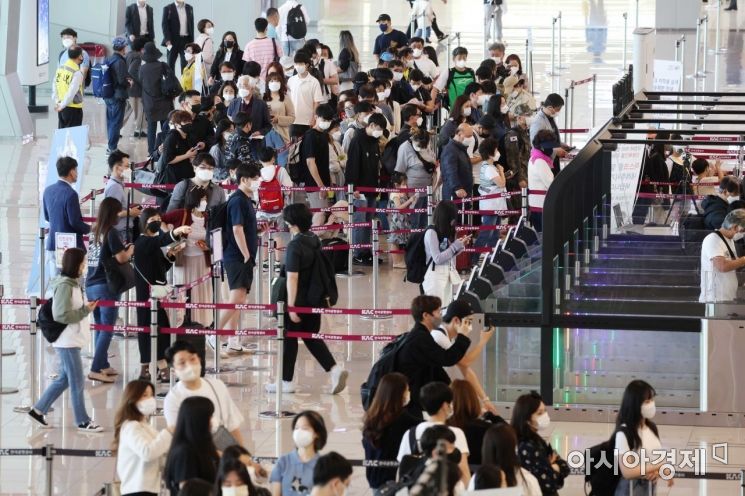 Seoul Gangseo-gu Gimpo Airport domestic terminal is bustling with travelers. Photo by Mun Ho-nam munonam@
The fuel surcharge, driven by rising international oil prices, is also fueling the increase in airfare prices. The fuel surcharge is a fee airlines charge separately on fares to compensate for losses caused by rising oil prices. When the fuel surcharge rises, the total airfare consumers pay also increases.
This month, Korean Air and Asiana Airlines are applying fuel surcharges at level 17 (33,800 to 256,100 KRW) for international flights. However, next month, Korean Air's international flight fuel surcharge will rise by two levels to level 19, with distance-based fees ranging from 37,700 to 293,800 KRW per one-way trip. Asiana Airlines will also apply level 19 next month, charging fuel surcharges ranging from 40,400 to 229,600 KRW based on distance per one-way trip. Level 19 is the highest level since the distance-based fuel surcharge system was implemented in May 2016.
Some cases of giving up overseas travel due to expensive airfares are also emerging. Kang, a worker in his 20s, said, "I was planning a trip to Bali with a friend in August. But the flight ticket prices have risen so much compared to before COVID that it was burdensome," adding, "I plan to wait a bit longer and reschedule the trip once airfare prices stabilize."
Meanwhile, the government announced plans to increase the number of international flights to 230 per week by next month, considering overseas travel demand. The number of international flights increased by 112 from 420 per week in April to 532 per week in May. Next month, it will increase by another 230 to 762 flights per week.
© The Asia Business Daily(www.asiae.co.kr). All rights reserved.













