Pro-Business Yoon Government Backed by Business Community
Samsung's Record Investment of 450 Trillion Won Over 4 Years
Hyundai Motor, Lotte, and Hanwha Also Confirm Investment Plans
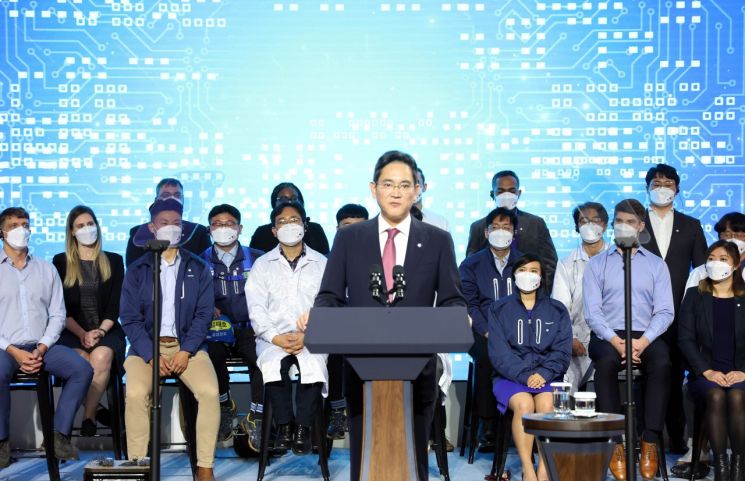
With the launch of the new Yoon Suk-yeol administration and U.S. President Joe Biden's visit to Korea, investment activities in the business sector are gaining momentum. In particular, major groups are rushing to unveil large-scale investment and employment packages in line with the new government's pro-business stance.
Attention is especially focused on the actions of Samsung, the eldest in the business community. Samsung is leading the overall business atmosphere by announcing large-scale investment and employment plans that surpass those of other groups.
◆ "As expected, Samsung" ... A record-breaking investment of 450 trillion won over 5 years = According to the business community on the 24th, Samsung will invest 450 trillion won over the next five years in future growth sectors such as semiconductors, bio, and new growth IT (information and communication). It also plans to hire 80,000 new employees over five years to expand youth employment.
On the same day, Samsung announced this large-scale investment plan under the title "Samsung's Future Preparation for Dynamic Innovative Growth."
Samsung plans to invest 450 trillion won over the next five years in future new businesses such as semiconductors, bio, artificial intelligence (AI), and next-generation communications, together with its affiliates. This amount is 120 trillion won more than the 330 trillion won invested over the past five years, representing an increase of over 30% in the average annual investment scale.
Of the total investment of 450 trillion won, 80%, or 360 trillion won, will be invested domestically. This is an increase of 110 trillion won compared to the 250 trillion won invested domestically over the past five years.
In the semiconductor sector, Samsung plans to strengthen its "super-gap" status in the memory field, which it has led for 30 years. To this end, it will enhance research and development (R&D) on new materials and new structures and proactively apply advanced technologies such as early adoption of cutting-edge extreme ultraviolet (EUV) technology.
Samsung also plans to secure competitiveness in fabless (design) system semiconductors needed for high-performance, low-power application processors (AP), and ultra-high-speed communication semiconductors such as 5G and 6G. In the foundry (contract manufacturing) business, it plans to apply next-generation production technologies to begin early mass production of products below 3 nanometers.
In the bio sector, Samsung aims to realize a "second semiconductor miracle" through aggressive investment. In the mid to long term, it plans to build a business structure centered on bio pharmaceutical contract development and manufacturing organization (CDMO) and biosimilars. In new growth IT sectors such as AI and next-generation communications, which determine future industrial competitiveness, Samsung intends to focus on strengthening competitiveness through "super-gap innovation."
Samsung also announced plans to hire 80,000 new employees over the next five years, focusing on core businesses. Previously, Samsung exceeded its "40,000 hiring plan over 3 years" announced in 2018 and also announced a plan to hire 40,000 people over three years last year.
Samsung plans to further expand hiring centered on core businesses such as semiconductors and bio, which are the foundation technologies of the 4th Industrial Revolution, contributing to the creation of good jobs led by the private sector.
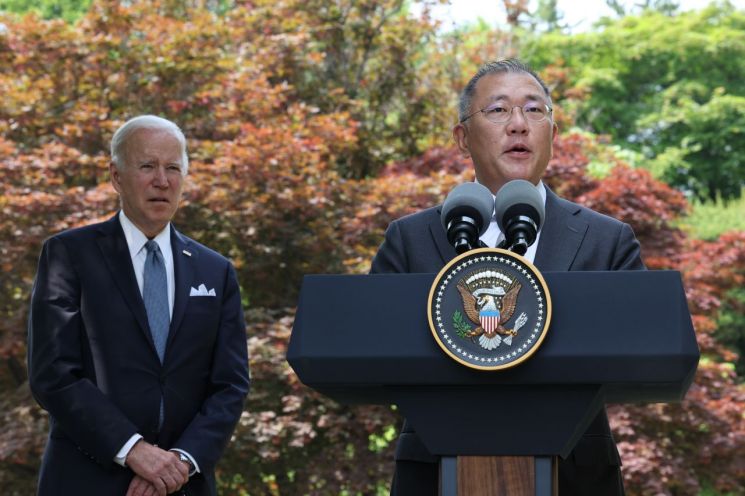
◆ Hyundai Motor, Lotte, and Hanwha also decide on tens of trillions of won in investments = Following the eldest Samsung Electronics, Hyundai Motor, Lotte, and Hanwha Group have also finalized large-scale investment plans. First, Hyundai Motor Group's finished car affiliates Hyundai Motor and Kia, along with parts maker Hyundai Mobis, will invest 63 trillion won in Korea by 2025. This is to strengthen the capabilities of domestic business sites as a hub for the entire industrial value chain, including research and development and production, amid rapid changes in the global automotive industry.
According to the mid- to long-term investment plan announced by Hyundai Motor Group on the day, the investment areas are broadly divided into three categories: electrification and eco-friendly sectors, new technologies and new businesses, and existing businesses.
First, the electrification and eco-friendly sector aims primarily to secure next-generation electric vehicles and parts development, as well as hydrogen fuel cell advanced technologies. The investment scale of the three companies is about 16.2 trillion won. This covers all vehicle types including pure electric vehicles, hydrogen electric vehicles, and plug-in hybrids.
To increase production capacity, they plan to build a new dedicated plant for purpose-built vehicles (PBV) electric cars and gradually increase mixed production systems for internal combustion engine and electric vehicles. A dedicated plant with an annual capacity of up to 150,000 units is planned to be built on the Kia Hwaseong plant site, targeting mass production in the second half of 2025. They will also expand electric vehicle dedicated lines at existing plants. They will develop core parts, advanced technologies, and high-performance electrification products and invest in research facilities. They plan to increase the variety of electrification products and refine PE systems such as batteries and motors, which are directly linked to product performance.
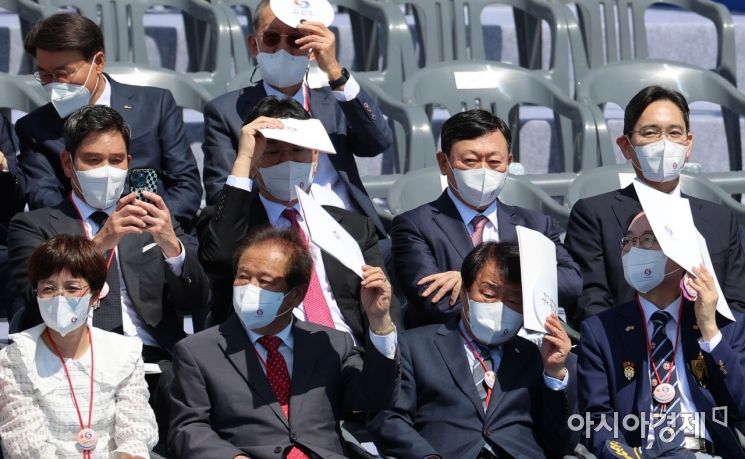 Jung Yong-jin, Vice Chairman of Shinsegae; Cho Won-tae, Chairman of Hanjin Group; Shin Dong-bin, Chairman of Lotte; and Lee Jae-yong, Vice Chairman of Samsung Electronics, are attending the inauguration ceremony of the 20th President Yoon Suk-yeol held at the National Assembly on the 10th. Photo by Yoon Dong-joo doso7@
Lotte will also invest a total of 37 trillion won over the next five years in new businesses and other areas. Including new growth themes such as health and wellness, mobility, and sustainability, Lotte plans to focus investments on core industries such as chemicals, food, and infrastructure to revitalize the regional economy and invigorate the domestic industrial ecosystem. Facility investments to strengthen the capabilities of the distribution and tourism industries, which had been weakened after COVID-19, will also be expanded.
In the health and wellness sector, Lotte, preparing to enter the bio pharmaceutical contract development and manufacturing organization (CDMO) business, plans to build a domestic factory worth about 1 trillion won following the acquisition of overseas factories. In the mobility sector, investments will focus on urban air mobility (UAM), targeting demonstration flights this year, and electric vehicle charging infrastructure. The UAM business will support the construction of domestic transportation infrastructure linking ground and air based on the group's offline bases.
Lotte, which has begun installing complex charging stations linked to operating stores such as distribution and hotels, will expand annual charger production to over 10,000 units through facility investments. Lotte Rental will also introduce 240,000 electric vehicles worth 8 trillion won, contributing to the activation of the electric vehicle ecosystem.
The distribution business group will invest 8.1 trillion won to lead commercial district development and job creation. Lotte Department Store plans to develop large-scale complex malls with high employment inducement effects in Sangam-dong, Mapo-gu, Seoul, and Songdo, Incheon, and will sequentially renovate key branches such as the main store and Jamsil branch. Lotte Mart plans to invest 1 trillion won to expand specialized stores leading new shopping cultures such as Zeta Flex, Max, and Bottle Bunker.
Hanwha Group also announced its investment plan for the next five years on the same day. Hanwha will invest a total of 37.6 trillion won, including 20 trillion won domestically, in future industries such as energy, carbon neutrality, and defense and aerospace. Through this, it plans to create more than 20,000 new jobs domestically over five years.
Hanwha Group explained on the 24th, "We judged that it is a time when investment in strengthening the competitive advantage of existing businesses, internalizing future technologies for future technology preemption and market leadership is more necessary," adding, "We aim to support private-led economic growth through such investments."
Of the total 37.6 trillion won investment, 20 trillion won will be concentrated domestically in three sectors: energy, carbon neutrality, and defense and aerospace.
By sector, about 4.2 trillion won will be invested in the energy sector, including solar and wind power. The plan is to strengthen solar research and development and build the latest production facilities to grow Korea into a "global core base" capable of producing high-efficiency solar products.
In the carbon neutrality business sector, 900 billion won will be invested in commercializing hydrogen co-firing (mixed combustion) technology and investing in water electrolysis mass production facilities. Additionally, 2.1 trillion won will be invested in developing eco-friendly new material products to align with carbon neutrality efforts. In the defense and aerospace sector, 2.6 trillion won will be invested to accelerate the globalization of "K-defense," including pioneering overseas markets for the K-9 self-propelled howitzer and entering new global markets with the Redback armored vehicle.
Hanwha will also take the lead in preempting future technologies and pioneering related markets in areas such as Korean satellites and satellite launch vehicles, and urban air mobility (UAM). Furthermore, 4 trillion won will be invested in facility investments to strengthen competitiveness in the petrochemical sector, and 2 trillion won each will be invested in expanding complex development projects in the construction sector and strengthening premium leisure businesses.
The 20 trillion won Hanwha Group plans to invest domestically over the next five years is close to the 22.6 trillion won the group invested domestically and abroad over the past five years. Along with domestic investments, Hanwha Group plans to create more than 20,000 new jobs over the next five years, contributing to social employment expansion.
© The Asia Business Daily(www.asiae.co.kr). All rights reserved.














