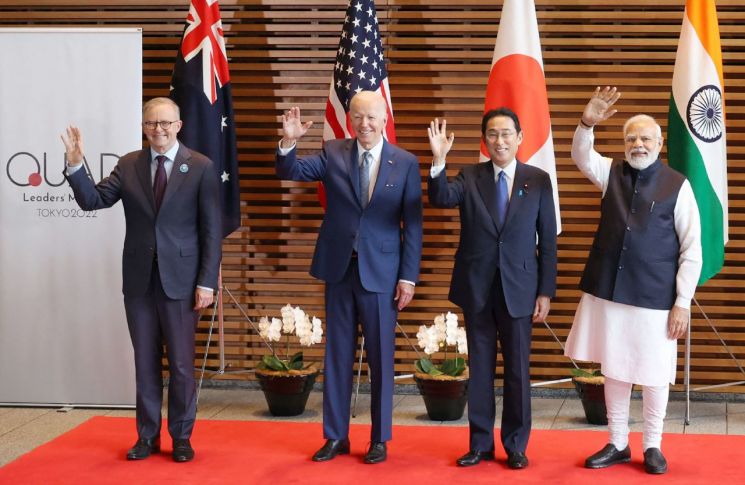
[Asia Economy Reporter Jeong Hyunjin] The four Quad countries? the United States, Japan, Australia, and India?held a summit in Japan on the 24th to discuss ways to counter China's expanding influence in the Indo-Pacific region. U.S. President Joe Biden, mindful of China and Russia, described the situation as a "democracy versus authoritarianism" dynamic and emphasized the need to "join forces to address the greatest challenges, including security."
According to NHK and other sources, President Biden, Japanese Prime Minister Fumio Kishida, Indian Prime Minister Narendra Modi, and Australian Prime Minister Anthony Albanese convened the Quad summit at the Prime Minister's Official Residence in Tokyo. This was the first in-person meeting of the four Quad leaders in about eight months since their last meeting in Washington D.C. on September 24 of last year.
In his opening remarks, President Biden stated, "Russia, which has triggered a humanitarian disaster, is attempting to erase Ukrainian culture," and added, "The United States will continue to cooperate with partners for an international response." He also highlighted, "The U.S. unveiled its Indo-Pacific strategy, emphasizing freedom, openness, connectivity, and resilience, just before the outbreak of the Ukraine war," stressing that "Russia's invasion has further underscored the importance of these goals."
Prime Minister Kishida said, "Russia's invasion of Ukraine is a direct challenge to the principles enshrined in the United Nations (UN) Charter," and added, "Such events must not occur in the Indo-Pacific region." He further noted, "Given the grave situation, it is highly significant that we gather in one place to demonstrate to the international community the solidarity of the four countries and our firm commitment to the shared vision of a 'free and open Indo-Pacific.'"
This in-person Quad meeting follows President Biden's launch of the Indo-Pacific Economic Framework (IPEF) in Tokyo the previous day, which involved 13 countries, marking a continued effort over two days to counter China. The outcomes of the meeting are expected to be announced soon in a joint statement.
NHK reported that the joint statement is likely to reaffirm the Quad's strong commitment to a free and open Indo-Pacific and strongly support principles such as freedom, the rule of law, sovereignty, and territorial integrity. Considering China's increasing maritime activities in the region, the statement is expected to emphasize the importance of adhering to international law.
Additionally, NHK reported that the statement will confirm the urgent need to resolve issues related to North Korea, including denuclearization of the Korean Peninsula and the abduction of Japanese citizens, and strongly condemn North Korea's nuclear and missile development, which destabilizes the situation. The statement is also expected to include cooperation in the Indo-Pacific region to develop new responses to climate change and collaboration in space, with the four countries sharing satellite data among themselves.
The Nihon Keizai Shimbun reported that, from an economic security perspective, the statement will include efforts to secure advanced technologies and establish semiconductor supply chains to counter China, as well as public-private cooperation in 5G and biotechnology. To enhance economic cooperation, there is also consideration of expanding working groups, currently six in number covering climate change, cyber issues, COVID-19 vaccines, and others.
© The Asia Business Daily(www.asiae.co.kr). All rights reserved.












