Manufacturing (93.6) and Non-Manufacturing (99.3) Both Sluggish
"Tax Burden Reduction and Tariff Cuts Needed to Improve Business Environment"
[Asia Economy Reporter Park Sun-mi] Due to the impact of rising international raw material prices, there is a forecast that corporate business conditions will remain sluggish for three consecutive months.
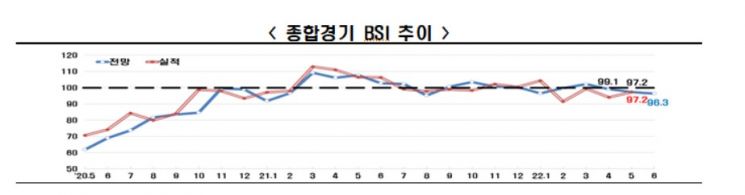
On the 24th, the Federation of Korean Industries (FKI) conducted a Business Survey Index (BSI) survey targeting the top 600 companies by sales, and the June BSI outlook recorded 96.3.
This is the first time in 16 months since February last year (96.6) that the index has fallen below the baseline of 100 for three consecutive months. An index above 100 indicates a positive business outlook compared to the previous month, while below 100 indicates a negative outlook. The FKI stated that the surge in international raw material prices and economic downturns in major countries, among other domestic and international economic uncertainties, have darkened companies' business outlooks. The actual BSI figure for May also recorded 97.2, falling below the baseline for four consecutive months since February this year.
In June, the BSI by industry showed that both manufacturing (93.6) and non-manufacturing (99.3) sectors were sluggish simultaneously for the first time this year. The FKI pointed out that the reason for the poor business outlook across industries is the increased burden of production and logistics costs due to the surge in international raw material and energy prices. Looking at detailed industries, the electricity, gas, and water supply sector (66.7) was hit the hardest due to the sharp rise in coal prices for power generation.
Examining the BSI by sector, domestic demand (102.2), investment (102.5), and employment (107.4) showed positive outlooks, while inventory was at the baseline (100), and exports (97.8), financial conditions (96.6), and profitability (95.7) showed negative outlooks. In the case of exports (97.8), due to the recent surge in prices and the resulting contraction in consumer sentiment in major advanced countries, a negative outlook has been recorded for three consecutive months since April this year. In fact, the consumer price inflation rate in OECD countries in the first quarter of this year rose by 7.9% year-on-year, and the consumer confidence index has been declining for 10 consecutive months since June last year.
Regarding profitability (95.7) and financial conditions (96.6), the outlook has worsened for three consecutive months since April this year due to deteriorating profitability combined with difficulties in financing. The FKI notes that the sharp rise in the won-dollar exchange rate has increased the cost of importing raw materials, and the rise in corporate bond interest rates due to the base interest rate hike is adding to the burden on companies' profitability and financial conditions.
Choo Kwang-ho, head of the FKI Economic Headquarters, said, “Recently, domestic companies are expected to see sales decline due to soaring prices and the economic slowdown in China, while the burden of financial costs due to tightening is also increasing.” He advised, “It is necessary to revitalize corporate management by easing tax burdens, reducing tariffs on major imported items to help secure corporate profitability, improving unreasonable regulations, and reforming the backward labor market.”
© The Asia Business Daily(www.asiae.co.kr). All rights reserved.











