Ministry of Environment Announces Postponement of 'Disposable Cup Deposit System' Implementation to December 1
"Burden of Label Costs and Labor Passed on to Small Business Owners" Faces Criticism
Environmental Groups Say "Policy Already Delayed for 2 Years... Concerned About Government and Corporate Attitudes Toward Environment"
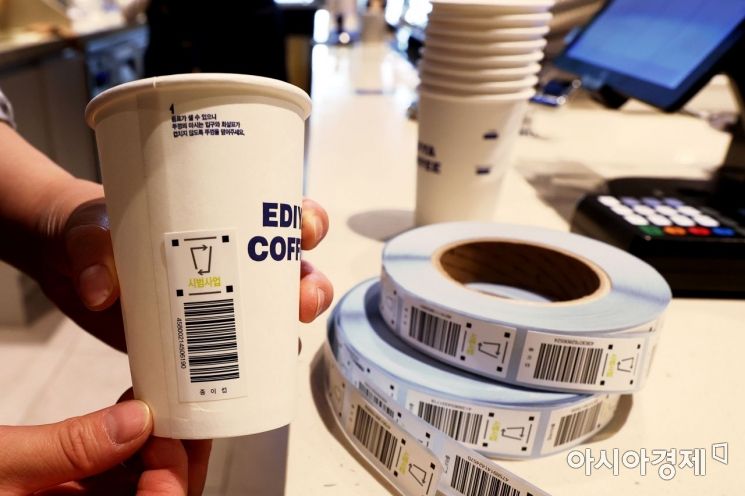 The Ministry of Environment held a public demonstration on the afternoon of the 6th at Ediya Coffee IBK Headquarters in Jung-gu, Seoul, ahead of the disposable cup deposit system set to be implemented on June 10. The demonstration introduced the process by which consumers return cups and receive the resource circulation deposit refund after the disposable cup deposit system is enforced. On that day, a staff member at the store attached a deposit return barcode to a cup. Photo by Kim Hyun-min kimhyun81@
[Asia Economy Reporter Park Hyun-joo] The Ministry of Environment has faced strong criticism from environmental groups after postponing the implementation of the disposable cup deposit system (cup deposit system), which was scheduled for June 10. The cup deposit system has long been criticized as a mere desk-bound policy that shifts the cost burden onto small business owners, and the People Power Party also requested a postponement of the system's implementation, citing harm to small business owners. However, environmental groups are pouring out criticism that the government has regressed an environmental policy that was decided to be introduced two years ago, pushed by political and public pressure.
On the 20th, the Ministry of Environment announced a six-month postponement of the cup deposit system's implementation. The Ministry stated, "Considering that small and medium-sized business owners who have endured the recession caused by COVID-19 need a recovery period, the implementation of the cup deposit system will be postponed until December 1," adding, "During the postponement period, we will support small business owners and small franchisees in complying with the system and actively seek administrative and economic measures to alleviate the burdens associated with system compliance."
The cup deposit system requires consumers to pay a deposit of 300 won when ordering a beverage in a disposable cup and receive the deposit back when returning the cup. The Ministry of Environment decided to standardize the cup sizes at franchise stores where the cup deposit system is implemented to prevent inconvenience to consumers when returning cups. The rationale is that allowing cups to be returned at franchise stores other than where the beverage was purchased will increase the cup collection rate and help establish the system.
The Ministry expects to collect 2.3 billion plastic cups annually through the cup deposit system. It is estimated that 2.8 billion disposable cups are used annually at franchise stores nationwide, with each citizen consuming about 56 cups per year.
Small business owners have opposed the system, arguing that it creates a "structure where the more you sell, the more you lose." This is because the costs of labels attached to returned cups and the processing fees for sending collected cups to recycling companies are all passed on to the store owners. Even aside from water and detergent costs for washing cups, they claim that labor costs increase significantly as the workload rises, such as washing and storing all returned cups.
Additionally, small business owners complain about the weak collection system. Ko Jang-su, president of the National Cafe Owners Association, said, "(The claims of small business owners) emphasize that while financial support is important, above all, the system should be designed to avoid inconvenience on the ground," adding, "There are about 38,000 stores subject to the system nationwide, but only 100 collection companies, meaning one collection company manages 380 stores. It is difficult to visit even 100 stores a day, so practically, each store can only be collected once a week. This means stores have to keep unsanitary cups used for a week, turning the store into a garbage dump rather than a store."
Ko also proposed establishing a public collection system for disposable cups. He explained, "If collection-related businesses are licensed to sell cup returns or related stickers to basic livelihood recipients, the disabled, and national veterans, similar to lottery ticket vendors, accessibility to the system will improve."
The People Power Party also supported the postponement request to the Ministry of Environment, backing the claims of small business owners. On the 18th, the Policy Committee of the People Power Party issued a statement under Chairman Seong Il-jong's name, saying, "We agree that the cup deposit system aligns with the Yoon Seok-yeol administration's national agenda of promoting a circular economy and carbon neutrality and must be implemented," but added, "Due to the economic downturn caused by COVID-19, there is a high possibility of unintended harm to small business owners and small franchise representatives. From the consumer's perspective, if cups are not returned, coffee prices may increase, resulting in higher dining-out costs."
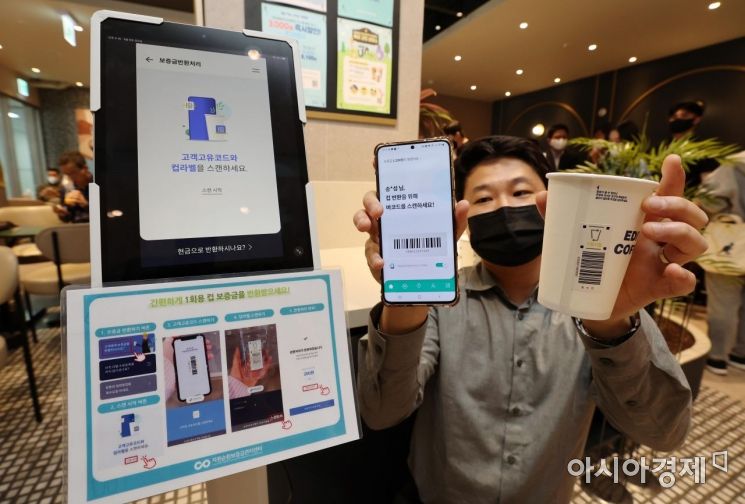 On the 6th, a Ministry of Environment official conducted a public demonstration at a coffee shop in Jung-gu, Seoul, ahead of the implementation of the disposable cup deposit system starting June 10. Through the demonstration, the Ministry promoted and inspected the process in which consumers return cups and receive a resource circulation deposit refund (300 won) after the system is enforced. Photo by Kim Hyun-min kimhyun81@
However, environmental groups strongly oppose the postponement of the cup deposit system. They argue that the difficulties faced by small business owners have been discussed multiple times, and the government bears significant responsibility for failing to resolve these issues during the two-year postponement period. The cup deposit system was first introduced as part of the amendment to the Act on the Promotion of Saving and Recycling of Resources (Resource Recycling Act) in June 2020 but was delayed until June this year due to the spread of COVID-19.
Shin Woo-yong, Secretary General of the Seoul Environmental Federation, dismissed the postponement as an "absurd decision." He said, "Even when the system was decided in 2020, we argued that a postponement period was necessary, which is why two years were given, but now the Ministry of Environment's decision to delay it again shows a lack of policy consistency and is truly regrettable," adding, "It seems they do not fully recognize the seriousness of waste and plastic problems. Delaying the implementation by six months does not solve the problem, and there was already sufficient preparation time." Given the severity of the plastic problem, the current attitude of the government and companies in postponing the system's implementation raises concerns that not only can the system's successful establishment not be guaranteed six months later, but the system itself might be reversed.
He also held the government and companies responsible for the postponement. Shin said, "During the two-year postponement period, the government was irresponsible, failing to mediate conflicts among self-employed and franchisees, and companies, while talking about ESG (environment, social, governance), avoided environmental responsibility and did not prepare for the system's implementation," adding, "Environmental policies at the corporate and national levels are not just regressing but moving backward. Citizens already empathize with the seriousness of the plastic problem enough to accept the system, so the government and companies must not remain idle." He also suggested a consumer boycott against companies that are passive about the cup deposit system.
© The Asia Business Daily(www.asiae.co.kr). All rights reserved.













