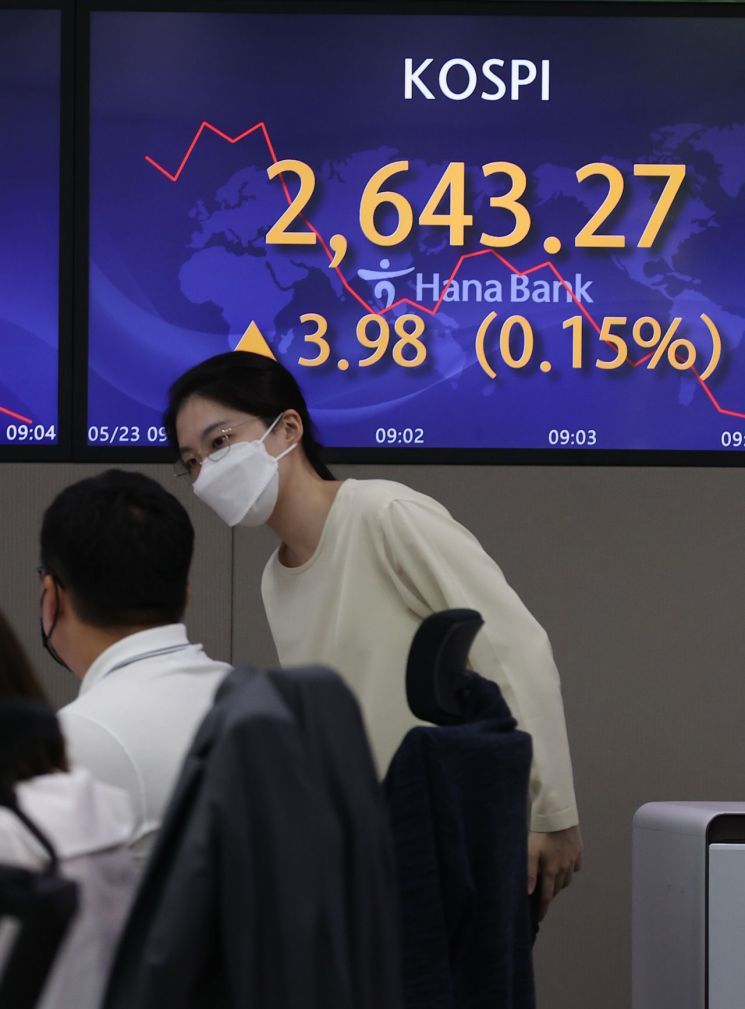
[Asia Economy Reporter Ji Yeon-jin] There is interest in whether U.S. President Joe Biden's recent visit to South Korea will bring a positive breeze to the domestic stock market, which has recently shown signs of rebound. Although the expected U.S.-Korea currency swap agreement did not materialize, so the foreign investor inflow effect due to dollar stabilization has yet to appear, sectors related to the agenda discussed at the Korea-U.S. summit are clearly benefiting.
According to the Korea Exchange on the 23rd, the upward trend continues mainly among large-cap growth stocks on the KOSPI, such as Samsung Electronics and LG Energy Solution, which had shown weakness earlier this year. The KOSPI index opened at 2,651.63, up 12.34 points (0.47%) from the previous trading day, then gave up some gains, and the number of declining stocks exceeded advancing ones, indicating a less favorable atmosphere. However, there is a strong trend centered on semiconductors and secondary batteries, which President Biden mentioned cooperation on during his visit last weekend.
Foreign investors showed a selling bias from the start of trading but are actively buying semiconductor and secondary battery-related stocks. The top 1 to 8 KOSPI market capitalization stocks all showed an upward trend from early trading, with Samsung Electronics, LG Energy Solution, SK Hynix, Samsung Biologics, and LG Chem seeing concentrated foreign buying and strong performance. In particular, LG Energy Solution struggled with foreign selling pressure after its January listing but has seen eight consecutive trading days of foreign buying recently. Ha In-hwan, a researcher at KB Securities, noted, "It is important to pay attention to President Biden expanding the existing security alliance into an 'economic security' and 'technology alliance.' Semiconductors and electric vehicle batteries are emerging as key geopolitical sectors."
Since the beginning of this year, foreign investors have sold over 13 trillion won worth of domestic stocks due to concerns about the U.S. big rate hikes amid global inflation and the prolonged Ukraine war, which could fuel high prices. This was due to increased global economic uncertainty and a preference for safe assets, sustaining the dollar's strength.
However, signs of the previously soaring dollar strength calming down, along with expectations that China will lift the Shanghai COVID-19 lockdown and implement economic stimulus measures starting next month, are factors that could stimulate foreign buying. Indeed, in the Seoul foreign exchange market on the same day, the won-dollar exchange rate traded at 1,267.8 won, down 0.3 won (-0.02%) from the previous trading day, showing weakness for two consecutive trading days. Ahn Young-jin, a researcher at SK Securities, said, "For foreigners to buy domestic stocks, a preference for risk assets in the financial market or exchange gains from won appreciation are prerequisites. Although the Korea-U.S. currency swap agreement was left as a future task at the summit, both countries agreed on the purpose of economic cooperation, and the discussion of industrial collaboration between the two countries could create a favorable atmosphere from the foreign investors' perspective."
The continuous decline in domestic corporate value since early this year, pushing prices down to support levels, also fuels expectations for improved foreign investor inflows. Shin Seung-jin, a researcher at Samsung Securities, said, "The dollar index, a barometer of risk asset avoidance, has recently turned downward, and as a result, the sustained foreign selling has eased since last week. Moreover, with the continued correction of the KOSPI, the support below 2,600 is solid, creating price attractiveness."
© The Asia Business Daily(www.asiae.co.kr). All rights reserved.