[Asia Economy Reporter Lee Seon-ae] There was no 'earnings surprise' in the first quarter. Although the sales and operating profits of KOSPI-listed companies increased compared to the first quarter of last year, net profits sharply declined. The drop in net profit margin was also significant, indicating a decrease in corporate profits. However, the performance of KOSDAQ-listed companies was better compared to KOSPI-listed companies.
KOSPI-listed companies, net profit down 26% excluding Samsung Electronics
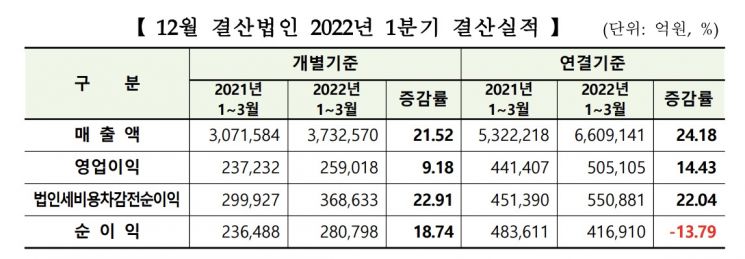
According to the '2022 Q1 Earnings Results of December Fiscal Year-End Listed Companies on the Stock Market' announced by the Korea Exchange on the 18th, the consolidated net profit of 608 December fiscal year-end listed companies (excluding 71 newly established or companies with non-standard audit opinions out of 679 December fiscal year-end companies) submitting consolidated financial statements was 41.691 trillion KRW, down 13.79% year-on-year.
Sales increased by 24.18% to 660.914 trillion KRW, and operating profit rose by 14.43% to 50.510 trillion KRW during the same period. Excluding Samsung Electronics (accounting for 11.77% of sales), consolidated sales (up 24.91%) and operating profit (up 4.69%) increased, but net profit (-26.33%) decreased.
The operating profit margin was 7.64%, and the net profit margin was 6.31%, down 0.65 percentage points and 2.78 percentage points respectively from the previous year. This means that for every 1,000 KRW sold, 63.1 KRW was retained as net profit.
Corporate financial soundness deteriorated. Among the 608 companies analyzed, 476 companies (78.29%) reported net profits, a decrease of 28 companies (4.60 percentage points) compared to 504 companies in the same period last year.
Looking at performance by industry, sales increased in all sectors, with the highest sales growth by individual standards in transportation and warehousing (49.47%), electricity and gas (34.58%), and chemicals (29.30%).
Regarding operating profit, 13 industries including transportation and warehousing and textiles and apparel saw increases, while 4 industries including construction showed declines. Net profit increased in 8 industries such as textiles and apparel and steel and metals, but decreased in 9 industries including services and pharmaceuticals.
Operating profit and net profit of 43 financial companies decreased by 5.61% and 5.71% respectively compared to the same period last year. While financial holding companies and banks showed improved results, securities firms’ operating profit fell by 34.16% compared to the same period last year, and insurance also decreased by 31.8%.
KOSDAQ-listed companies see increases in both operating and net profits
The performance of KOSDAQ-listed companies was favorable. Sales, operating profit, and net profit all increased compared to the same period last year. However, the net profit margin declined.
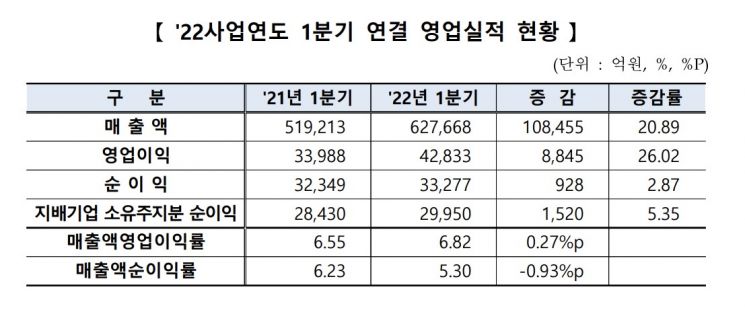
According to the '2022 Q1 Earnings Results of December Fiscal Year-End Companies on the KOSDAQ Market' announced by the Korea Exchange on the same day, sales of 1,050 companies based on consolidated financial statements reached 62.7668 trillion KRW, up 20.89% year-on-year. Operating profit and net profit also increased by 26.02% and 2.87% to 4.2833 trillion KRW and 3.3277 trillion KRW respectively. The operating profit margin rose by 0.28 percentage points to 6.82% year-on-year, but the net profit margin fell by 0.93 percentage points to 5.30%.
Financial soundness deteriorated. The debt ratio at the end of the first quarter was 109.39%, up 2.36 percentage points from the end of last year.
By industry, except for a slight decrease in net profit in other industries, overall sales, operating profit, and net profit increased. In particular, the IT sector showed significant growth. Sales in IT, manufacturing, and other industries all recorded average growth rates of over 20%.
The 377 IT companies saw sales, operating profit, and net profit increase by 20.68%, 39.94%, and 9.44% respectively year-on-year. In IT hardware, sales, operating profit, and net profit all rose significantly by 22.98%, 81.74%, and 74.26% respectively. IT components also recorded strong growth of 31.77%, 230.42%, and 125.98% respectively.
The semiconductor sector also saw increases in sales, operating profit, and net profit by 16.50%, 38.38%, and 26.88% respectively.
The 479 manufacturing companies overall posted increases of 18.80%, 28.20%, and 2.15% in sales, operating profit, and net profit respectively compared to the same period last year. Particularly, medical and precision instruments saw significant growth with sales, operating profit, and net profit rising by 36.80%, 79.35%, and 54.72% respectively, while the pharmaceutical sector also increased by 30.18%, 69.62%, and 44.51%. The metal industry also grew substantially by 37.55%, 55.12%, and 78.78%.
Among 201 companies in other industries, sales and operating profit increased by 25.25% and 5.14% respectively year-on-year, but net profit slightly decreased by 7.75%. The construction sector saw increases in sales, operating profit, and net profit by 23.51%, 55.84%, and 40.74% respectively.
Looking at the status of profit and loss companies, out of 1,050 companies analyzed, 687 companies (65.43%) posted profits, while 363 companies (34.57%) recorded losses.
The Korea Exchange KOSDAQ Market Division analyzed, "Despite increased uncertainties in the global financial market due to the prolonged COVID-19 pandemic, interest rate hikes, inflation, and soaring raw material prices, the pharmaceutical sector related to diagnostic kits showed strong performance, and the battery and semiconductor sectors led the earnings growth," adding, "In particular, the operating profit margin relative to sales improved, enhancing profitability."
© The Asia Business Daily(www.asiae.co.kr). All rights reserved.













