Top 4 Domestic Virtual Exchanges Luna Assets
4 Million at End of Last Year... Now Surged to 70 Billion
Luna Holders Increased from 80,000 to 280,000, Over 100,000 Added During Crash
Upbit Suspended Luna Deposits and Withdrawals Then Suddenly Lifted Ban... Global Day Traders Flock In
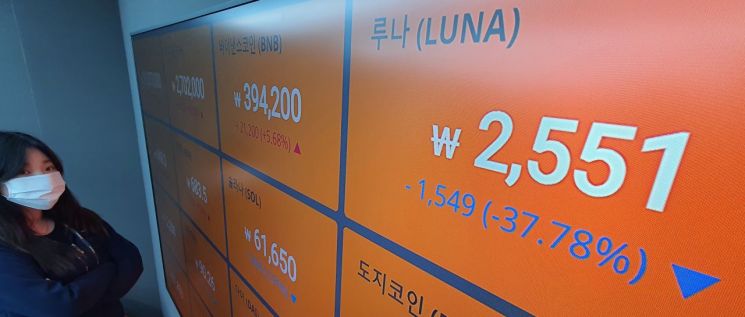
[Asia Economy Reporter Ji Yeon-jin] Recently, amid the global cryptocurrency market turmoil caused by the crash of Terra and Luna, domestic investors engaged in large-scale 'buying at low prices,' resulting in a confirmed 17,500-fold surge in domestic Luna assets.
According to the virtual asset industry on the 18th, the amount of Luna held on the four major domestic cryptocurrency exchanges?Upbit, Bithumb, Coinone, and Korbit?has surged from 4 million units at the end of last year to 70 billion units currently. During this period, the number of domestic investors holding the coin increased by 200,000, from 80,000 to 280,000. In particular, after Binance, the world's largest cryptocurrency exchange, suspended margin trading of Luna, 100,000 new investors purchased Luna within two days. On the previous day at the National Assembly's Political Affairs Committee, Financial Services Commission Chairman Ko Seung-beom stated, "There are 280,000 domestic Luna users, and it is estimated that they hold about 70 billion units."
Luna is a sister coin designed to help Terra, a stablecoin issued with a fixed value pegged to traditional currencies such as the US dollar, maintain its $1 value. Terraform Labs, the issuer of both coins, saw Terra plummet by 99% within a week starting from the 8th, due to concerns over stagflation?simultaneous inflation and economic recession?that caused a sharp drop in the US stock market. According to CoinMarketCap, Luna, which traded around 90,000 KRW at 2 a.m. on the 8th, fell to 40,000 KRW on the 10th, 1,000 KRW on the 12th, and below 1 KRW on the 13th.
During the same period, Luna trading volume on Upbit, the largest domestic cryptocurrency exchange, exploded from around 10,000 transactions until the 6th to 140,000 on the 9th, 300 million on the 10th, 12 billion on the 12th, and 163.3 billion on the 13th. Domestic investors concentrated their purchases on the 12th and 13th, when the coin price fell below 1,000 KRW.
In this process, cryptocurrency exchanges faced criticism for not suspending Luna trading early, which exacerbated the damage to domestic investors and enabled global short-term traders to engage in currency exchange arbitrage. Luna was listed on Upbit only for trading against Bitcoin (BTC). Although it was designated as an investment caution item on the 11th and Binance suspended Luna trading on the 12th (local time), deposits and withdrawals of Luna were not blocked. Notably, on the 13th, deposits and withdrawals were blocked around 1 a.m. at the request of Terraform Labs but were allowed again from around 3 a.m., and trading was suspended again at 5 p.m. As a result, Upbit is estimated to have earned 10 billion KRW in fees.
However, under current law, inappropriate actions by virtual exchanges related to the Terra incident cannot be penalized. The virtual asset market is currently regulated by the Financial Services Commission under the Act on Reporting and Using Specified Financial Transaction Information (Special Financial Transactions Act), which only sets rules for virtual asset service providers to prevent money laundering and for the travel rule regarding fund transfers. A Financial Services Commission official said, "Just as authorities cannot protect against losses when stock prices fall, they cannot protect against losses from coin price declines," adding, "There is currently no legal basis to sanction unfair trading related to virtual assets."
© The Asia Business Daily(www.asiae.co.kr). All rights reserved.












