Export Restrictions Led by Food Protectionism Continue
International Grain Prices Fluctuate Daily...Domestic Food Prices Also Rising
Experts Urge "Rapid Establishment of Crisis Response System"
[Asia Economy Reporters Seungyun Song and Eunmo Koo] The global food crisis triggered by the war between Russia and Ukraine is significantly impacting our economy as well. Prices of raw materials used in essential goods such as wheat, corn, and palm oil have skyrocketed, causing distress not only among companies but also consumers. Experts emphasize the necessity of establishing a structural preparedness system and consistently implementing food security policies.
Food Companies Anxious Over Domino Price Increases; Consumers Uneasy
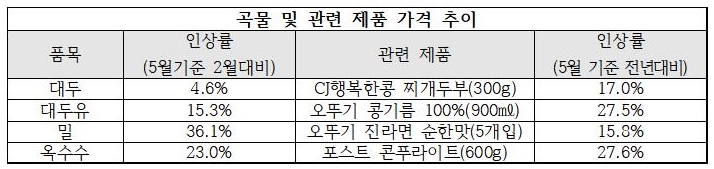
According to industry sources on the 17th, international grain prices have been fluctuating recently as India has taken measures such as banning wheat exports under the banner of ‘food protectionism.’ Wheat prices had already risen more than 40% since the beginning of this year and have continued to climb following the Russia-Ukraine war. The Food and Agriculture Organization (FAO) of the United Nations reported that the global grain price index for April was 169.5 points, slightly down 0.4% from the record high of 170.1 in the previous month, but still at a high level. According to the Chicago Board of Trade (CBOT), the price of wheat in May was $403 per ton, a 36% increase compared to $296 in February. During the same period, soybean and soybean oil prices rose by 4.6% and 15.3%, respectively, while corn prices increased by 23%.
As international grain prices rise, food prices using these raw materials are also on the rise. According to the Korea Consumer Agency, the average selling price of ‘Ottogi 100% Soybean Oil (900ml)’ in May was 4,916 won, up 27.5% compared to the same period last year. ‘Post Corn Flakes (600g)’ and ‘Nongshim Shrimp Crackers (90g)’ also increased by 27.6% and 10.1%, respectively. Additionally, BBQ raised chicken prices by 2,000 won starting this month. Dining-out costs are also rising; the average price of jajangmyeon in Seoul last month was 6,146 won, up 6.5% from February, and the average price of kalguksu rose 3.9% to 8,269 won, with Myeongdong Kyoja’s price entering the 10,000 won range during the same period.
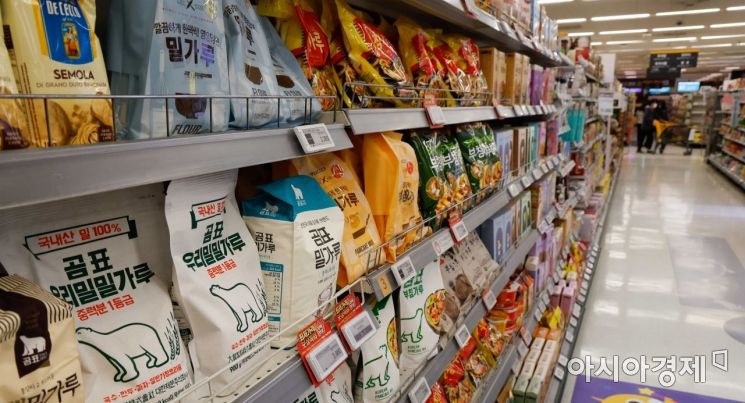 On the 16th, as the Indian government immediately banned wheat exports to secure its food security, making further price increases for domestic snacks and bread more visible, wheat flour is displayed at a large supermarket in Seoul. Photo by Jinhyung Kang aymsdream@
Domestic food companies mainly import wheat from the United States, Australia, and Canada, so they are not expected to be directly affected by India’s recent export ban. However, if global export restrictions continue and international grain prices keep rising, they cannot remain unaffected. Although companies are currently managing with pre-secured inventory, there are forecasts that price increases will be inevitable starting in the second half of the year if the situation prolongs. However, since major companies in the ramen and confectionery industries, including the three leading ramen manufacturers, have already implemented price hikes, others are currently just watching and waiting.
Consumers are equally anxious. Since the Russia-Ukraine war cut off sunflower oil supplies and Indonesia’s palm oil export suspension compounded the situation, prices of edible oils have surged dramatically, leading to panic buying in some areas. Warehouse discount stores have imposed purchase limits to respond to the situation, but as prices of essential goods rise overall, concerns about a food price crisis are growing. The price of 18-liter cooking oil, commonly used in restaurants, has surpassed 60,000 won and is approaching 70,000 won. Some wholesalers even predict that wheat flour prices could rise by more than 30% this year, causing small business owners to sigh daily.
Import-Dependent Structure is the Cause... "Food Security Policy Must Be Consistent"
The reason domestic food prices are easily shaken by international grain price fluctuations is the vulnerable grain self-sufficiency rate, as most grains used in food manufacturing and feed are imported. South Korea’s grain self-sufficiency rate was 20.2% in 2020, but excluding rice, it was only 3.2%. Particularly, self-sufficiency rates for wheat (0.5%) and corn (0.7%) are at critically low levels. The Global Food Security Index (GFSI), which compares and evaluates countries’ food security levels, ranked South Korea 32nd last year, placing it at the bottom among OECD countries.
International grain prices generally affect import prices with a 3 to 7-month lag due to forward purchasing by import grain processors, which increases volatility but lowers the likelihood of sudden supply disruptions in the short term. However, if grain price volatility continues for a long time, the prices of substitute grains will also rise in a chain reaction, increasing import costs and inevitably leading to reduced economic activity in related industries such as processed foods, livestock products, and dining out, as well as inflation.
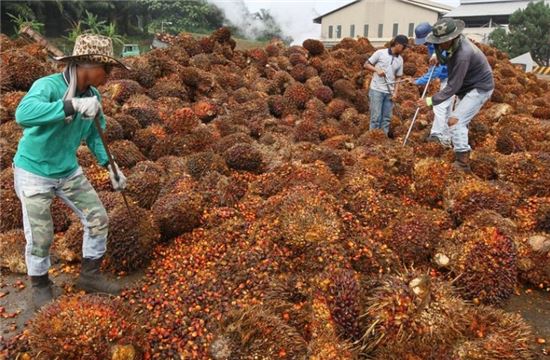 ▲Palm oil production farm in Malaysia (Photo by Bloomberg)
As concerns about food security grow due to the low grain self-sufficiency rate, the need to establish a structural preparedness system to respond to the international grain crisis is increasing. First, there are calls to recognize food issues as national security and to manage them by enshrining them in the constitution.
Huh Yong-jun, Director of Future Strategy at the NongHyup Economic Research Institute, explained, "Stability of staple foods is a basic condition for maintaining social stability, and maintaining adequate food stocks and a certain level of domestic production is a fundamental responsibility of the state." The institute also added that it is necessary to codify food security policies in the National Finance Act to ensure consistent implementation.
At the industry level, there are suggestions to secure measures to stably import overseas grains during crises. Kim Jong-jin, a research fellow at the Korea Rural Economic Institute, said, "In the short term, alternative sources of origin should be developed, and financial and tax support that can minimize the impact on domestic prices should be strengthened." He added, "It is necessary to stabilize supply chains by improving domestic grain self-sufficiency, expanding reserves, forward purchasing, and long-term contracts, and to establish an international grain procurement system by entering the international grain distribution sector," emphasizing mid- to long-term countermeasures.
The government also plans to actively respond to stabilizing grain and food prices. The government recently included a budget of 54.6 billion won in the supplementary budget for stabilizing wheat flour prices and expanded comprehensive funding support for the food and dining industry. Earlier, the Ministry of Agriculture, Food and Rural Affairs lowered interest rates on raw material purchase funds for feed and food companies in March to respond to international grain market instability, and last month increased the allocation of substitute feed grain materials.
© The Asia Business Daily(www.asiae.co.kr). All rights reserved.












