Optimal Treatment Possible if Daily Average Cases Within 100,000
Risk Level 'Medium' ... "January Level Just Before Omicron Surge"
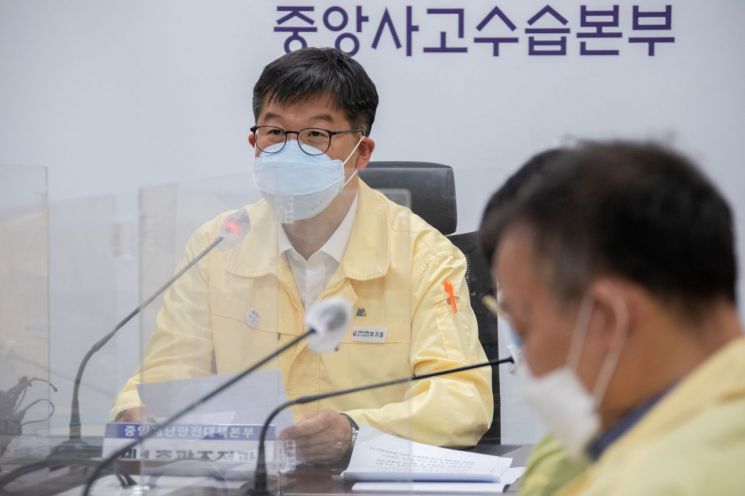
[Asia Economy Reporter Jo In-kyung] As the country is going through a 4-week "transition period" for COVID-19 normalization, the government plans to discuss next week the timing for entering the "settlement phase" of normalization, scheduled for the 23rd.
Lee Ki-il, the 1st General Coordinator of the Central Disaster and Safety Countermeasures Headquarters (Vice Minister of Health and Welfare), held the first Central Disaster and Safety Countermeasures Headquarters meeting since the new government took office on the morning of the 11th, reviewing the tasks of the "100-Day Emergency Response Roadmap for COVID-19" announced last month by the Presidential Transition Committee, and announced this plan.
Lee said, "We will closely examine and evaluate the 4-week transition period that began on April 25 with experts," adding, "After a comprehensive evaluation next week, we will also discuss the timing for entering the settlement phase." He further explained, "Currently, with our medical system and quarantine response capabilities, we believe that if the number of confirmed cases remains below an average of 100,000 per day weekly, we can provide optimal treatment without major problems."
The quarantine authorities aim to reestablish a scientific and sustainable COVID-19 response system within 100 days of the new government's launch and to thoroughly prepare for a possible resurgence of COVID-19.
First, they will conduct quarterly antibody positivity rate surveys on 10,000 people nationwide and closely analyze the effectiveness of the quarantine measures implemented so far, promoting quarantine policies based on scientific evidence. Additionally, as the COVID-19 response system transitions to the general medical system, they will prepare thoroughly to ensure no gaps in emergency and special patient care, establishing a sustainable infectious disease response system under any circumstances.
They plan to build a fast track that allows high-risk groups to receive treatment prescriptions and hospital admissions on the same day as testing, as well as manage infections in nursing hospitals and care facilities. They also reaffirmed plans to strengthen national responsibility for vaccine adverse reactions and to secure sufficient treatments early to expand prescriptions.
Lee emphasized, "Even at this moment, various new variants continue to be reported overseas, and domestic experts are also warning of the possibility of a resurgence in the fall," adding, "We must never let our guard down and continue the fight against COVID-19 until the end."
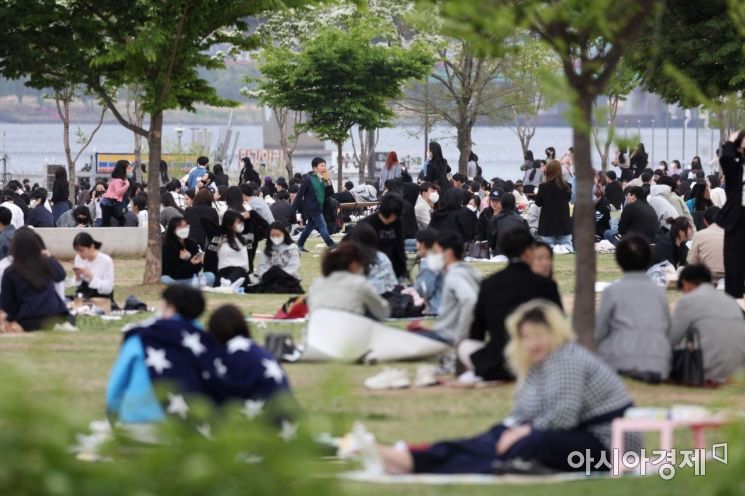 On the 1st, one day before the outdoor mask mandate is lifted, citizens are resting at Yeouido Hangang Park in Seoul. Photo by Mun Ho-nam munonam@
Meanwhile, the average daily number of COVID-19 confirmed cases last week was about 38,000, marking a decrease for seven consecutive weeks. The number of new critically ill patients was 312, down 27.8% from the previous week, and the number of deaths was 495, a 35.7% decrease compared to the previous week. Accordingly, the COVID-19 risk level in the first week of May was assessed as moderate in both the metropolitan and non-metropolitan areas, the same level as in January before the Omicron wave.
Among confirmed cases last week, those aged 60 and over accounted for 22%, and among total deaths, those aged 60 and over accounted for 91.1%. Notably, only 4% of those aged 60 and over were unvaccinated or had received only the first dose, yet they accounted for 36.1% of total deaths, which the quarantine authorities say confirms once again the effectiveness of vaccination.
Lee urged, "We ask for active participation in the fourth dose currently being administered to the elderly," adding, "We also ask children and local governments to help the elderly receive vaccinations conveniently."
© The Asia Business Daily(www.asiae.co.kr). All rights reserved.













