6 of the Top 10 ETFs by Trading Volume in May Are Inverse ETFs
[Asia Economy Reporter Myunghwan Lee] Domestic investors have been betting on a stock price decline since the beginning of this month. Amid the global stock market falling due to various negative factors, inverse exchange-traded funds (ETFs), which generate profits as the index falls, accounted for the majority of the top traded stocks by volume. Securities firms advised that inverse ETFs should be used as a short-term profit-taking tool.
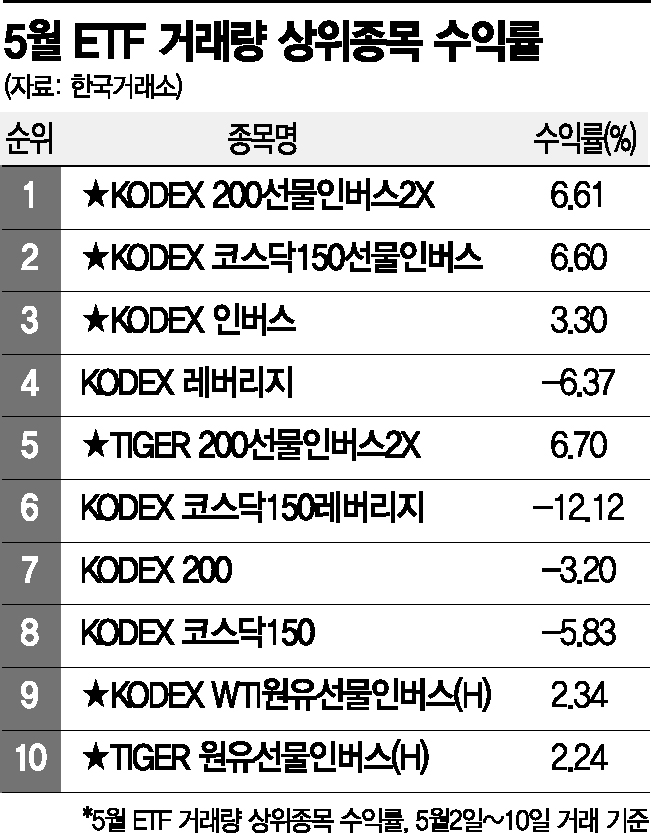
On the 11th, Asia Economy analyzed domestic ETF trading from the 2nd to the 10th of this month and found that six out of the top 10 traded ETFs by volume were inverse ETFs. Samsung Asset Management's 'KODEX 200 Futures Inverse 2X,' a 'Gopbus' ETF that tracks the KOSPI 200 futures index with 2x inverse leverage, ranked first with a trading volume of 959.29 million during this period. This ETF can yield twice the profit when the tracked index falls. It also led in trading value with 2.5546 trillion KRW.
'KODEX KOSDAQ 150 Futures Inverse,' which inversely tracks the KOSDAQ 150 futures index, followed with a trading volume of 180.25 million. Other inverse ETFs such as 'KODEX Inverse' (3rd), 'TIGER 200 Futures Inverse 2X' (5th), 'KODEX WTI Crude Oil Futures Inverse (H)' (9th), and 'TIGER Crude Oil Futures Inverse (H)' (10th) also ranked within the top 10 by trading volume.
Given the recent continuous decline in the domestic stock market due to overlapping negative factors such as the U.S. Federal Reserve's tightening and China's COVID-19 lockdowns, these ETFs recorded solid returns. The top traded 'KODEX 200 Futures Inverse 2X' posted a 6.61% return, and the average return of the six inverse ETFs reached 4.63%. The average return of four inverse ETFs tracking the KOSPI and KOSDAQ futures indices was even higher at 5.80%. This is a notable return compared to the KOSPI's 3.65% decline during the same period.
Looking at investor types, individual investors showed the strongest buying sentiment. During this period, individuals net purchased ETFs worth 257.2 billion KRW, showing the largest buying power. Foreign investors also bought 131.3 billion KRW worth. Institutions, however, showed a sole selling trend with net sales of 442.8 billion KRW.
However, securities firms advised that inverse ETFs should only be used as short-term trading tools. Hyunjong Jung, a researcher at Korea Investment & Securities, explained, "Inverse and leveraged ETFs are more effective when used as short-term directional trading tools rather than for long-term holding," adding, "The greater the volatility and market noise, the more losses occur due to rebalancing."
Meanwhile, leveraged ETFs such as 'KODEX Leverage' (4th) and 'KODEX KOSDAQ 150 Leverage' (6th) also appeared among the top traded stocks by volume. However, as the tracked indices declined during this period, they recorded losses of -6.37% and -12.12%, respectively.
© The Asia Business Daily(www.asiae.co.kr). All rights reserved.












