'Seoul Vision 2030 Future Sensory City' Core Task 'Jicheon Renaissance' → Renamed to 'Seoul-style Waterside Sensory City'
Transforming living spaces and revitalizing economy and balanced development by linking waterways and local resources
Waterside space harmonizing commercial, cultural, and historical elements by first half of next year
Mayor Oh Se-hoon visits pilot project site 'Hongjecheon' on the 28th
[Asia Economy Reporter Lim Cheol-young] The Seoul Metropolitan Government is reorganizing the spatial structure centered on the 332km of streams and small rivers flowing throughout Seoul to create a 'Seoul-style waterfront emotional city,' one of the core tasks of 'Seoul Vision 2030.' The city plans to start four pilot projects on Dorimcheon, Jeongneungcheon, and Hongjecheon, each with different characteristics.
On the 28th, Mayor Oh Se-hoon visited the artificial waterfall site at Hongjecheon, one of the four pilot project sites and where the 'No. 1 waterfront open-air cafe' will be established, stating that through the 'Seoul-style waterfront emotional city,' water zones will be created throughout Seoul so that citizens can enjoy waterfront life.
Along with the full-scale launch of the 'Seoul-style waterfront emotional city,' Seoul plans to invest 10 billion KRW to prioritize three tasks: pilot projects to prepare business models by type, introducing various cultural and economic activities such as waterfront open-air cafes through deregulation, and establishing water resource utilization plans and improving the design of river facilities to restore clean and abundant streams.
Dorimcheon - Revitalizing the local economy through waterfront activation... Jeongneungcheon - Rebirth as a complex cultural space
First, through pilot projects, three waterfront attractions with different themes will be created at Dorimcheon, Jeongneungcheon, and Hongjecheon. Rather than simple maintenance projects like installing bike paths, the focus is on maximizing the unique characteristics of each area to create value in waterfront spaces that combine hardware (facilities) and software (content).
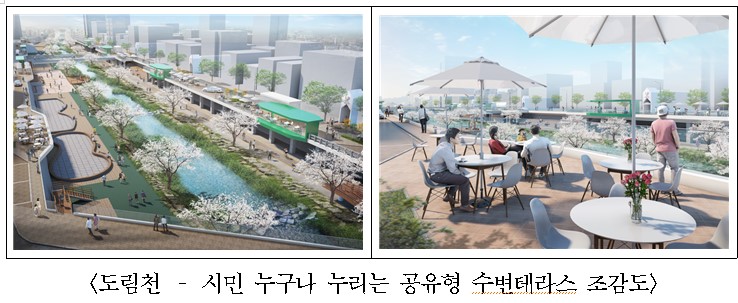
Dorimcheon aims to recover the local economy through waterfront activation. The city plans to create waterfront terraces and resting areas accessible to all citizens by restructuring roads and installing decks. People can buy food at the market and come to the waterfront to leisurely eat while enjoying various cultural activities such as performances or having a picnic. The natural connection between the waterfront and commercial areas is expected to contribute to the recovery of the local economy, which was depressed due to COVID-19.
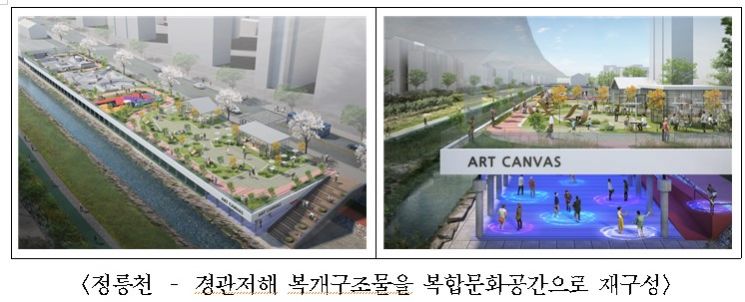
Jeongneungcheon will transform a large idle space above the stream, a covered structure (320m×25m×6m), into a complex cultural space where various activities such as sports and culture can take place. This facility, installed during urbanization and currently used as a public parking lot, has low utilization as less than 50% of the space is used.
Seoul plans to create an 'urban cultural canvas' concept, with the upper part divided into an activity zone for lifestyle and action sports and a healing and community zone for rest and exchange, and the dark and secluded lower part into a digital emotional zone combined with media art. The city will install various public facilities designed with a 'Fun' concept for citizens to enjoy diverse experiences and collaborate with local artists to present creative cultural and artistic content.
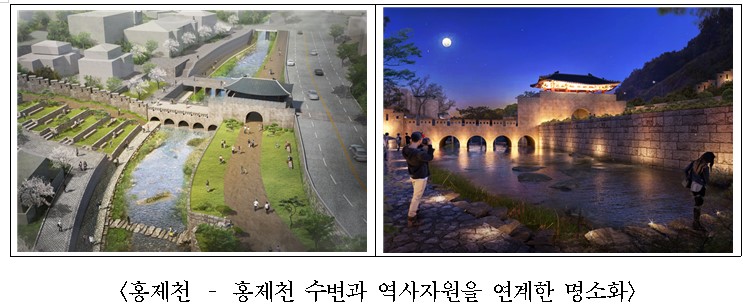
Hongjecheon will be developed into a landmark space where emotional night views, history, and rest coexist by linking the beautiful waterfront rock scenery with representative local historical resources such as Hongjimun and Tangchundaeseong (Seoul City Tangible Cultural Property No. 33). While preserving the original form of the cultural assets, walkways and bridges will be maintained to improve accessibility, and various viewing and resting points and night lighting will be installed. The city plans to develop diverse cultural and tourism programs such as exploring the Hanyangdoseong defense system, walking guided tours, and night photography events, emphasizing the historical significance of Hongjimun and Tangchundaeseong.
Introduction of 'Open-Air Cafes by Waterways'... Designation of 'Waterfront Special Zone' at Hongjecheon Artificial Waterfall
Restoration of shallow and dry streams, commencement of 'Water Resource Utilization Plan'
Additionally, the Hongjecheon artificial waterfall pilot project, which introduces open-air cafes by waterways (waterfront terrace cafes) commonly seen in European cities, will be presented to citizens first this summer in collaboration with Seodaemun-gu, ahead of other pilot projects. This location offers a panoramic view of the beautiful natural scenery of Hongjecheon and Ansan and will be created as a space to enjoy seasonal themed music, coffee, and relaxation by utilizing some idle space in the public parking lot.
Furthermore, efforts will focus on increasing the utilization of various urban water resources so that streams, which are shallow and dry, can be restored to their original function of flowing clean and abundant water throughout the four seasons. Most streams in Seoul are dry streams, with an average depth of about 10cm. Therefore, Seoul plans to start a feasibility study and basic plan within this year to actively utilize treated sewage water and groundwater discharged during underground space development as urban water resources, aiming to complete it by the second half of next year.
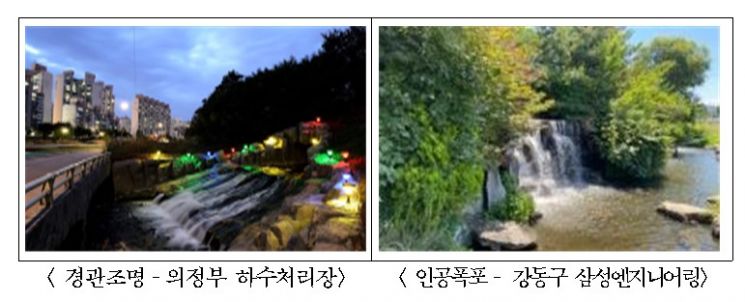
To improve the landscape of streams, new design guidelines for water management facilities along streams, such as sewage discharge outlets, will be prepared by the end of the year. Currently, there are 2,733 various stream discharge facilities along streams in Seoul, but they were installed mainly for function, which impaired the landscape and sometimes caused misunderstandings that wastewater was being discharged. The city plans to develop citizen-friendly designs and prioritize maintenance in areas with high citizen usage.
Furthermore, within the scope of ensuring safety, the city will improve existing regulations that restrict the use of waterfront spaces to maximize their utilization. When redevelopment or reconstruction projects are carried out within 500m to 1km of the waterfront, new urban planning guidelines will be established to allow waterways to enter daily life. The city will also actively propose amendments to related laws such as the River Act and Building Act to the government to allow various facilities within river zones.
Seoul plans to steadily promote the four pilot projects and create larger-scale 'public waterfront districts' at the district level in five locations, including Jungnangcheon and Anyangcheon, by 2030. In small streams and neighborhood streams, 30 'waterfront vitality points' such as waterfront terrace cafes and resting areas will be created to enrich daily life.
Mayor Oh Se-hoon said, "The keywords I have consistently emphasized while presenting Seoul's future vision and urban space future concept are 'waterfront' and 'emotion.' We will reorganize streams into new attractive points of Seoul to provide conditions for a higher quality of daily life, contribute to the revival of the local economy, and establish a new foundation for the balanced development of all 25 autonomous districts."
© The Asia Business Daily(www.asiae.co.kr). All rights reserved.














