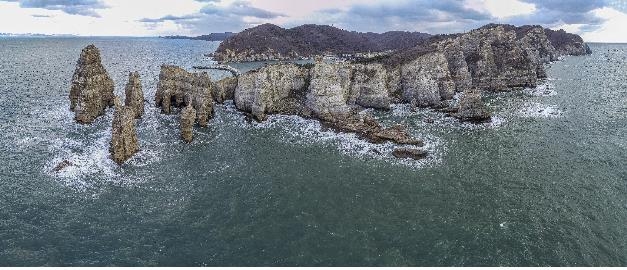
[Asia Economy Reporter Park Hyesook] Incheon City has begun laying the groundwork to obtain UNESCO Global Geopark certification for Baengnyeong and Daecheong National Geoparks.
On the 21st, the city announced that it has commissioned the Korea Environment Institute to undertake the "Baengnyeong-Daecheong UNESCO Global Geopark Certification Promotion Strategy Establishment Project."
The city aims to receive UNESCO Global Geopark certification by 2026 to create conditions for sustainable regional development through the revitalization of tourism in Baengnyeong and Daecheong National Geoparks. This project is a preliminary preparation procedure expected to be completed by October.
The project will conduct research on the current status analysis of Baengnyeong-Daecheong National Geoparks, analysis of UNESCO Global Geopark certification criteria and proposal of certification methods, identification of sites for the establishment of a geopark center, and setting a roadmap for UNESCO Global Geopark certification.
Baengnyeong-Daecheong National Geoparks were certified as the 11th national geopark in Korea in July 2019, thereby obtaining the minimum qualification to pursue UNESCO Global Geopark certification.
In Baengnyeong and Daecheong areas, metamorphic sedimentary rocks from the Neoarchean era, dating back one billion years, are distributed, and traces of stromatolites, the oldest biological fossils in Korea, remain, which are highly valued for their geological significance.
There are ten geological attractions including Dumujin in Baengnyeongdo, basalt at Jinchon-ri, Sagot Beach, Kongdol Coast, Nongyeo Beach in Daecheongdo, Okjukdong Coastal Sand Dunes, and Seopungbaji.
Among these, the tree-ring rock at Nongyeo Beach exudes the power of intense tectonic changes due to its vertically standing strata. Also, Seopungbaji forms a magnificent vertical cliff with quartzite blocks reaching about 100 meters in height, creating a spectacular view.
Additionally, the Okjukdong Coastal Sand Dunes form the largest sand dunes in Korea with sand blown by the wind from the sea, evoking the vast feeling of a desert.
The Global Geopark is a UNESCO system that promotes sustainable regional development through the conservation and utilization of geological, biological, and cultural heritage, and is one of UNESCO’s three major protection systems alongside "World Heritage" and "Biosphere Reserves."
An official from Incheon City stated, "Based on diverse opinions from advisory committee members and the results of the project, we plan to develop a certification strategy that leverages the strengths of Baengnyeong and Daecheong," adding, "UNESCO Global Geopark certification will not only enhance Incheon City's international status but also greatly boost the pride of local residents."
© The Asia Business Daily(www.asiae.co.kr). All rights reserved.












