KAIST Professor Kang Jung-kyu's Team
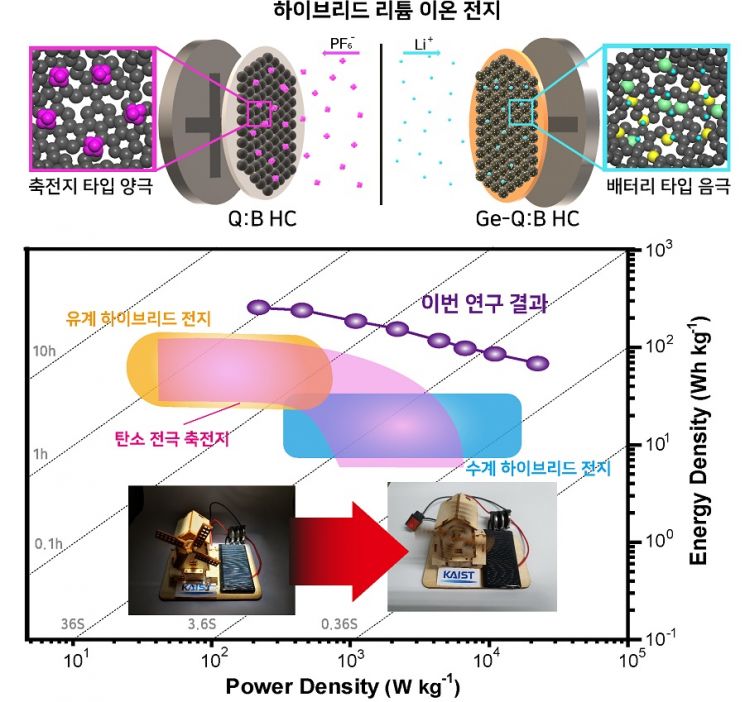 Schematic diagram of hybrid lithium-ion battery and implementation of device characteristics. Photo by KAIST.
[Asia Economy Reporter Kim Bong-su] Domestic researchers have developed a high-energy, high-power hybrid lithium-ion battery capable of rapid charging within a few minutes.
The Korea Advanced Institute of Science and Technology (KAIST) announced on the 21st that Professor Jung-Koo Kang's research team in the Department of Materials Science and Engineering successfully synthesized a porous carbon hollow structure with a large surface area by changing the orientation of polymer resin, and developed anode and cathode materials based on this structure to realize a high-performance hybrid lithium-ion battery.
Currently, lithium-ion batteries are a representative commercialized energy storage device, essential across the electronics industry from smart electronic devices to electric vehicles, earning the nickname "the second semiconductor." However, due to fundamental limitations such as low power density, long charging times, and large volume caused by slow electrochemical reaction rates, limited electrode materials, and anode-cathode asymmetry, the development of high-performance electrode materials and next-generation energy storage devices is necessary.
To address these issues, hybrid batteries, which combine battery-type anodes and capacitor-type cathodes, have been actively researched recently. They offer both high storage capacity and fast charge-discharge speeds, making them a promising next-generation energy storage device that could replace conventional lithium-ion batteries.
However, to realize hybrid batteries with high energy and high power density, it is necessary to improve the electrical conductivity and ion diffusion rate of battery-type anodes, increase the energy storage capacity of capacitor-type cathodes, and optimize the two electrodes according to their different ion storage mechanisms.
The research team proposed a new synthesis method to create porous carbon structures with a large surface area by changing the orientation of polymer resin. Based on this, they developed anode and cathode materials and successfully realized a high-energy, high-power hybrid lithium-ion energy storage device. By adding melamine to the resorcinol-formaldehyde resin synthesis process, the resin orientation was changed from linear to twisted. When the twisted resin was carbonized, more micropores were formed, producing a carbon structure with a surface area 12 times larger than that of carbon structures generated from conventional linear resin. The carbon structure produced through this process was used as a capacitor-type cathode material. The research team confirmed that the large surface area not only adsorbs many ions on the surface but also allows ions to rapidly diffuse through the hollow structure and mesopores, resulting in high capacity and rate performance.
The team synthesized a carbon hollow structure embedded with germanium (Ge) precursor particles at the molecular level by inserting the Ge precursor with high energy storage capacity into the twisted resin structure, using this as the battery-type anode material. The molecular-level Ge particles embedded in the porous carbon structure suppressed performance degradation caused by large volume expansion during charge-discharge cycles and allowed lithium ions to rapidly diffuse internally, resulting in high lifespan and rate characteristics.
The researchers assembled the developed anode and cathode into a full cell to realize a high-performance hybrid lithium-ion battery. This hybrid lithium-ion battery demonstrated both energy density comparable to commercially available lithium-ion batteries and power density characteristics of capacitors. It is expected to be applicable to electric vehicles, drones, and smart electronic devices, enabling rapid charging from a few seconds to several minutes as a next-generation energy storage device.
The research results were published on the 4th in the international nanotechnology journal 'ACS Nano.'
Professor Kang stated, "The hybrid lithium-ion battery, with a high energy density of 285 Wh/kg based on the electrode and a high power density of 22,600 W/kg enabling rapid charging, will be a new breakthrough to overcome the limitations of current energy storage systems," adding, "It can expand the range of applications for all electronic devices, including electric vehicles."
© The Asia Business Daily(www.asiae.co.kr). All rights reserved.

![Clutching a Stolen Dior Bag, Saying "I Hate Being Poor but Real"... The Grotesque Con of a "Human Knockoff" [Slate]](https://cwcontent.asiae.co.kr/asiaresize/183/2026021902243444107_1771435474.jpg)














