Long-term Foreign Residents in Korea Exempt from PCR Negative Certificate upon Entry
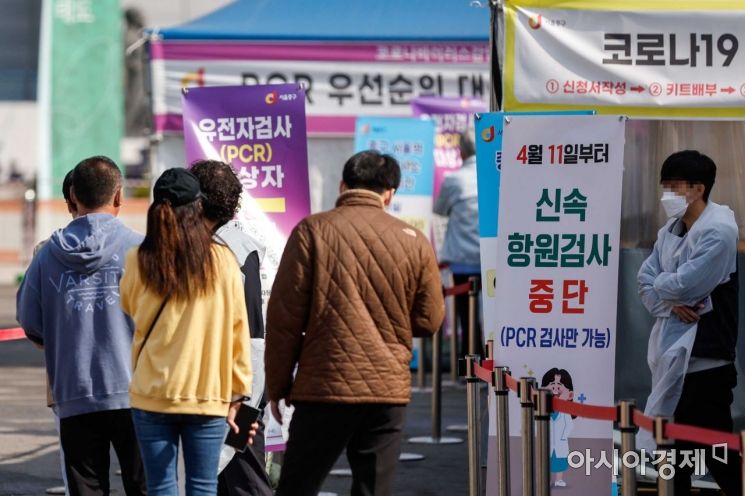 An announcement stating that rapid antigen testing will be suspended from the 11th is placed at the temporary screening clinic set up at Seoul Station Plaza on the 10th, as the number of COVID-19 confirmed cases continues to decline. Photo by Kang Jin-hyung aymsdream@
[Asia Economy Reporter Jo In-kyung] "You have to pay 5,000 to 6,000 won for one self-test kit, and hospital tests cost about the same, but people in their 50s like us are not even eligible for free tests at screening clinics, so honestly, it's a burden. (58, Jungnim-dong, Seoul)"
The free COVID-19 rapid antigen tests (RAT) for individuals, which were provided at public health center screening clinics and temporary screening sites upon request, will be discontinued starting from the 11th.
As the Omicron wave has passed its peak and the number of confirmed cases has significantly decreased, and with the expansion of local clinics and hospitals capable of conducting rapid antigen tests, the health authorities explained that the COVID-19 diagnostic testing system will shift to a private-sector-centered model.
Accordingly, from this day forward, only polymerase chain reaction (PCR) tests will be conducted at screening clinics and temporary screening sites.
PCR tests will be available to priority groups such as seniors aged 60 and over, individuals with a doctor's note indicating the need for testing, epidemiologically related persons such as close contacts, and those who tested positive on rapid antigen tests.
Citizens who want to take a rapid antigen test due to suspected symptoms can purchase a self-test kit or visit local clinics and hospitals designated for respiratory care (respiratory designated medical institutions) or respiratory specialized clinics that conduct diagnostic tests.
At clinics and hospitals, doctors will perform the test using professional kits. Users must pay 30% of the consultation fee (5,000 won for clinics), and if the professional kit test result is positive, it will be immediately recognized as a confirmed COVID-19 case.
The list of medical institutions capable of conducting rapid antigen tests can be checked on the Health Insurance Review & Assessment Service or the COVID-19 website.
The health authorities plan to prioritize distributing self-test kits within the limits held by local governments to vulnerable groups who feel burdened by the cost of purchasing self-test kits or clinic fees. Eligible groups include basic livelihood security recipients, near-poverty groups, residents of single elderly facilities, and medically underserved areas. Kits will also be provided free of charge to daycare centers, kindergartens, elementary schools, workers in infection-vulnerable facilities, elderly welfare facilities, pregnant women, and other vulnerable groups.
According to the Korea Disease Control and Prevention Agency, from January 26 to 0:00 on the 8th of this month, a total of 12,457,842 individual RATs were conducted at public health centers.
From this day, long-term foreign residents in Korea who have a history of COVID-19 infection will no longer be required to submit a negative PCR test certificate when re-entering the country after traveling abroad. Previously, only Korean nationals who had completed their isolation period after infection were exempt from submitting a negative certificate upon entry, but the exemption has now been extended to long-term foreign residents with a living base in Korea.
However, while Korean nationals' overseas infection history is recognized, only domestic infection history is recognized for long-term foreign residents.
Long-term foreign residents with alien registration cards who were confirmed infected with COVID-19 10 to 40 days before departure can submit a 'quarantine notice' issued in Korea instead of a negative test certificate.
© The Asia Business Daily(www.asiae.co.kr). All rights reserved.












