250 Members of School Violence Relationship Recovery Support Group to Visit School Sites Starting April
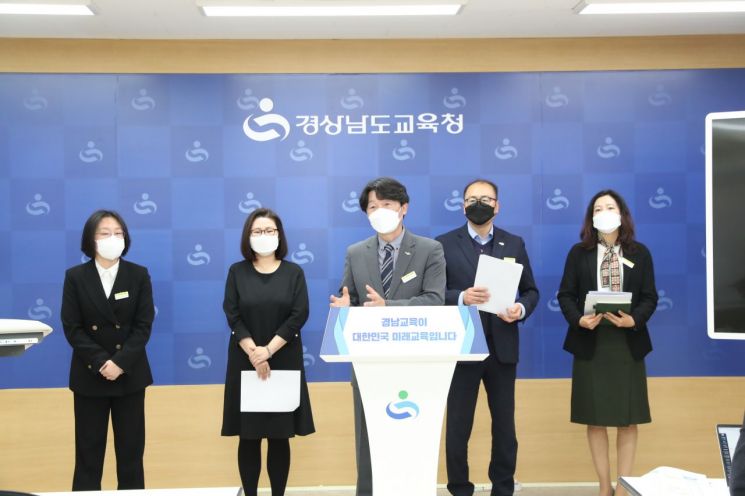 Gyeongnam Office of Education holds a press conference to address school violence conflicts and support the restoration of relationships among students.
[Asia Economy Yeongnam Reporting Headquarters Reporter Lee Seryeong] The Gyeongnam Office of Education is forming a School Violence Relationship Restoration Support Group to help victimized students recover and resolve conflicts related to school violence.
The School Violence Relationship Restoration Support Group, consisting of about 250 members across all 18 regional education offices, stated that it will overcome the limitations of the current School Violence Prevention and Countermeasures Act, which involves ‘relationship severance.’
Currently, handling school violence cases involves imposing strict measures on the perpetrating students and separating them from the victimized students.
An education office official explained that in this process, both sides miss educational opportunities to resolve conflicts healthily based on mutual understanding.
Recently, new types of relational violence such as cyber violence, verbal abuse, and ostracism have been increasing more than physical or bodily violence.
Because these occur within existing relationships, they cause greater mental and psychological harm to the victimized students.
Due to changes in the types of school violence, it is emphasized that support for restoring relationships between victim and perpetrator students, focusing not only on punishing the perpetrator but also on the recovery of the victim, is urgently needed.
The School Violence Relationship Restoration Support Group is composed of current teachers, professional counselors, community teachers, school administrators and professionals, retired teachers, current and former police officers, university professors, and restorative justice experts.
They are relationship restoration experts who have completed over 80 hours of training in restorative life education, nonviolent communication, conflict mediation, or have extensive lecture experience in the field of restorative life education.
The support group will complete integrated training and capacity-building training provided by the education office and plans to visit schools directly starting in April.
With the consent of the parties involved, they will support relationship restoration and conflict mediation programs to help with victim recovery.
After conversing with the related students, if psychological counseling and treatment support are deemed necessary, they plan to cooperate with the Ijoa Hope Dream Center, which is linked with hospital and clinic specialists, to support recovery.
Community teachers and relationship restoration experts will lead the recovery of victimized students and the voluntary responsibility for perpetrating behavior at schools, creating a foundation to solve children’s conflict issues together with the community.
Song Ho-chan, Director of Democratic Citizenship Education, said, “There are often cases where even minor school violence issues escalate into conflicts leading to lawsuits,” adding, “School violence should not be viewed merely as incidents to be handled or targets to be dealt with, but as opportunities to teach and learn how to respond when human relationships are broken.”
© The Asia Business Daily(www.asiae.co.kr). All rights reserved.











