Trend of daily life recovery including easing social distancing... Proactive late-night travel support, expansion of Owl Bus routes
Operating scale increased from current 9 routes and 72 buses to 14 routes and 100 buses... Improved convenience of late-night bus use across Seoul
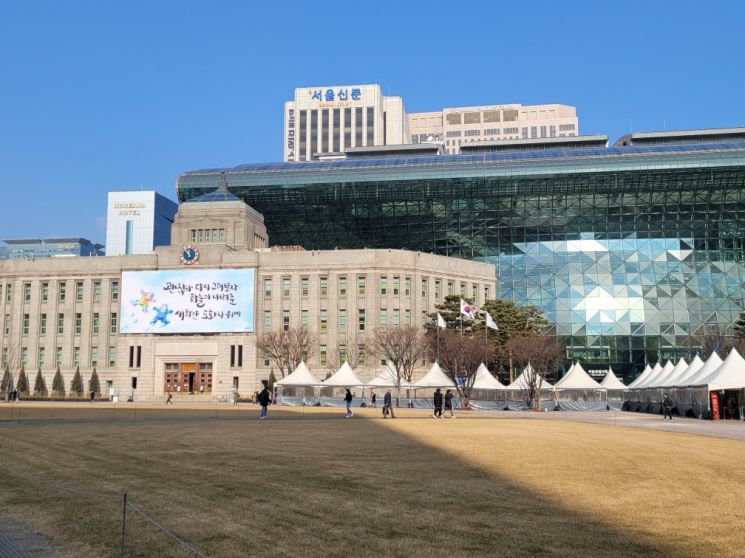
[Asia Economy Reporter Lim Cheol-young] Seoul City is expanding the Owl Bus routes from 9 to 14 and increasing the number of buses from 72 to 100 in line with the trend of daily life recovery. Additionally, new late-night bus routes will be established, and efforts will be made to strengthen the connectivity between downtown and sub-centers.
On the 5th, Seoul City announced that starting from the 18th, it will gradually expand the operation of Owl Buses and reorganize the late-night transportation system. Since its launch in 2013, the Owl Bus has become a representative late-night public transportation service, with 3.1 million annual users and a cumulative total of 28 million users over nine years. Seoul City plans to enhance the convenience of late-night buses through ▲ expansion of routes and number of vehicles ▲ establishment of new routes in areas lacking late-night buses ▲ strengthening the connection between downtown and sub-centers, and proactively support citizens' mobility in line with the easing of social distancing and the pace of daily life recovery.
First, the Owl Bus, which has been operating with 9 routes and 72 buses, will be significantly expanded to 14 routes and 100 buses. Currently, taxis and private cars are mainly used for late-night returns home, but the goal is to increase the supply and accessibility of Owl Buses so that they become the primary late-night transportation option for citizens.
Before reviewing the expansion of Owl Bus operations, Seoul City conducted a thorough analysis by examining late-night floating population and mobility patterns using big data. In particular, about 200 million pieces of big data, including communication data-based Seoul living mobility data and transportation card data, were utilized to analyze citizens’ main travel routes and late-night bus blind spots.
Big data analysis showed that the floating population during late-night hours from midnight to 4 a.m. was 342,000, indicating very high travel demand in major commercial and business districts. The distribution of floating population arrivals and departures was concentrated in commercial and bustling areas such as Gangnam (Yeoksam 1-dong), Yeouido (Yeoui-dong), Hongdae (Seogyo-dong), Sindang (Sindang-dong), and Konkuk University Entrance (Hwayang-dong). Yeouido showed a unique pattern with the floating population concentrated in Hangang Citizen’s Park.
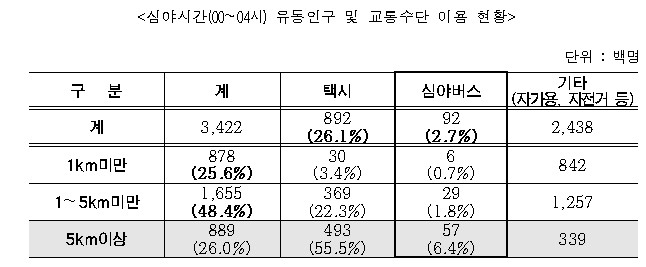
By distance and mode of transportation, the highest proportion of floating population traveled between 1 km and less than 5 km. While the taxi usage rate was 26.1%, the late-night bus usage rate was only 2.7%, indicating a need to expand accessibility and activation of Owl Buses. Among the late-night traveling population, 25.6% traveled less than 1 km on foot, 48.4% traveled between 1 km and less than 5 km using bicycles or other means, and 26.0% traveled more than 5 km.
The main concentration areas for late-night traffic were found to be downtown and sub-centers densely packed with commercial and business facilities. These concentration areas are mainly distributed along the subway Line 2 section, and blind spots occur between these concentration areas and nearby residential areas. Therefore, it is necessary to enhance citizens’ mobility rights by expanding routes that connect these concentration and blind spot areas, linking downtown and sub-centers.
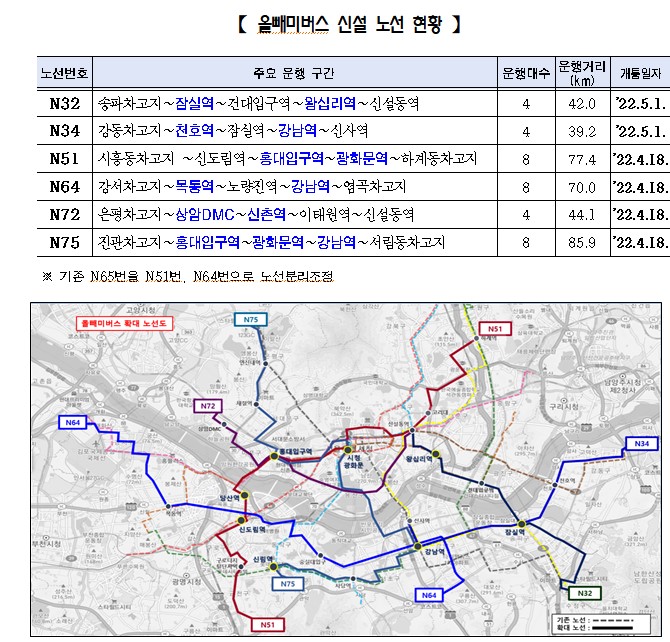
Along with data and citizen mobility demand analysis, Seoul City comprehensively considered operational data and citizen feedback from late-night routes that were temporarily operated at year-end, and newly established a total of six routes: three east-west axis connection routes between downtown and Gangnam, and three north-south axis routes connecting downtown and sub-centers centered around the Hangang River.
With the new Owl Bus routes and expansion, the passenger capacity is expected to increase from the existing 15,000 to 20,000, improving convenience for citizens significantly. In terms of fare, the cost burden for citizens who previously had no alternative to taxis will be reduced, which is also expected to revitalize the local economy in major commercial areas.
Meanwhile, Seoul City will provide Owl Bus operation information in real-time via internet web, smartphone apps, and bus stop BITs to enhance user convenience. The newly established and expanded Owl Bus routes will begin operation in phases on April 18 and May 1, and usage and operational status will be monitored continuously to improve any inconveniences.
Baek Ho, Director of Urban Transportation at Seoul City, said, “As Seoul’s urban economic activities are now operating on a 24-hour basis due to changes in social and economic structures, it is necessary to expand late-night public transportation services that match citizens’ lifestyle changes. Through this expansion of Owl Bus operations, we will strive to create an environment where citizens can return home safely and comfortably using public transportation.”
© The Asia Business Daily(www.asiae.co.kr). All rights reserved.

![Clutching a Stolen Dior Bag, Saying "I Hate Being Poor but Real"... The Grotesque Con of a "Human Knockoff" [Slate]](https://cwcontent.asiae.co.kr/asiaresize/183/2026021902243444107_1771435474.jpg)
















