Annual 500,000t Duty-Free Benefit
Korea Has Yet to Start Negotiations
[Asia Economy Reporter Hyun-ui Cho] The United States has finally put an end to the steel tariff dispute with the United Kingdom, following the European Union (EU) and Japan.
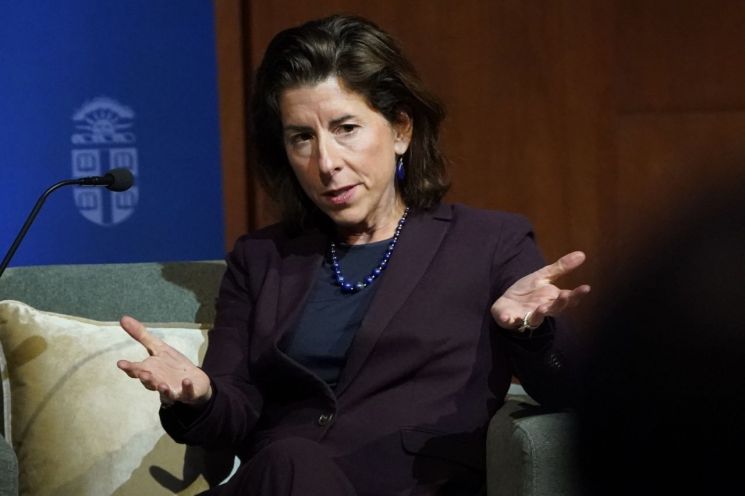
Gina Raimondo, U.S. Secretary of Commerce, and Katherine Tai, U.S. Trade Representative, announced this in a joint statement on the 22nd (local time), saying, "This will protect steel and aluminum companies and workers in both countries and also help reduce inflation in the United States."
Under this agreement, the U.S. will apply tariff-free benefits to 500,000 tons of British steel products imported annually. The UK plans to withdraw retaliatory tariffs imposed on U.S. products such as Harley-Davidson motorcycles, bourbon whiskey, and Levi's jeans.
Raimondo and Tai also expressed hope that this agreement would allow them to focus on China's unfair trade practices. Major foreign media reported, "Under this agreement, the UK must audit the financial records of British steel companies owned by Chinese entities to assess the Chinese government's influence and share the results with the U.S." British Steel, the UK's second-largest steel company acquired by China's Jingye Group in 2020, is expected to be the first subject of this application.
Since March 2018, during the Donald Trump administration, the U.S. has imposed tariffs of 25% on steel and 10% on aluminum imports from countries worldwide based on Section 232 of the Trade Expansion Act. This was due to concerns that China's overproduction was damaging the domestic steel industry and threatening national security.
However, after the Biden administration took office, the U.S. agreed in October last year with the EU to apply a tariff-rate quota (TRQ) system on regional steel products, conditional on the withdrawal of retaliatory tariffs. Last month, an agreement was also reached with Japan to eliminate tariffs on 1.25 million tons of Japanese steel products annually starting in April, with a 25% tariff applied to quantities exceeding that amount.
Negotiations with South Korea have not yet even begun. South Korea accepted a quota system limiting export volumes to 70% of the average export volume from 2015 to 2017 (3.83 million tons) instead of high tariffs in 2018.
Representative Tai drew a line on the necessity of negotiations with South Korea during a visit to the SK Siltron Michigan plant expansion site in Michigan on the 16th. He said, "Through the quota system, we already allow duty-free imports of some steel products from South Korea, which does not apply to most of our trade partners," adding, "I want to remind that South Korea is already in a better position and receiving benefits compared to many other countries."
© The Asia Business Daily(www.asiae.co.kr). All rights reserved.












