Experiments Underway in the UK and Japan as Well
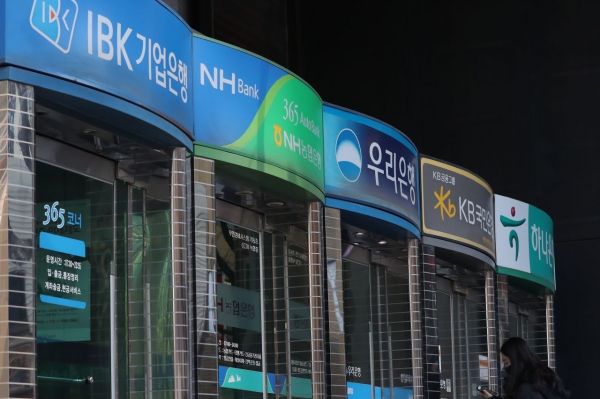
[Asia Economy Reporter Yu Je-hoon] The banking sector is beginning to actively experiment with 'joint branches.' This comes amid a decline in demand for face-to-face branches due to digital transformation and an increase in non-face-to-face transactions.
According to the financial sector on the 20th, Woori Bank and Hana Bank will open a joint branch next month in Sinbong-dong, Suji-gu, Yongin-si, Gyeonggi Province. The two banks will jointly use the second floor of the former Woori Bank Sinbong branch, marking the first joint branch to appear in the banking sector.
KB Kookmin Bank and Shinhan Bank are also preparing to open a joint branch. It is reported that the two banks are discussing plans to open joint branches in places such as Yeongju, Gyeongbuk, within the first half of this year. Additionally, the four major commercial banks are said to have reached a consensus on operating joint branches within post offices in cooperation with the Korea Post.
The banking sector's move to experiment with joint branches is due to the reduction of frontline branches caused by digital transformation and the increase in non-face-to-face transactions. According to the Financial Supervisory Service, as of the third quarter of last year, the number of domestic branches of the four major commercial banks was 3,203, a decrease of 203 branches (about 6%) compared to the same period the previous year. Compared to the third quarter of 2016, five years ago, 574 branches (about 15%) have disappeared. This naturally could lead to restricted financial accessibility for certain consumer groups such as the elderly and farmers and fishermen.
Overseas, the operation of joint branches is actively promoted as an alternative to reducing bank branches. According to Hana Financial Management Research Institute, the UK has operated a joint branch for small and medium-sized enterprises and SOHO (Small Office/Home Office) called the 'Business Banking Hub' since 2019, and since April last year, it has been piloting the 'Bank Hub' for general customers in two regions.
For example, in Rochford, UK, where the Bank Hub pilot project is underway, five participating banks (HSBC, Lloyds, Barclays, National Westminster, Santander) provide face-to-face services in rotation one day a week. Additionally, simple tasks such as deposits and withdrawals can be handled at the post office where the hub is located.
In Japan, regional banks such as Chiba Bank maintain financial accessibility within local communities by jointly operating branches through agreements with Daishi Bank, Musashino Bank, and others, while reducing rental costs in urban areas such as Minato-gu, Tokyo.
A financial sector official said, "Joint branches are a clever solution that can achieve both cost reduction and financial consumer protection in a situation where demand for face-to-face sales is decreasing due to digital transformation," but added, "There will also be many issues to resolve, such as financial accidents that may occur during operation and the responsibility for such incidents."
© The Asia Business Daily(www.asiae.co.kr). All rights reserved.

![Clutching a Stolen Dior Bag, Saying "I Hate Being Poor but Real"... The Grotesque Con of a "Human Knockoff" [Slate]](https://cwcontent.asiae.co.kr/asiaresize/183/2026021902243444107_1771435474.jpg)














