Weekly Apartment Price Trends After the Presidential Election
Under 40㎡: From -0.03% to 0.02% Increase
Gangnam 3 Districts Stabilize, Ending Downward Trend
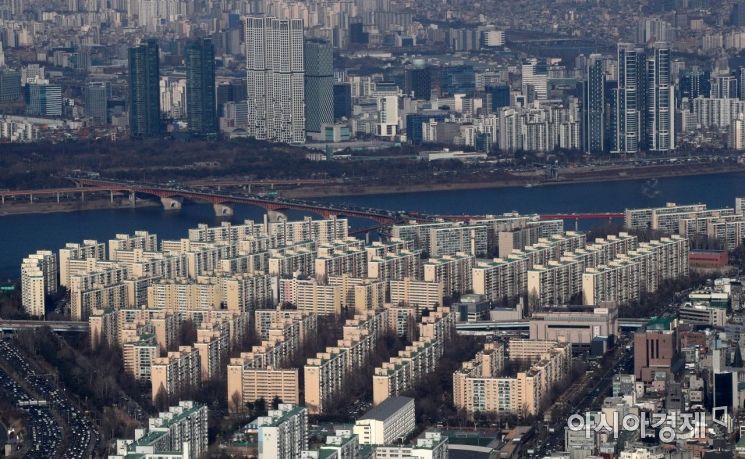
[Asia Economy Reporter Jo Gang-wook] In the first weekly apartment price survey conducted after the presidential election, prices of ultra-small apartments in Seoul turned upward. Additionally, apartment prices in the three Gangnam districts?Gangnam, Seocho, and Songpa?all stopped declining simultaneously. With growing expectations for real estate market deregulation under President-elect Yoon Seok-yeol, Seoul's housing prices are already showing signs of movement.
According to the weekly apartment price trend time series data from the Korea Real Estate Board on the 18th, in this week's survey (based on data as of the 14th), the price index change rate for apartments in Seoul with exclusive area under 40㎡ shifted from -0.03% the previous week to 0.02%, marking a rise. Ultra-small apartment prices, which had been declining for six consecutive weeks from the fifth week of January to the first week of March, were the only size category to increase within a week after the election day on the 9th. In particular, ultra-small apartments in the Gangnam area, including Seocho and Gangnam districts, and in the northwest area, including Mapo, Seodaemun, and Eunpyeong districts, turned upward from -0.01% to 0.05% and from -0.11% to 0.09%, respectively. Although the northern, central, southwestern, and southeastern areas remained negative as in the previous week, the rate of decline decreased across all these regions.
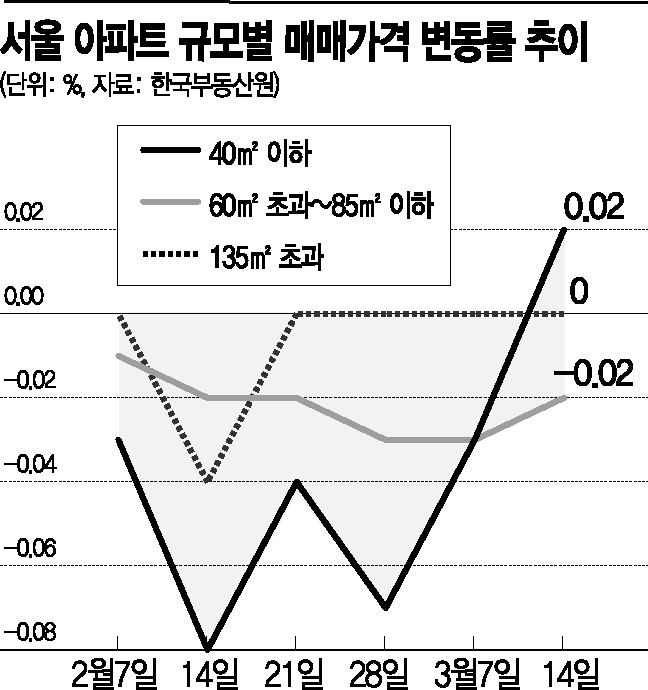
Looking at the apartment market as a whole, the atmosphere in the Gangnam area and Mok-dong has changed compared to before the presidential election. Apartment prices in Gangnam and Songpa districts, which had fallen by 0.01% last week, stabilized in this week's survey. This marks the end of a five-week decline in Gangnam and a six-week decline in Songpa. Yangcheon district, centered around the Mok-dong new town where reconstruction projects are concentrated, also halted its decline and stabilized amid expectations that safety inspection regulations will be eased. The asking price for a 66㎡ apartment in Mok-dong New Town 7th complex, which had been capped around 2 billion KRW until recently, rose to 2.1 billion KRW after the election. Additionally, the asking price for a 76㎡ apartment in Jamsil Jugong 5th complex in Songpa district, which was around 2.8 billion KRW after passing the maintenance plan in mid-last month, has jumped to 3.1 billion KRW.
Until now, apartment prices continued to decline amid a deepening "transaction cliff" caused by the current government's loan regulations and interest rate hikes. However, expectations for deregulation measures such as easing reconstruction safety inspections, improving the excess profit recovery system, increasing floor area ratios, and reducing property taxes, which were pledged by President-elect Yoon Seok-yeol, appear to have influenced the real estate market. Especially for ultra-small apartments, since their prices are relatively low and less affected by loan regulations, transactions have been smoother, leading to price increases.
Kim Hak-ryeol, head of SmartTube Real Estate Research Institute, said, "Not only ultra-small apartments but overall housing prices are expected to rise," adding, "In a situation where loans are not easy to obtain, ultra-small apartments are the properties that can be financed and purchased immediately, so price increases occurred first in this segment." He further noted, "It can be seen that the cautious sentiment that had continued since November last year changed to optimistic expectations in just about a week after the presidential election."
© The Asia Business Daily(www.asiae.co.kr). All rights reserved.













