After 20% of Overseas Population Infected, Decline Observed... Currently 2.15 Million Cumulative Cases
European Countries Ease Quarantine Measures... Cautious Discussion on Endemic Phase

[Asia Economy Reporter Ki Ha-young] The daily number of new COVID-19 cases has remained around 100,000 for a week, continuing the spread of the Omicron variant. As the government's peak forecast has expanded from '130,000 to 170,000' to '140,000 to 270,000' cases per day, analysis suggests that more than 10 million people, or 20% of the total population, must be infected with COVID-19 for the peak to subside.
Over 20% of Population Infected in the US and UK
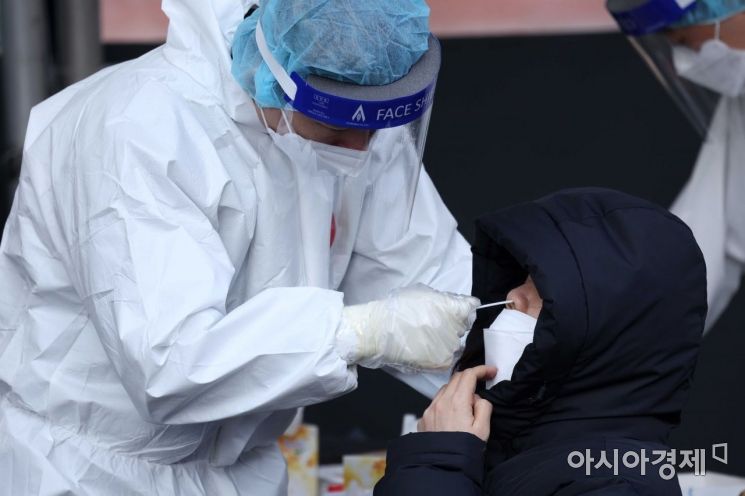
On the 22nd at midnight, the Central Disease Control Headquarters reported 99,573 new confirmed cases, bringing the cumulative total to 2,157,734. This marks a sustained level of around 100,000 new cases daily for a week since the 16th.
With expectations that new cases will increase further this week due to the spread of the Omicron variant, attention is focused on the scale and timing of the peak. However, as the Omicron variant situation changes rapidly, experts have somewhat differing predictions regarding the exact scale and timing of the peak.
In overseas countries that experienced the Omicron wave earlier, the epidemic size began to decline only after more than 20% of the population had been infected cumulatively. According to the World Health Organization (WHO) and Our World in Data, it took about three weeks from the point when Omicron became the dominant strain to the peak in the UK. After becoming dominant in the third week of December last year, the epidemic size started to decline from the second week of January. As of the 20th, the UK had about 18.65 million cumulative confirmed cases, representing 27% of its population of approximately 68.49 million. In France, it took about four weeks from dominance to peak, and in the US about five weeks. As of the 20th, the US had about 78.48 million cumulative confirmed cases, accounting for 23% of its population of approximately 334.8 million. France's cumulative confirmed cases reached about 22.34 million, or 34% of its population of approximately 65.58 million.

South Korea Expected to Reach Peak by Mid-March
In South Korea, it took seven weeks for Omicron to become the dominant strain. Based on overseas cases, since Omicron became dominant in the third week of January, it is highly likely that the peak will be reached about seven weeks later, around mid-March. Professor Jeong Jae-hoon of the Department of Preventive Medicine at Gachon University College of Medicine said on a radio broadcast the previous day, "This week will be the fastest in terms of epidemic speed," adding, "Experts say the peak will be in mid-March, but there is a point where the slope flattens like the summit of a mountain, which is estimated to be around 200,000 cases in the first week of March."
The cumulative confirmed cases in South Korea account for about 4.2% of the population of 51.62 million. Compared to overseas cases, it is estimated that about 10 to 15 million people, or 20-30% of the population, need to be infected with COVID-19 for the peak to subside. Professor Cheon Eun-mi of the Department of Respiratory Medicine at Ewha Mokdong Hospital said, "In the UK, US, and Israel, the number of confirmed cases decreased only after one-third of the population was confirmed positive," and added, "In South Korea, the number of confirmed COVID-19 cases will also need to reach one-third of the total population before it declines." She further noted, "Including asymptomatic and hidden cases, more than half of the population would need to be infected to come down from the peak."
"Endemic Status Should Be Judged Carefully"
Following the peak and entering a decline phase, countries in Europe including the UK have recently eased quarantine measures. The UK plans to abolish all legal quarantine regulations, including self-isolation, starting from the 24th (local time). However, the South Korean government, while mentioning endemicity (the disease becoming endemic), maintains a cautious stance on easing social distancing and returning to normal life since the peak has not yet been reached.
Son Young-rae, head of the Social Strategy Division at the Central Disaster and Safety Countermeasures Headquarters, said the previous day, "Due to the characteristics of Omicron, the epidemic spreads very quickly, but the severity and fatality rates are lower," adding, "It is necessary to go through at least one large wave to transition to endemicity." Jeong Eun-kyung, commissioner of the Korea Disease Control and Prevention Agency, stated, "Careful judgment is needed regarding when endemicity will occur," and continued, "As the epidemic repeats to some extent, acquiring various immunities and stabilizing the medical response system to manage COVID-19, we expect the path to normal life recovery to be accelerated."
© The Asia Business Daily(www.asiae.co.kr). All rights reserved.

![Clutching a Stolen Dior Bag, Saying "I Hate Being Poor but Real"... The Grotesque Con of a "Human Knockoff" [Slate]](https://cwcontent.asiae.co.kr/asiaresize/183/2026021902243444107_1771435474.jpg)
















