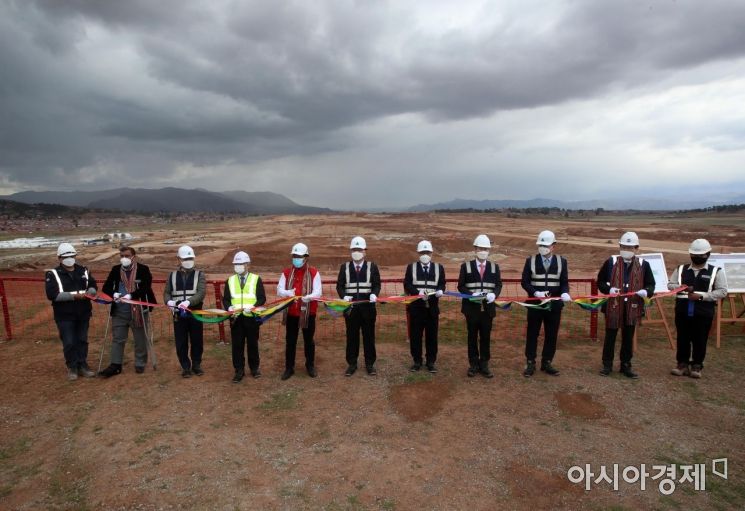
 Korea Airports Corporation and the Ministry of Land, Infrastructure and Transport held a groundbreaking ceremony on the 19th (local time) for the construction of a new airport in Chinchero City, Cusco Province, the gateway to Machu Picchu, a world-renowned tourist destination in Peru. On this day, officials from Korea and Peru are cutting the ribbon at the groundbreaking ceremony. From the second left: Luis Alberto Urubamba, Mayor; Cho Young-jun, Ambassador to Peru; Son Chang-wan, President of KAC. Also present were Roberto Sanchez, Minister of Tourism and Commerce of Peru; Yoon Young-jun, President of Hyundai Construction; Joo Jong-wan, Airport Policy Officer of the Ministry of Land, Infrastructure and Transport; and Kim Yong-gu (third from the right), President of Dohwa Engineering. / Photo by Airport Photographers Group
The government has selected seven major projects to boost export performance in airport development and operation businesses, and will intensively monitor their progress while providing financial and manpower support.
On the 14th, the Ministry of Land, Infrastructure and Transport announced that it had prepared this "Airport Overseas Export Promotion Plan" after gathering opinions from industry and experts and discussing it at the Aviation Policy Committee.
The government has been supporting activities such as managing major overseas projects and dispatching high-level bidding support teams to secure overseas airport development contracts, which is considered the third major infrastructure market following railroads and roads. As a result, last year saw achievements such as signing an infrastructure memorandum of understanding for the new airport development in Poland (February), securing operating rights for Manta Airport in Ecuador (April), winning the Luang Prabang Airport development project in Laos (May), winning the construction contract for the new Chinchero Airport terminal in Peru (July), and signing a contract for the operation and development of Batam Airport in Indonesia (December).
However, while there is a comparative advantage in airport operation and technical capabilities, it was found that improvements are needed in areas such as business model establishment and manpower training. Accordingly, the government decided to implement the airport export promotion plan under four major frameworks: ▲ selection and management of major airport projects ▲ strengthening support for project discovery and planning ▲ securing a dedicated support system ▲ building cooperative systems and manpower training.
First, considering the economic effects and likelihood of winning contracts, the new airport in Poland, planned as the largest multimodal transport hub in Eastern Europe, and Long Thanh New Airport, the largest airport project in Vietnam, were selected as the two core projects. Additionally, the new Chinchero Airport in Peru, Batam Airport in Indonesia, Kuwait Airport, Manta Airport in Ecuador, and Luang Prabang Airport in Laos were designated as five key management projects.
The government will expand the Overseas Airport Development Promotion Council, which currently operates on a semi-annual basis, to a monthly working-level council at the director level for these projects. Through this, issues for each project will be discussed regularly and the latest trends and information will be shared promptly.
Considering the characteristics of export markets, differentiated strategies will be established and implemented. In emerging markets such as Asia and the Middle East, where passenger numbers have increased post-COVID-19 and development demand is high, focus will be on new airport development projects such as investment and development or construction projects, as well as securing contracts for entrusted operations. Meanwhile, for relatively mature markets like Europe, efforts will focus on pioneering new markets in Eastern Europe and selectively considering equity acquisitions mainly in medium to large airports in Western Europe that are operating stably.
The roles of Incheon International Airport Corporation and Korea Airports Corporation have also been clearly defined. Incheon International Airport Corporation will leverage its strengths in operating large airports to focus on equity acquisitions and investment development projects in advanced countries, while Korea Airports Corporation will concentrate its capabilities on developing small to medium-sized airports in emerging countries such as those in Asia.
Centered on the core and key management projects, the government plans to dispatch high-level bidding support teams and strengthen contract support activities by expanding government-to-government (G2G) contracts through online bilateral meetings at ministerial and vice-ministerial levels. Considering the characteristics of airport development projects, which often involve large-scale public-private partnerships (PPP) or equity investment structures, specialized financial structures will also be established. For example, preferential financial conditions such as interest rates and limits will be offered for public-private joint ventures, and the scale and scope of feasibility study (F/S) support will be expanded.
Additionally, a public-private "airport network" will be established through channels such as the Overseas Infrastructure Cooperation Center, the Overseas Construction Association, and local chambers of commerce. Exchanges of personnel and joint participation in overseas projects with global airport operators and developers will be expanded. Reforms to the education system for training highly skilled technicians and the introduction of qualification and certification systems will also be considered.
A Ministry of Land, Infrastructure and Transport official stated, "This measure aims to turn the overseas airport sector into a new opportunity for economic growth in the post-COVID-19 era."
© The Asia Business Daily(www.asiae.co.kr). All rights reserved.












