Decision on Extension of Fuel Tax Reduction to Be Made Next Month
 Due to the rise in international oil prices, gasoline prices at gas stations in Seoul have increased for the fourth consecutive week, with prices exceeding 2,000 won on the 17th. Photo by Yoon Dong-ju doso7@
[Asia Economy Reporter Oh Hyung-gil] As international oil prices surge sharply, domestic petroleum product prices are soaring again. There are concerns that the effect of the fuel tax reduction, set to end in April, will soon disappear.
According to the Korea National Oil Corporation on the 13th, the retail price of gasoline at gas stations in the second week of this month was 1,691.8 KRW per liter, an increase of 24.2 KRW compared to the previous week.
Domestic fuel prices have been on the rise since the third week of last month due to the increase in international oil prices. Until last week, the increase was in the 10 KRW range, but this week it exceeded 20 KRW.
The Korea National Oil Corporation explained that international oil prices are rising due to concerns over the conflict between Russia and Ukraine, and the domestic fuel price increase trend is expected to continue for the time being.
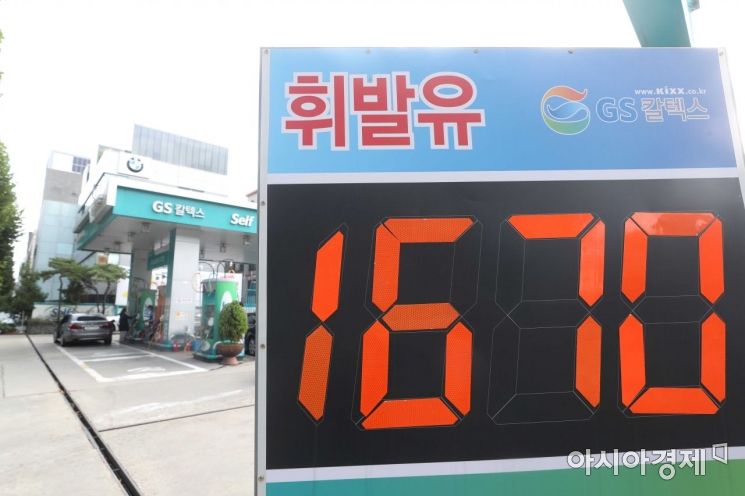 As international oil prices rise, gasoline prices at gas stations nationwide are also soaring. A gas station in downtown Seoul on the 12th. Photo by Mun Ho-nam munonam@
Currently, the government is implementing a temporary 20% reduction in fuel tax on gasoline, diesel, and LPG butane.
This is the largest reduction ever in the history of fuel tax cuts. Assuming the 20% fuel tax cut is fully reflected in consumer prices, the price of gasoline would decrease by 164 KRW per liter. Diesel prices would drop by 116 KRW, and LPG butane would be reduced by 40 KRW.
When the government implemented the fuel tax cut in the second week of November last year, the average price of Dubai crude oil, which serves as the benchmark for imported crude oil, was 82.5 dollars.
However, with the recent rise in international oil prices, the effect of the fuel tax cut is expected to disappear.
The average price of Dubai crude oil in the first week of this month rose to 87.9 dollars, and especially on the 7th, the spot price of Dubai crude oil (based on the Singapore Exchange) soared to 90.91 dollars per barrel, and on the 11th it recorded 90.25 dollars.
International oil prices have surpassed the level at the time of the fuel tax cut. Considering that domestic gas station gasoline prices usually follow international oil prices with a lag of 2 to 3 weeks, additional price increases are expected within this month.
The government plans to monitor international oil price trends and consider extending the fuel tax reduction if necessary. The fuel tax cut requires a revision of the enforcement decree. Considering the revision process, the decision on whether to extend it is expected to be made by the end of next month.
© The Asia Business Daily(www.asiae.co.kr). All rights reserved.

![Clutching a Stolen Dior Bag, Saying "I Hate Being Poor but Real"... The Grotesque Con of a "Human Knockoff" [Slate]](https://cwcontent.asiae.co.kr/asiaresize/183/2026021902243444107_1771435474.jpg)















