"Joseonjok Dongpo Culture and Clothing Also Have the Right to Be Respected"
"China Must Stop Cultural Hegemony and Historical Distortion"

[Asia Economy Reporter Lim Juhyung] At the opening ceremony of the 2022 Beijing Winter Olympics, a woman appeared wearing a traditional costume presumed to be Hanbok, sparking the so-called 'Hanbok Gongjeong' controversy. While presidential candidates have raised concerns, saying they "oppose cultural gongjeong," Kang Minjin, leader of the Youth Justice Party, pointed out that "we need to think from the perspective of our compatriots living as Chinese citizens."
In a post on her Facebook on the 5th, Kang said, "There are indeed our compatriots who hold Chinese nationality and live within Chinese territory."
She continued, "Hanbok is not only ours but also belongs to our compatriots, and the Joseonjok compatriots living as Chinese citizens also have the right to have their culture and clothing respected by the state."
She then asked, "If Hanbok had been excluded among the various ethnic costumes of China, how would it have felt from the perspective of the compatriots living in China?"
However, she added, "I think this incident is a sensitive issue in the context of China's repeated historical distortion controversies," and criticized, "China must stop cultural hegemony and historical distortion, such as claiming that Hanbok originated from Hanfu."
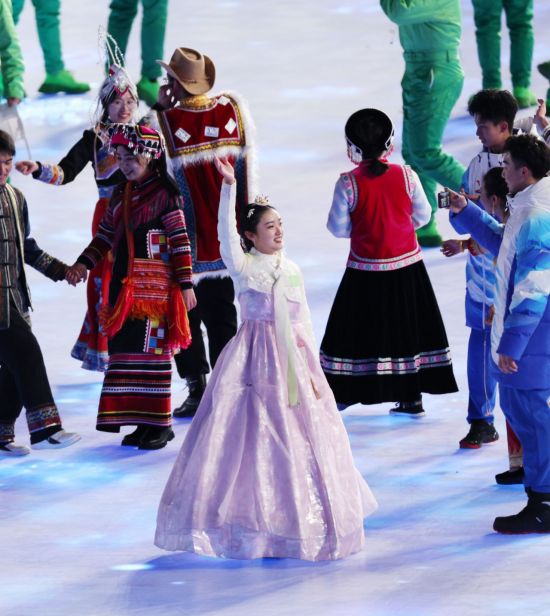 On the 4th (local time), at the National Stadium in Beijing, China, during the opening ceremony of the 2022 Beijing Winter Olympics, a performer wearing a hanbok is waving their hand. / Photo by Yonhap News
Kang emphasized, "South Korea is gradually transforming into a multicultural society. I hope that in the future, we too can become a highly inclusive country where various ethnic groups can live with their cultures respected."
The 'Hanbok Gongjeong' controversy arose during the 'Ordinary Citizens' National Flag Delivery' event at the Beijing Winter Olympics opening ceremony on the 4th (local time).
This event was conducted by members of 56 ethnic minorities in China delivering a huge Five-star Red Flag, and at this time, a woman who appeared as a representative of a minority group wore Hanbok, causing issues. Netizens pointed out that Hanbok, Korea's unique traditional clothing, could be mistaken as part of Chinese minority culture.
Regarding this, Professor Seo Kyungdeok of Sungshin Women's University also pointed out on his Facebook on the 5th that it was "China's cultural Northeast Project," urging, "We need to clearly identify what is wrong. Instead of just being angry, we should widely inform the world of the truth that Hanbok is Korea's traditional costume."
Presidential candidates also expressed concerns. Lee Jae-myung, the Democratic Party presidential candidate, posted a brief phrase on Facebook saying, "Do not covet culture. Oppose cultural gongjeong," and Ahn Cheol-soo, the People's Party candidate, repeatedly emphasized, "I tell the Chinese authorities: It is Hanbok, not Hanfu. Hanbok is Korean culture."
© The Asia Business Daily(www.asiae.co.kr). All rights reserved.













