Rose Prices Double... Supply Decreases Due to Cold Wave
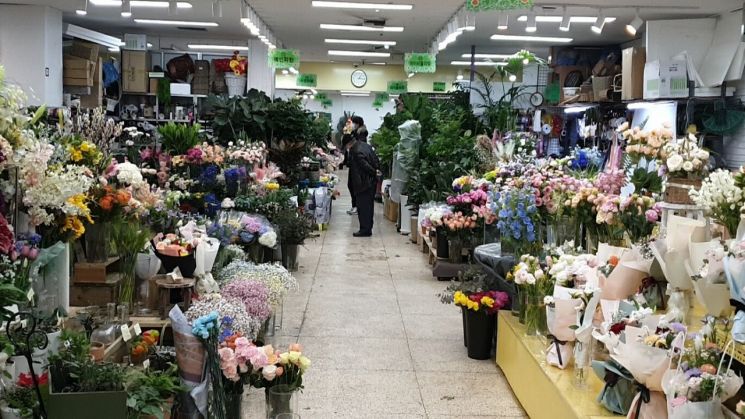 On the afternoon of the 11th, a customer is purchasing flowers at the flower market in Yangjae-dong, Seocho-gu, Seoul.
[Asia Economy Reporter Lim Chun-han] "I've heard that flower prices have gone up, but they are really expensive. Fresh flowers cost at least 50,000 won, so I couldn't buy any. But I can't just skip the graduation ceremony, so I'm trying to find a cheaper place online."
Due to the impact of COVID-19, graduation ceremonies have been moved up from February to January, causing flower bouquet prices to soar. The price of roses has doubled, making it necessary to pay at least 50,000 won to get a bouquet for the graduation ceremony.
On the afternoon of the 11th, a merchant named Jo at the Yangjae Flower Market in Seocho-gu, Seoul, said, "Because flower prices are high, customers have dropped sharply. In the past, people lined up to buy flowers during graduation season, but now there are no customers at all," sighing. Cut flowers used in bouquets have their stems and leaves trimmed and last less than a week, so if merchants buy them but cannot sell them, they incur losses. Since COVID-19, household flower consumption has decreased, leading merchants to reduce their purchases continuously. Additionally, a cold wave reduced supply, causing prices to surge.
According to the Korea Agro-Fisheries & Food Trade Corporation (aT), the average auction price for one bunch (10 stems) of cut roses at the aT Flower Auction Market in Yangjae-dong, Seoul, from the 1st to the 10th of this month was 14,884 won. Considering that the average price for one bunch of roses during the same period last year was 8,176 won, the price has roughly doubled. Consequently, retail flower shops raised the price of bouquets from the previous 30,000 won range to 50,000 won, and those previously priced at 50,000 won rose to 70,000 won.
The reason for the sharp rise in flower prices from the beginning of the year is that demand increased while supply decreased. Most graduation ceremonies, which used to be held in early February, were moved up, causing a surge in flower demand in January. According to a survey by the Ministry of Agriculture, Food and Rural Affairs on the graduation schedules of over 5,800 elementary, middle, and high schools nationwide, about 2,200 schools, nearly 40%, held graduation ceremonies from late December to January 14. A representative from the aT Flower Auction Market said, "Since last month, the weather has become sharply colder, temporarily reducing domestic production. Overseas, farms have closed due to labor shortages caused by COVID-19, leading to an overall decrease in imports. Along with the surge in flower demand for graduation ceremonies, prices have risen."
Kim, who has been in the flower business for 30 years, said, "Compared to before, flower supply has decreased and prices have risen, so we cannot keep much inventory. I was looking forward to the graduation season, but prices have risen so much that even customers who visit the store after a long time leave empty-handed after much hesitation, which worries me."
© The Asia Business Daily(www.asiae.co.kr). All rights reserved.












