Possibility of Partial Allocation for Exclusive Routes
Top Preferred Route Gimpo-Haneda
Considered a Golden Route for Business Use
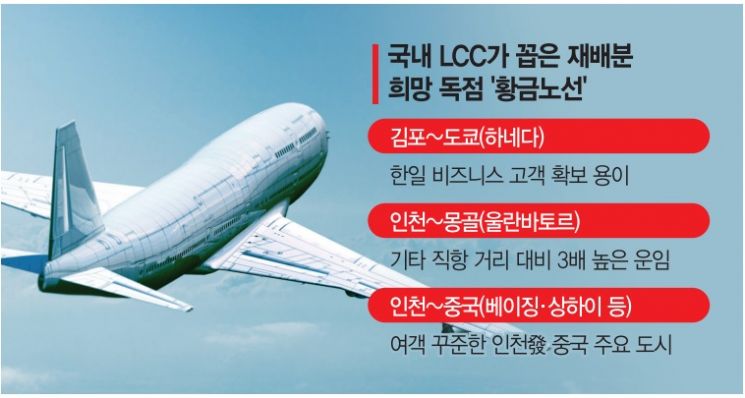
Domestic low-cost carriers (LCCs) are calculating strategies to secure traffic rights for monopoly routes that are set to be redistributed following the conditional merger of Korean Air and Asiana Airlines. The regions of interest for LCCs are major Asian areas such as Japan and China, which are currently monopolized by large airlines. This is based on the judgment that they can achieve maximum effect at a lower cost compared to European and American routes, which require new investments such as securing medium-to-large aircraft.
On the 31st, a survey was conducted among major domestic LCCs (Jeju Air, Jin Air, T’way Air, Air Busan, Air Seoul, Fly Gangwon, Air Premia, and Air K) regarding their preferred routes for redistribution, with the Gimpo-Haneda (Tokyo) route being the most frequently selected.
This route is a ‘non-liberalized’ air route that requires traffic rights allocated by the government to airlines in order to operate. Currently, Korean Air and Asiana Airlines operate it with 100% monopoly. The advantage of the Gimpo-Haneda route is its easy accessibility to Seoul. Although the flight distance is similar to the Incheon-Narita route at about 2 hours and 10 minutes, its proximity to Seoul makes it highly popular among business customers traveling between Korea and Japan.
The Incheon-Mongolia (Ulaanbaatar) route is also considered a valuable route. Currently, it is monopolized by large airlines and Air Busan (departing from Busan). Ulaanbaatar is about 3 hours and 40 minutes direct flight from Incheon, a distance similar to Hong Kong. According to the Ministry of Land, Infrastructure and Transport, the Incheon-Ulaanbaatar route had an air passenger volume of approximately 392,000 between the two countries in 2019, before the COVID-19 outbreak, recording an average annual growth rate of 6.8% from 2015 to 2019. Especially due to seat restrictions, the peak season load factor reaches 90%, causing a chronic shortage of air tickets and fares that are more than twice as high compared to other routes of similar distance.
Major Chinese routes such as Incheon-Beijing and Shanghai are also attracting attention. These routes have the advantage of securing stable tourist and business customers between the two countries. The industry hopes for redistribution this time because the Chinese government restricts route permissions to curb the expansion of Incheon Airport by limiting the passenger demand of its nationals. The routes preferred by LCCs for redistribution have short flight times, allowing operation with currently owned short-haul aircraft to minimize additional costs.
Additionally, carriers with medium-to-long-haul aircraft have expressed interest in European routes. T’way Air plans to secure traffic rights for European routes starting with flights to Croatia using the Airbus A330-300. Air Premia also hopes for redistribution of major routes such as Paris and London.
An LCC industry official said, "We hope that the redistribution of major routes monopolized by large airlines so far will become an opportunity to restructure the domestic aviation industry."
© The Asia Business Daily(www.asiae.co.kr). All rights reserved.












