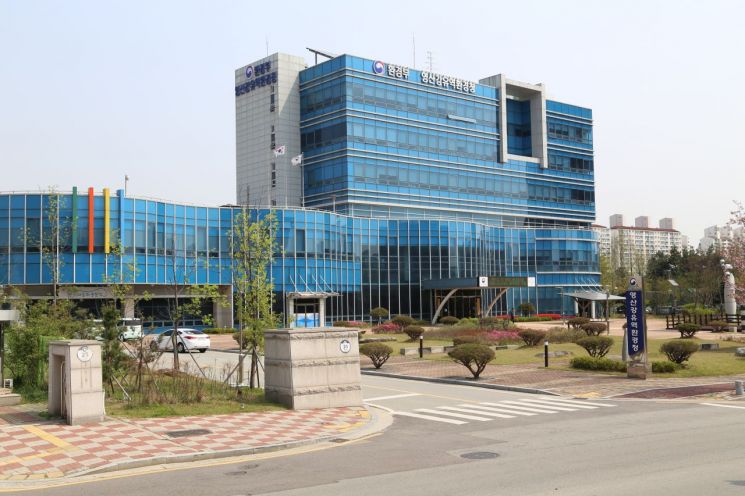
[Asia Economy Honam Reporting Headquarters Reporter Park Jin-hyung] The Yeongsan River Basin Environmental Office (Director Ryu Yeon-gi) announced on the 28th that “through scientific analysis and verification, it has been identified that the ammonia nitrogen in the discharged water from Gwangju No.1 Sewage Treatment Plant is the main cause of water quality deterioration in the Yeongsan River.”
The Yeongsan River has a short river length and a watershed area about 1/8 that of the Han River, resulting in consistently insufficient river flow. In spring and autumn, approximately 70% of the main stream flow of the Yeongsan River consists of discharged water (720,000 m³/day) from Gwangju Sewage Treatment Plants (No.1 and No.2), making its water quality the worst among the five major rivers.
Regarding water quality, Damyang, located at the uppermost stream of the Yeongsan River, maintains first-grade water quality, but it deteriorates to fourth-grade as it passes through Gwangju Metropolitan City upstream, then somewhat recovers to third-grade after passing through Naju in the midstream, showing a somewhat unusual trend. In particular, in the upper stream section passing through Gwangju No.1 Sewage Treatment Plant, the BOD level sharply rises to about 7.4 ppm.
The Yeongsan River Basin Environmental Office, through a series of processes including actual investigations and research over two years from last year to this year, and scientific verification, revealed that the high discharge of ammonia nitrogen due to structural factors of Gwangju No.1 Sewage Treatment Plant is one of the causes of water quality deterioration in the Yeongsan River.
In the first year (2020), to identify the cause of water quality deterioration, about 50 employees from five departments of the office collected and analyzed river water day and night to understand changes in river water quality. In the second year (2021), through scientific verification (outsourcing), it was confirmed that the ammonia nitrogen (NH3-N) concentration in the discharged water from Gwangju No.1 Sewage Treatment Plant was high (average 6.4 mg/L). Especially, at Geungnakgyo Bridge located 1 km downstream from the sewage treatment plant, ammonia nitrogen accounted for 73% of total nitrogen (T-N).
The Yeongsan River, with its consistently insufficient flow, experiences nitrification* of the high ammonia nitrogen (NH3-N) entering the river, which consumes a large amount of oxygen and acts as a major cause of increased BOD.
The reason for the high ammonia nitrogen discharge from Gwangju No.1 Sewage Treatment Plant appears to be due to the 2008 process of advanced sewage treatment system upgrades, where the size of the aeration tank was halved and the anaerobic and anoxic tanks were increased. While the total nitrogen (T-N) concentration improved, the insufficient retention time in the aeration tank led to an increase in ammonia nitrogen.
To address this, the Yeongsan River Basin Environmental Office has sought understanding and cooperation from Gwangju Metropolitan City and nearby local governments, and through multifaceted efforts, strengthened and announced the total nitrogen water quality standard for discharged water from Gwangju No.1 Sewage Treatment Plant to half the current level (from 20 to 10 mg/L) on December 29, 2021. This standard is expected to be applied starting in 2027, when the sewage treatment plant improvement project is completed.
Gwangju City plans to carry out the sewage treatment plant improvement project over about four years (2023?2027) to comply with the strengthened and announced discharge water quality standards.
This improvement project will be implemented at the planned third-stage site of Gwangju No.1 Sewage Treatment Plant, including expansion of biological reactors (such as aeration tanks) and improvement of existing facilities, with a total project cost of approximately 150 billion KRW.
Ryu Yeon-gi, Director of the Yeongsan River Basin Environmental Office, expressed gratitude to Gwangju Metropolitan City for their responsible efforts to improve the water quality of the Yeongsan River despite local financial burdens and difficulties in nitrogen treatment, stating, “We plan to strive to secure as much national funding as possible for the Gwangju No.1 Sewage Treatment Plant improvement project and other financial support, and we expect that once the facility improvements are completed in 2027, the water quality and aquatic ecosystem health of the Yeongsan River will be greatly enhanced”.
© The Asia Business Daily(www.asiae.co.kr). All rights reserved.












