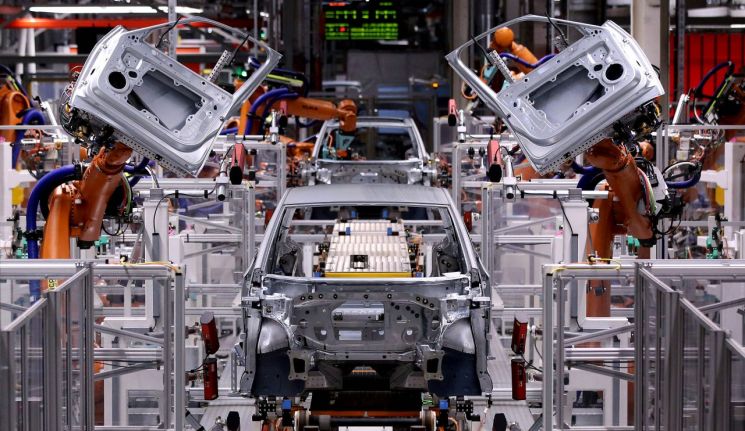
[Asia Economy Reporter Park Byung-hee] As Europe transitions to the electric vehicle era, concerns are rising that hundreds of thousands of job losses will occur in the automotive industry sector. Europe's largest automaker Volkswagen announced on the 10th (local time) that it would increase its investment in the electric vehicle sector from the existing 35 billion euros to 52 billion euros, an increase of 17 billion euros, triggered by conflicts between management and labor unions over layoffs.
Recently, the European Association of Automotive Suppliers (CLEPA) estimated that if the transition to an electric vehicle system banning the sale of internal combustion engine vehicles after 2035 proceeds as planned by the EU, 501,000 people could lose their jobs in the European automotive sector.
On July 14, the European Commission announced the carbon emission reduction plan "Fit for 55," aiming to reduce greenhouse gas emissions to 55% of 1990 levels by 2030, and stated that the sale of internal combustion engine vehicles would only be allowed until 2035.
CLEPA pointed out that two-thirds of the 500,000 jobs to disappear will vanish within five years, emphasizing the need to prepare measures to cope with the social and economic shocks caused by large-scale unemployment. CLEPA represents more than 3,000 automotive parts suppliers in Europe.
Consulting firm PricewaterhouseCoopers (PwC) also pointed out that large-scale job losses are inevitable. However, since new jobs will also be created due to the transition to electric vehicles, the scale of job reduction is not as large as CLEPA estimates. PwC stated that 226,000 new jobs will be created in the electric vehicle manufacturing sector, estimating a net job loss of 275,000 over the next 20 years.
Executives in the automotive industry argue that investment is inevitable for the transition to the electric vehicle system, and therefore layoffs are necessary to reduce costs.
Carlos Tavares, CEO of Stellantis, said at a conference on the 8th, "The speed of transition to electric vehicles is pushing the automotive industry to the limit," adding, "The cost of developing new technologies could cause significant losses."
Volkswagen decided to increase investment in the electric vehicle sector to maintain employment as much as possible. Volkswagen CEO Herbert Diess argues that cost reduction is necessary to compete with electric vehicles such as Tesla. Diess's statement that employment should be reduced by up to 30,000 due to the transition to the electric vehicle system provoked the labor union, leading to weeks of conflict between Diess and the union. As a result, a compromise was reached to increase investment in the electric vehicle sector, including producing the representative electric vehicle model 'ID.3' at the Wolfsburg plant.
Germany's largest automotive parts supplier Continental stated that policies creating new job opportunities for those working in the fossil fuel industry must accompany climate change response policies; otherwise, social consensus could be jeopardized. Arian Reinhardt, director at Continental, said, "Not only accelerating the transition (to eco-friendliness) but also preventing large-scale unemployment are necessary conditions for responding to climate change."
© The Asia Business Daily(www.asiae.co.kr). All rights reserved.











