3~5% Level Silicon Content Increase Competition
SK to Mass-Produce Silicon Anode Materials with 'Group 14' Domestically from Next Year
[Asia Economy Reporter Hwang Yoon-joo] The domestic battery industry is intensifying efforts to develop silicon anode materials. As the Chinese battery industry, backed by absolute support from its government, expands its market share mainly with low-cost products, the domestic battery industry is interpreted as adopting a strategy to counter with high-capacity, long-life, and high-safety technologies.
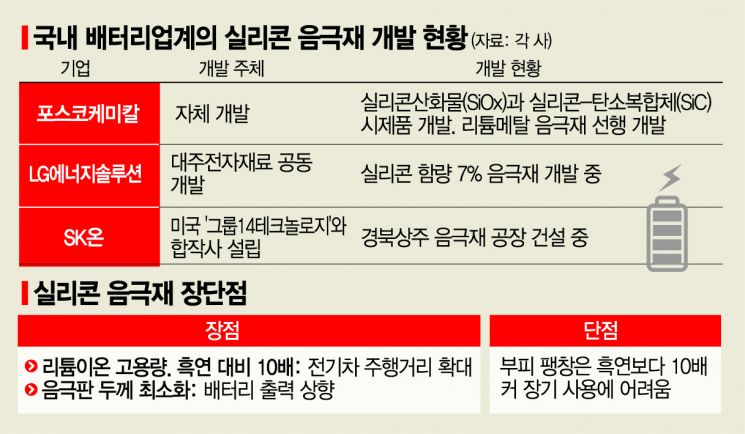
According to the industry on the 6th, the competition in battery materials, which has so far focused on cathode materials, is recently expanding to the development of anode materials with increased silicon content. This is because silicon can hold up to 10 times more lithium ions than graphite, making it a key material for next-generation batteries. The more lithium ions it can hold, the longer the driving range. Additionally, using silicon allows the existing anode substrate to be thinner, which can increase battery output. However, there are technical challenges. The volume expansion caused by charging and discharging is about 10 times greater than graphite, limiting long-term use, and the reactivity with the electrolyte also affects battery safety. This is why battery companies currently keep the silicon anode material content at around 3-5%.
The expected rapid growth of the silicon anode material market is also driving increased investment. According to SNE Research, the demand for silicon anode materials is expected to grow at an average annual rate of about 70% until 2025. The market size, which is only 4,000 tons this year, is expected to grow to more than 200,000 tons by 2030.
Posco Chemical is moving quickly in technology development. The company has completed demo development of next-generation silicon anode materials, ‘silicon oxide (SiOx)’ and ‘silicon-carbon composite (SiC)’ anode materials. It is currently conducting research on finished products and commercialization, and is also developing lithium metal anode materials, a precursor to all-solid-state batteries, centered at the group’s secondary battery materials research center.
SK Group is showing the most aggressive investment. Last month, SK Materials, together with the US-based Group14 Technologies, began construction of a silicon anode material factory in Sangju, Gyeongbuk, and plans to start commercial production in 2022. The silicon anode materials produced by SK and Group14 have succeeded in minimizing volume expansion. Because of this, evaluations are underway from more than 30 customers, including battery manufacturers as well as electric vehicle, home appliance, and IT companies.
LG Energy Solution, which has succeeded in commercializing silicon anode materials, continues to invest in technology development to increase the silicon ratio. Previously, the company supplied silicon anode materials for the German Porsche electric vehicle model ‘Taycan’ in 2019 in collaboration with Daewoo Electronic Materials. LG Energy Solution is known to maintain a certain proportion of silicon anode material mass production at its battery joint venture being built with GM in the United States.
An industry insider said, "Battery technology must be supported by material technologies such as silicon anode materials," adding, "As high-nickel cathode and silicon anode material technologies improve, it will lead to a battle over all-solid-state batteries, so each company is focusing on material development."
© The Asia Business Daily(www.asiae.co.kr). All rights reserved.











