Resolution on Partial Amendment Bills of the Special Education Act and the Scholarship Foundation Act
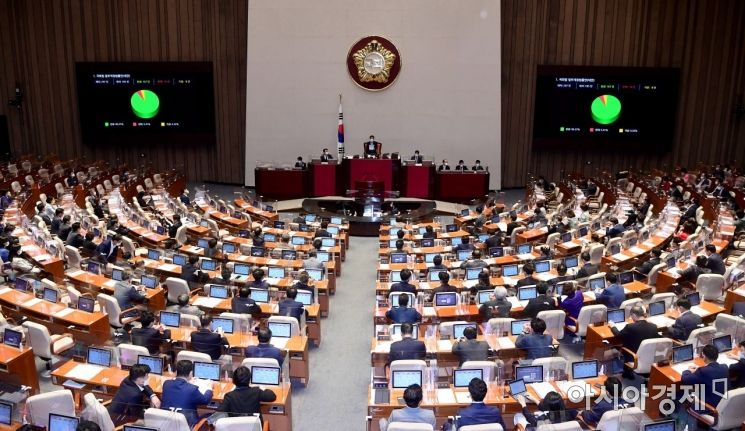 On the 28th, during the plenary session held at the National Assembly, the amendment to the National Assembly Act to establish a branch of the National Assembly building in Sejong City was passed. Photo by Yoon Dong-ju doso7@
[Asia Economy Reporter Han Jinju] Seven bills, including the amendment to the Special Education Act allowing the lowering of class installation standards for students with severe disabilities and the amendment to the Korea Student Aid Foundation Establishment Act to ease interest burdens on high-interest student loan borrowers, have passed the National Assembly.
On the 2nd, the Ministry of Education announced that seven bills, including amendments to the Special Education Act, the Student Aid Foundation Establishment Act, the School Health Act, the School Meals Act, the Education Environment Protection Act, the Education Facilities Act, and the Local Finance Grant Act, were approved at the plenary session of the National Assembly.
The amendment to the Special Education Act allows the class installation standards by school level to be lowered by up to half for classes where students with two or more disabilities and severe disabilities are placed. It enables the provision of customized therapeutic support considering the type and severity of disabilities of special education students.
For disabled university students, university heads are required to provide accommodations such as audio description, closed captions, or sign language interpretation for videos used during classes, and to stipulate specific matters necessary for supporting disabled students' learning in the school regulations.
The amendment to the Korea Student Aid Foundation Establishment Act expands the low-interest refinancing loan to include borrowers who took out high-interest student loans in 2012. Currently, refinancing loans are only provided to borrowers up to 2009, but this will be extended to those who borrowed in 2012. Additionally, from 2023, learners in the credit bank system will also be eligible for student loan support and other financial aid.
The amendment to the School Health Act adds prevention of smartphone and internet overdependence and gambling addiction to the health education conducted in schools, and sets the frequency of environmental hygiene and food hygiene inspections to twice a year. It also includes provisions for regular inspections of air quality measuring equipment inside school buildings at least twice a year.
The amendment to the School Meals Act allows education offices and support offices to appoint nutrition teachers to support meals in small-scale kindergartens, thereby strengthening health management for young children. In case of disasters making meal provision difficult, the superintendent of education can provide food ingredients to students' homes after deliberation by the school meal committee.
The amendment to the Education Environment Protection Act requires that when the superintendent of education approves an education environment assessment report submitted by a maintenance project implementer, they must collect opinions from the principals of schools in the education environment protection zone and provide the report to the city/provincial education environment protection committee for review.
The amendment to the Education Facilities Safety and Maintenance Act mandates an annual survey on the installation status of fire facilities and access routes for fire trucks at educational facilities. It includes infection prevention in the safety and maintenance standards for educational facilities. It also provides psychological treatment support for students, staff, and their families affected by educational facility safety accidents and includes this within the scope of the Korea Educational Facilities Safety Institute's projects.
The Local Education Finance Grant Act expands the entities eligible to transfer funds to the special education expense account of city/provincial education offices from metropolitan local governments ("si/do") to include basic local governments ("si/gun/gu") as well.
© The Asia Business Daily(www.asiae.co.kr). All rights reserved.











