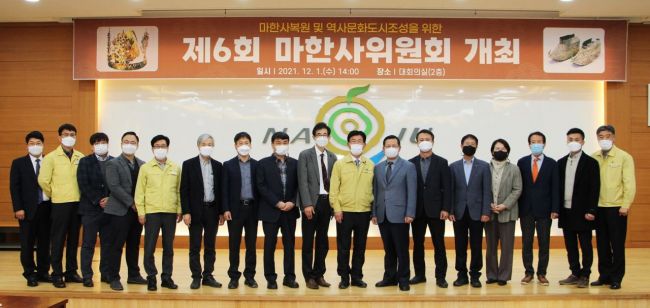
[Naju=Asia Economy Honam Reporting Headquarters Reporter Kim Yukbong] Jeollanam-do Naju City (Mayor Kang In-gyu) announced on the 2nd that it held the ‘6th Meeting of the Mahan History Committee’ of the Naju Citizens’ Public-Private Joint Committee and the ‘Naju Mahan Historical and Cultural Survey, Research, and Maintenance Plan Results Report Meeting’ in the main conference room of the city hall on the 1st.
At the meeting, discussions were held by the committee on the overall survey of Mahan cultural zone relics distributed in the Naju area, deriving maintenance and restoration strategies based on the Mahan history SWOT analysis, inter-regional cooperation, and utilization plans in the tourism sector through a presentation by the Baekje Culture Research Institute of Kongju National University.
Also attending were Mayor Kang In-gyu, the standing chairman of the public-private joint committee, Im Young-jin, director of the Mahan Research Institute and co-chairman of the Mahan History Committee, Park Joong-hwan, former curator at the Ministry of Culture, Sports and Tourism, Eun Hwa-soo, director of the National Naju Museum, Professor Jeong Jae-yoon of the History Department at Kongju National University, and Professor Lee Gye-han of the Forest Resources Department at Chonnam National University.
Co-chairman Park Joong-hwan said, “The city has been proactively re-examining Mahan history more than any other region and has been dedicated to research and restoration work for the revival of Mahan history from 1,500 years ago through the Mahan History Committee,” adding, “I hope the results report meeting will serve as a guideline for the next government’s Mahan history restoration policy.”
Professor Jeong Jae-yoon of Kongju National University, who gave the presentation, explained the research results, saying, “This is a study highlighting why the Mahan historical and cultural zone is important and why the restoration of Mahan history should be centered on Naju,” and “Through analysis of related cases and papers and a survey of all relics in the Naju area, detailed maintenance plans, priorities for relic excavation, and a focus on the excavation of Mahan national administrative centers were derived.”
Professor Jeong identified the strengths of the Naju Mahan cultural zone through SWOT analysis as “various Mahan relics and artifacts” and “unique types of tombs such as tumuli and jar coffins,” while weaknesses included “low awareness of Mahan culture” and “insufficient linked development and formation among Mahan relics.”
He selected “enforcement of the Special Act on the Maintenance of Historical and Cultural Zones” and “the rich potential of Mahan culture” as opportunity factors, while pointing out “lack of educational opportunities for local residents” and “absence of inter-regional cooperative systems” as threats.
Furthermore, he emphasized the need for a basic preservation and management plan for each relic through a full survey of Naju area Mahan relics such as tumuli, mountain fortresses, and stone chambers, as well as the expansion of maintenance and academic investigations focusing on unexamined designated cultural properties, and if necessary, rescue and recovery excavations followed by preservation measures.
He designated the ‘Bannam Tumuli Cluster,’ ‘Bokam-ri Tumuli Cluster,’ and ‘Oryang-dong Kiln Site’ as core Mahan historical relics and presented plans for maintenance and activation measures such as discovering experiential content tailored to the characteristics of each relic.
In addition, he proposed utilizing Mahan-related facilities such as the National Naju Museum and Naju Bokam-ri Tumuli Exhibition Hall, promoting inter-regional cooperation within the Mahan cultural zone, and plans for promotion and tourism revitalization linking food, sights, experiences, and shopping.
Professor Jeong said, “According to a tourist survey, there is a need for access to various cultural contents that appeal to the public, such as education and historical and cultural experience content focused on securing family visitor stay time,” and “The Mahan Cultural Festival, which has proven competitive as a historical and cultural festival, should continuously discover differentiated content.”
After the presentation, the Mahan History Committee suggested through discussion the discovery of ‘non-face-to-face tourism platforms’ reflecting social changes after COVID-19, ‘creation of physical spaces themed on Mahan’s socio-cultural storytelling,’ and ‘establishment of plans aligned with the basic plan of the Special Act on the Maintenance of Historical and Cultural Zones.’
Chairman Park Joong-hwan attracted attention by proposing, “In the globally popular Netflix drama ‘Hellbound,’ ‘Sodo’ appears, and there was a system in the Mahan society relics where people who committed crimes went there, and criminals could not be caught,” adding, “Reinterpreting and utilizing such aspects in a modern way to develop spaces and content where tourists can heal their mind and body is also a good method.”
Mayor Kang In-gyu said, “The Cultural Heritage Administration is currently establishing a basic plan according to the Special Act on the Maintenance of Historical and Cultural Zones,” and “In line with this, I ask for the boundless wisdom and advice of the Mahan History Committee so that the Mahan historical and cultural survey research and maintenance plan promoted by our city can have completeness and executability and be included in the presidential election national agenda.”
Naju=Asia Economy Honam Reporting Headquarters Reporter Kim Yukbong bong2910@asiae.co.kr
© The Asia Business Daily(www.asiae.co.kr). All rights reserved.

![Clutching a Stolen Dior Bag, Saying "I Hate Being Poor but Real"... The Grotesque Con of a "Human Knockoff" [Slate]](https://cwcontent.asiae.co.kr/asiaresize/183/2026021902243444107_1771435474.jpg)














