5 Major Banks' Household Loans in November Increase by 2.36 Trillion Won
Noticeable Decrease in Growth Compared to Previous Month
Jeonse Loan Growth Remains Amid Housing Shortage
'Corona Survival' Self-Employed Loans Near 300 Trillion Won
[Asia Economy Reporters Sunmi Park and Hyojin Kim] As loan management in the banking sector tightens and interest rates rise, household loans at the five major banks increased by just about 2 trillion KRW last month. In contrast, jeonse loans, which are exempt from total volume restrictions, showed an increase similar to previous months.
It was found that loans related to companies and self-employed individuals struggling with prolonged COVID-19 difficulties surged as they relied on debt for survival. With additional base rate hikes expected next year following last month, borrowers' interest burdens are projected to increase further.
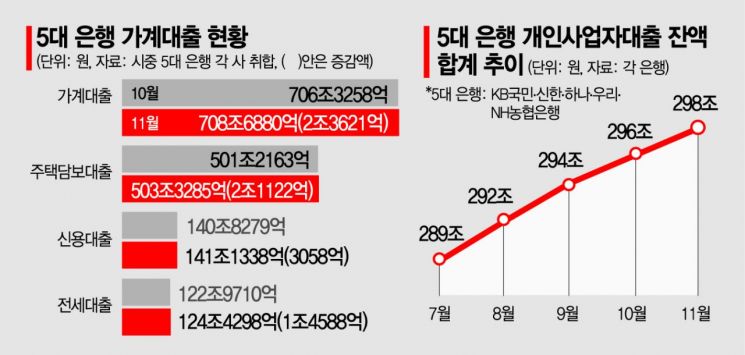
According to the financial sector on the 2nd, the outstanding household loans at the five major banks?KB Kookmin, Shinhan, Hana, Woori, and NH Nonghyup?stood at 708.688 trillion KRW at the end of last month. This is an increase of 2.3621 trillion KRW from 706.3258 trillion KRW in the previous month. This amount is less than 70% of the net increase of 3.438 trillion KRW recorded in October.
This reflects the impact of regulatory measures by financial authorities that have curbed the growth of household loans at commercial banks. The tightening of total household loan limits in the banking sector, along with the effect of loan interest rate hikes due to reduced preferential rates, has shown some results. In fact, the increase, which exceeded 9 trillion KRW until April, has been halved since August.
On the other hand, during the same period, the balance of jeonse loans, which mainly serve real demand, reached 124.4298 trillion KRW, increasing by 1.4588 trillion KRW compared to the previous month. This trend is similar to the increases of 1.4637 trillion KRW in September and 1.5402 trillion KRW in October.
Loans to individual business owners, most of whom are self-employed, also approached 300 trillion KRW. The outstanding loans to individual business owners at these banks stood at 298.7476 trillion KRW during the same period, up 2.009 trillion KRW from 296.7467 trillion KRW the previous month. While the balance at the end of last month was not significantly higher compared to the second half trend, the fact that the amount continues to increase by more than 2 trillion KRW monthly is noteworthy.
According to the Bank of Korea, the total outstanding loans to self-employed individuals from deposit banks in the third quarter of this year increased by 11.1 trillion KRW from the previous quarter to 429.6 trillion KRW. This is the largest increase since the second quarter of last year (21.2 trillion KRW), when the impact of COVID-19 became full-scale, and the second-largest increase since the fourth quarter of 2018, when related statistics began to be recorded.
"Recovery of Self-Employed Repayment Ability Unlikely"
An official from a commercial bank said, "The increase maintained around the 2 trillion KRW level is already high, so it is difficult to attribute much significance to the fact that last month's increase was relatively small," adding, "As interest burdens continue to rise, the pain for self-employed individuals will only deepen."
Since a significant portion of individual business loans likely corresponds to ‘COVID survival loans,’ concerns are growing that the increase could directly become a trigger for non-performing loans.
Professor Jeonggeun Oh of Konkuk University’s Department of Economics pointed out, "Measures such as the deferral of principal repayments related to COVID-19 will end in March next year, but it will be difficult for the economy to recover enough for self-employed individuals to secure the capacity to repay by then," adding, "After that, a significant portion of self-employed individuals' loans could be classified as non-performing loans, which will inevitably increase the overall financial burden."
© The Asia Business Daily(www.asiae.co.kr). All rights reserved.

![Clutching a Stolen Dior Bag, Saying "I Hate Being Poor but Real"... The Grotesque Con of a "Human Knockoff" [Slate]](https://cwcontent.asiae.co.kr/asiaresize/183/2026021902243444107_1771435474.jpg)














