0.24 Percentage Point Increase Compared to 15.66% at the End of June
[Asia Economy Reporter Park Sun-mi] The capital ratios, which indicate the soundness of domestic banks, rose despite the spread of COVID-19, supported by capital increases and realization of net profits.
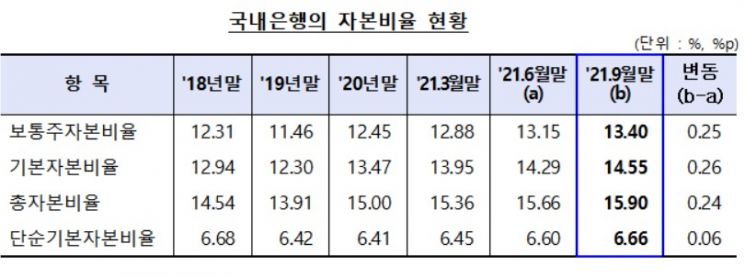
According to the Financial Supervisory Service on the 1st, as of the end of September, the total capital ratio of domestic banks under the Basel Committee on Banking Supervision (BIS) was recorded at 15.90%, up 0.24 percentage points from 15.66% at the end of June. The common equity tier 1 capital ratio and the tier 1 capital ratio were also recorded at 13.40% and 14.55%, respectively, increasing by 0.25 percentage points and 0.26 percentage points compared to the end of June.
This is attributed to an increase in capital due to capital increases and realization of net profits despite the rise in risk-weighted assets such as loan assets. Risk-weighted assets such as loan assets increased by 1.9% (37.6 trillion KRW) compared to the end of June, but the total capital growth rate reached 3.5% (10.7 trillion KRW) due to capital increases and net profit realization. In the third quarter, Kakao Bank (2.5 trillion KRW), K Bank (1.2 trillion KRW), Suhyup Bank (100 billion KRW), and Woori Bank (100 billion KRW) carried out capital increases.
As of the end of September, all domestic banks exceeded the regulatory ratios (including capital conservation buffer and D-SIB additional capital). Seven banks (Citi, SC, Export-Import Bank, DGB, Industrial Bank, JB, Hana) whose risk-weighted assets such as loans increased more than capital saw a decline in capital ratios, but the capital ratios of Kakao Bank and K Bank, which conducted capital increases in the third quarter, rose sharply. Woori Financial Group, which has been approved for the internal ratings-based approach, saw its risk-weighted assets decrease, resulting in an increase in its capital ratio.
The total capital ratio of eight bank holding companies was 15.79% at the end of June, while 19 non-holding banks recorded 17.02%. A Financial Supervisory Service official stated, "In the face of recent domestic and international market uncertainties such as U.S. tapering and global supply chain disruptions, we plan to induce sound capital management to maintain sufficient loss absorption capacity to proactively respond to the expansion of systemic risk."
© The Asia Business Daily(www.asiae.co.kr). All rights reserved.












