[Sejong=Asia Economy Reporter Son Seon-hee] Among the 17 cities and provinces nationwide, Sejong City has maintained its undisputed number one birth rate for seven consecutive years.
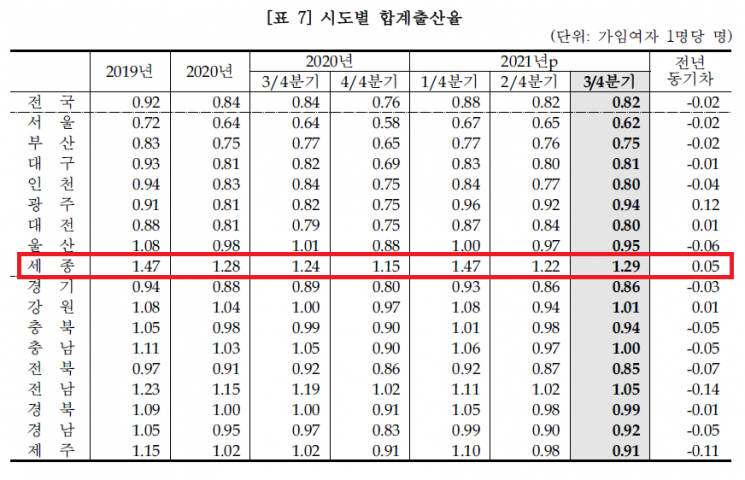
According to the recently released "September 2021 Population Trends" by Statistics Korea, examining the total fertility rate (the average number of children a woman is expected to have in her lifetime) by city and province for the third quarter (July to September), Sejong recorded the highest at 1.29. This was followed by Jeonnam at 1.05, Gangwon at 1.01, and Chungnam at 1.00. The remaining 13 cities and provinces, excluding these four, had total fertility rates in the 0 range. In other words, on average, women are having fewer than one child. The national total fertility rate was also at a record low of 0.82.
This trend is not limited to the third quarter but has continued for several years. According to past annual total fertility rate statistics provided by "e-Nara Indicator," Sejong City has consistently shown the highest total fertility rate nationwide from 2015 through last year. Given that it ranked first in the statistics for the first to third quarters of this year as well, it is expected to maintain the highest birth rate for seven consecutive years.
Amid an overall decline in birth rates, the reason Sejong has consistently maintained a high birth rate nationwide is attributed primarily to factors such as income level security due to stable employment and residential environment.
Meanwhile, the number of births in the third quarter was 66,563, a 3.4% (2,337) decrease compared to the same period last year, marking a new record low.
The number of deaths in the third quarter was 77,077, a 4.7% (3,447) increase compared to the same period last year.
With births decreasing and deaths increasing, South Korea's population continues to naturally decline. Since November 2019, the natural increase (births minus deaths) has been negative for 23 consecutive months. This means South Korea's population is steadily decreasing.
© The Asia Business Daily(www.asiae.co.kr). All rights reserved.












