[Asia Economy Reporter Jeong Hyunjin] Over the past five years, South Korea's tax competitiveness has rapidly declined compared to the major advanced countries known as the G5, prompting calls for urgent measures to enhance competitiveness through tax rate reductions and simplification of the tax system to promote economic growth.
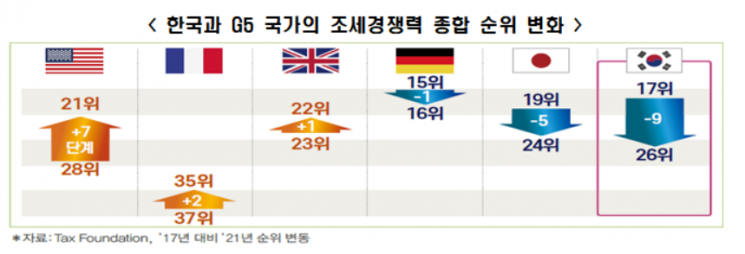
On the 25th, the Korea Economic Research Institute (KERI), under the Federation of Korean Industries, analyzed and compared the trends in tax competitiveness between South Korea and the G5 using the U.S. Tax Foundation's Global Tax Competitiveness Report. The results showed that South Korea's tax competitiveness ranking dropped nine places from 17th in 2017 to 26th this year, marking the largest decline among the G5. The comprehensive tax competitiveness rankings for the G5 were as follows: the United States (28th → 21st, up 7 places), France (37th → 35th, up 2 places), the United Kingdom (23rd → 22nd, up 1 place), Germany (15th → 16th, down 1 place), and Japan (19th → 24th, down 5 places).
KERI added that among the 37 OECD countries, South Korea experienced the largest drop in tax competitiveness ranking.
According to KERI, by major tax categories, South Korea's rankings declined in three of the four main tax areas?corporate tax, income tax, and property tax?while only the consumption tax category saw an improvement in ranking.
In the corporate tax category, South Korea's tax competitiveness ranking fell seven places from 26th in 2017 to 33rd this year. Among the G5 countries, the United States and France improved their rankings, while Germany and Japan each dropped by two places. The United Kingdom remained unchanged at 18th. South Korea raised its top corporate tax rate by 3 percentage points from 22% to 25% in 2018 and expanded the tax bracket stages from three to four. In contrast, the United States, which saw a 15-place rise in corporate tax competitiveness ranking, lowered its top corporate tax rate by 14 percentage points from 35% to 21% in 2018 and reduced the number of tax brackets from eight to one. France, which improved by two places, also gradually lowered its top corporate tax rate.
In the income tax category, South Korea's competitiveness ranking dropped seven places over five years to 24th. Japan, the United States, and Germany improved by three, two, and one places respectively, while France and the United Kingdom each fell by one place. South Korea increased its top income tax rate from 40% in 2018 to 42%, and further to 45% this year. The number of income tax brackets also expanded twice, from six to seven in 2018 and from seven to eight this year. Meanwhile, Japan applied a 20-year tax exemption on small and long-term installment fund investment gains in 2018. The United States lowered its top income tax rate by 2.6 percentage points to 37% in 2018 and doubled the standard deduction for income tax.
Regarding property tax competitiveness, South Korea's ranking slipped one place from 31st in 2017 to 32nd this year. Among the G5, France improved by three places, having continuously eased the residential property tax burden on single-homeowners since 2018 and abolished the wealth tax on financial assets. The United States rose two places by increasing the basic exemption amount for inheritance and gift taxes in 2018. South Korea, however, has continuously raised real estate holding and transaction tax rates, expanded the tax bracket stages for the comprehensive real estate tax, and subdivided the taxable targets.
The only tax category where South Korea's ranking improved was consumption tax. By expanding the simplified VAT taxpayer threshold from an annual sales of 48 million KRW last year to 80 million KRW this year, South Korea's competitiveness ranking rose one place from 3rd to 2nd over five years. The United Kingdom improved from 23rd in 2017 to 22nd this year, while Germany dropped from 10th to 11th and Japan from 2nd to 3rd, each falling one place. France remained at 21st and the United States at 5th.
Choo Kwang-ho, Director of Economic Policy at KERI, stated, "Improving tax competitiveness can enhance private sector vitality and contribute to economic growth," and argued, "It is necessary to ease excessive taxes on corporate tax, income tax, and property tax?which have been pointed out as factors weakening South Korea's tax competitiveness?and to simplify the complex tax system."
© The Asia Business Daily(www.asiae.co.kr). All rights reserved.












