[Asia Economy Reporter Seo So-jeong] To avoid confusing the autumn delicacy 'wild giant freshwater prawn' with 'farmed whiteleg shrimp' when purchasing, it is important to carefully examine the shape of the rostrum, legs, and tail color.
According to the Ministry of Food and Drug Safety on the 31st, although the giant freshwater prawn and whiteleg shrimp have similar tastes, there have been cases where relatively cheaper whiteleg shrimp were purchased at higher prices, so caution is needed.
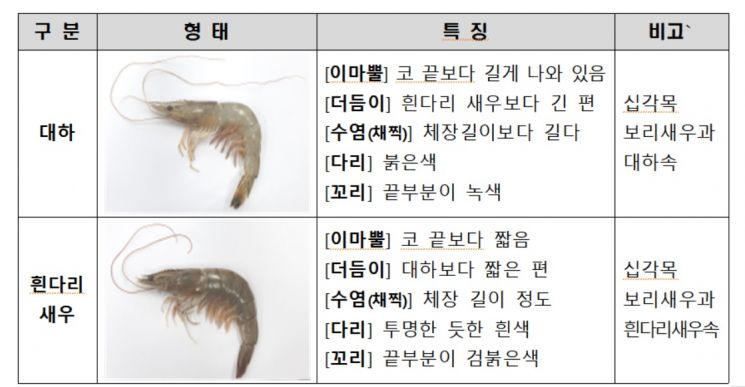
The easiest way to distinguish between the giant freshwater prawn and whiteleg shrimp is to check the color of the tail: the giant freshwater prawn's tail has a greenish tint, while the whiteleg shrimp's tail has a reddish hue.
They can also be distinguished by their whisker-like antennae called "whips." The giant freshwater prawn's whiskers are about 2 to 3 times the length of its body, longer than those of the whiteleg shrimp, making this a useful method to identify whether cooked shrimp at restaurants are giant freshwater prawns or whiteleg shrimp.
They can also be differentiated by the antennae at the tip of the shrimp's rostrum, which might be mistaken for whiskers: whiteleg shrimp have very short antennae, whereas giant freshwater prawns have antennae long enough to be mistaken for whiskers.
Generally known differences in leg color and rostrum length can also be used for identification. As the name suggests, whiteleg shrimp have transparent white legs, while giant freshwater prawns have reddish legs. However, since both turn red when cooked, distinguishing them after cooking is difficult.
The rostrum of the whiteleg shrimp is shorter than the tip of the rostrum, whereas the giant freshwater prawn's rostrum extends forward beyond the tip, making visual identification possible. However, the rostrum can be damaged during harvesting or distribution, limiting its reliability as a distinguishing feature.
Since wild giant freshwater prawns die within minutes of being caught, it is difficult to find live giant freshwater prawns in fish markets; therefore, live shrimp in tanks are more likely to be whiteleg shrimp.
Grilling on salt allows gentle cooking without burning
The reason for grilling shrimp on coarse salt is not to season the shrimp with salt but to cook the shrimp thoroughly and gently without burning it.
If shrimp are grilled directly, their shells burn easily, but since salt has a melting point of about 800°C, it transfers heat to the inside of the shrimp without burning it.
Therefore, when grilling shrimp, place them neatly without overlapping on coarse salt and cover with a pot lid to steam. The moisture inside the pot transfers to the shrimp meat, resulting in tender shrimp meat and removing fishy odors, leaving only a clean taste.
The Ministry of Food and Drug Safety stated, "We will continue to develop morphological identification methods and genetic analysis techniques to determine the authenticity of species to prevent consumer damage caused by similar species that are difficult to identify, and we will continuously disclose this information to consumers and related industries."
© The Asia Business Daily(www.asiae.co.kr). All rights reserved.












