Director Jeong Seong-hye and others hold a one-person relay protest from October 25 to November 5, 8-9 AM at the Ministry of Personnel Innovation main gate (499 Hannuri-daero, Sejong City, Sejong Post Building) urging "Ministry of Personnel Innovation to guarantee flexible working hours through legal amendments"
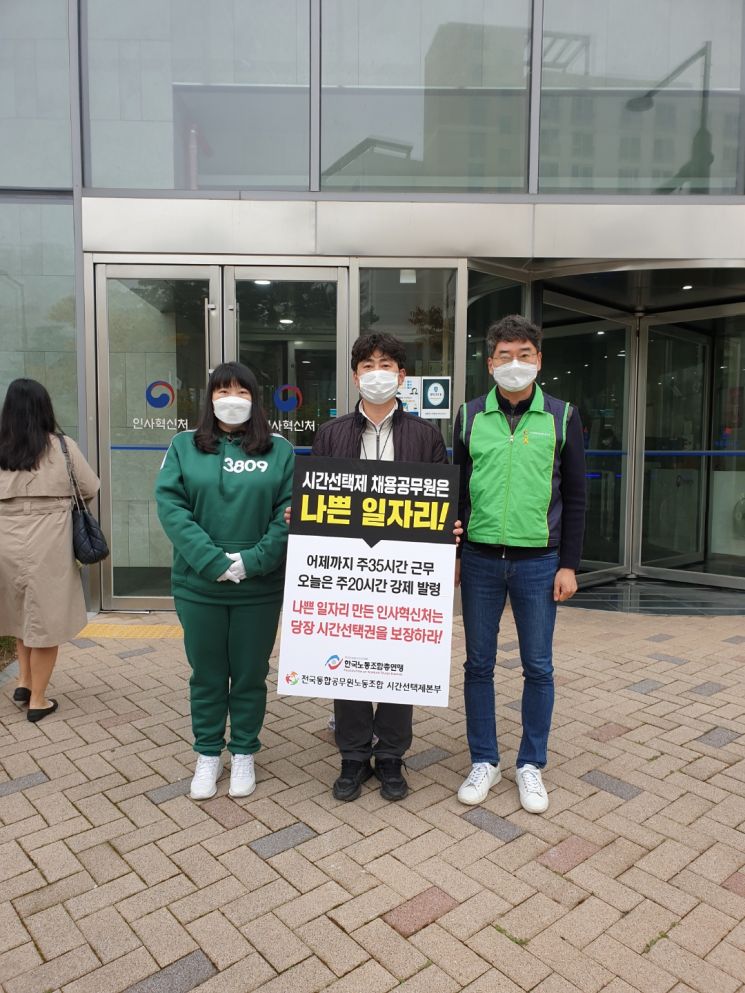
[Asia Economy Reporter Jongil Park] Jeong Seong-hye, head of the Time-Selective Employment Headquarters of the National Integrated Public Officials Union, and union members held a one-person relay protest from 8 a.m. on the 25th in front of the Ministry of Personnel Management’s main gate, urging the revision of laws to grant working hour selection rights to time-selective employed public officials.
The union members began a one-person relay protest for one hour each day from 8 a.m. to 9 a.m. from October 25 to November 5.
On September 17, 2013, the government introduced time-selective employed public officials as "general public officials who can choose to work only the hours they desire."
Under the Park Geun-hye administration, aiming to achieve a 70% employment rate and expand short-time jobs, the government promoted time-selective employed public officials. Now in its seventh year, 1,841 national and 4,152 local officials have been hired, with 3,809 still in service as of December 31, 2020, resulting in a resignation or dropout rate approaching 40%.
On June 18, 2019, the Public Officials Appointment Decree was revised to allow time-selective employed public officials to work up to 35 hours per week. However, while time-selective converted public officials?who are the same type of time-selective officials?are legally allowed to set their working hours in consultation with the appointing authority "when the public official wishes," time-selective employed public officials are only stipulated as having their working hours "determined by the appointing authority." This has led to abuses by institutions, arbitrarily changing working hours without the officials’ consent.
As an example of abuse, a time-selective employed public official A working at the Korea Coast Guard claimed that, upon the institution’s request, they took over duties from a colleague on parental leave and worked 35 hours per week starting April 5, 2021. However, despite notifying the institution on July 31, 2021, of their intention to take parental leave due to personal circumstances, they were forcibly reassigned to 20 hours on July 30, 2021, the day before the leave began, even though no replacement had been hired yet.
The official filed a personnel grievance with the institution, but on September 24, 2021, the Korea Coast Guard rejected it, stating that "the adjustment was made ex officio due to relevant laws and personnel management needs, and there is currently no legal provision granting time-selective employed public officials the right to choose their working hours." When the Time-Selective Employment Headquarters raised this as an abuse and power harassment case, the Coast Guard responded absurdly, saying, "We inquired with the Ministry of Personnel Management and were told it was possible, so we issued the order."
Another abuse case involved a time-selective employed public official B working in the Ministry of Trade, Industry and Energy’s civil affairs office. From late December 2020, B was assigned to work 35 hours per week (8 hours Monday to Thursday, 3 hours Friday) until December 30, 2021, working 5 hours of overtime every Friday to avoid work gaps. B continuously expressed to the personnel department a desire to transfer to a department where they could continue working 35 hours per week, contributing to the institution and working stably. However, B was instead reassigned to another civil affairs office and notified by email on September 7, 2021, that starting September 8, 2021, their working hours would revert to 20 hours per week.
The Public Officials Appointment Rules stipulate that the Minister of Personnel Management may conduct surveys on personnel grievances and obstacles to time-selective work for time-selective public officials and recommend improvements to departments based on the results. Although this allows for improvement recommendations to institutions abusing the system after surveys of time-selective public officials in central administrative agencies, the union criticized the Ministry of Personnel Management for neglecting this duty.
When the 35-hour workweek law was revised in 2019, the Time-Selective Employment Headquarters submitted a petition with 1,520 signatures to the Ministry of Personnel Management, requesting legal amendments to grant working hour selection rights to the officials themselves. However, no improvements have been made. In March 2021, they submitted over 1,100 “public proposals” requesting revision of Article 3-3, Paragraph 2 of the Public Officials Appointment Decree from "determined by the appointing authority" to "determined by the appointing authority upon the public official’s request," allowing the official and appointing authority to agree on working hours, but these were rejected in April.
Jeong Seong-hye, head of the Time-Selective Employment Headquarters, said, “It seems the Ministry of Personnel Management is waiting until all time-selective employed public officials retire, playing a survival game like Squid Game.” Representing the 3,809 time-selective employed public officials who have survived this government-created survival game, she urged the revision of the Public Officials Appointment Decree to grant working hour selection rights. She announced the start of a one-person relay protest dressed as a Squid Game participant at 8 a.m. on October 25, which will continue for two weeks until November 5.
© The Asia Business Daily(www.asiae.co.kr). All rights reserved.












