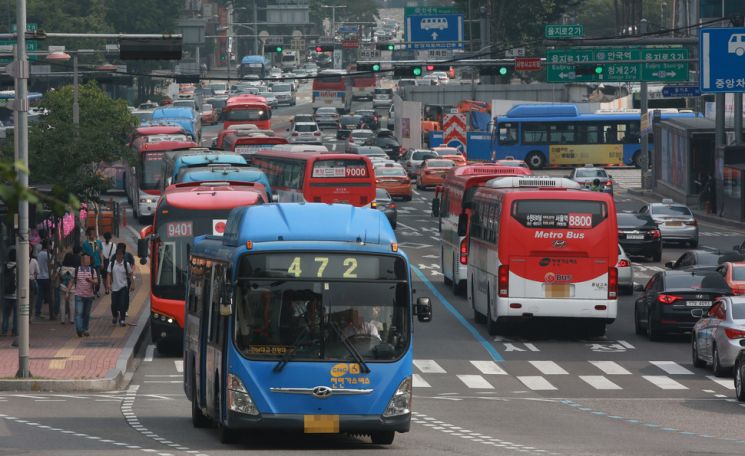
The Ministry of Land, Infrastructure and Transport announced on the 24th that it will establish the 'Guidelines for the Introduction and Improvement of the Semi-Public Bus System' and distribute them to local governments nationwide on the 25th to provide a basis for the autonomous improvement of the semi-public bus system.
The semi-public system is a scheme in which the competent authority supports part of the insufficient transportation revenue to bus operators to strengthen the public nature of bus services. It was introduced in Seoul in 2004 and is currently implemented in Busan, Daegu, Incheon, and other cities.
While the introduction of the semi-public system has had positive effects such as improving drivers' working conditions, reducing bus accidents, and increasing satisfaction with bus services, there have also been many criticisms that the financial burden on local governments has increased and the management efficiency of the bus industry has declined.
Accordingly, the Ministry of Land, Infrastructure and Transport analyzed various issues arising in regions operating the semi-public system and prepared guidelines to enhance the system's efficiency. The guidelines were established in two types: 'Joint Revenue Management Type' and 'Route Bidding Type.'
The Joint Revenue Management Type jointly manages the revenue of all bus routes of companies within the jurisdiction and distributes revenue according to each company's operational performance, compensating for deficits. The Route Bidding Type grants licenses temporarily for a certain period to companies that offer the lowest subsidy through bidding for each route.
The Ministry standardized cost components such as fuel and labor costs to present unified criteria. Items unrelated to transportation costs, such as donations, advertising expenses, and loan fees, were excluded from the standard transportation cost calculation to prevent excessive support.
Additionally, external audits by professional institutions are mandated for transportation companies receiving financial support, and penalties such as subsidy recovery are stipulated for cases of receiving subsidies or loans through fraudulent means.
The basic profit rate unrelated to bus operation performance was adjusted, and excessive executive salaries were restricted. Furthermore, the agreement specifies the competent authority's rights to operate and adjust routes, allowing the authority to modify routes. In cases of shareholder changes, prior consultation with the competent authority is required to strengthen the local government's authority.
Ahn Seok-hwan, Director General of Comprehensive Transportation Policy at the Ministry, said, "We hope these guidelines will be usefully utilized and helpful to both local governments planning to newly introduce the semi-public system and those seeking to improve it."
© The Asia Business Daily(www.asiae.co.kr). All rights reserved.












