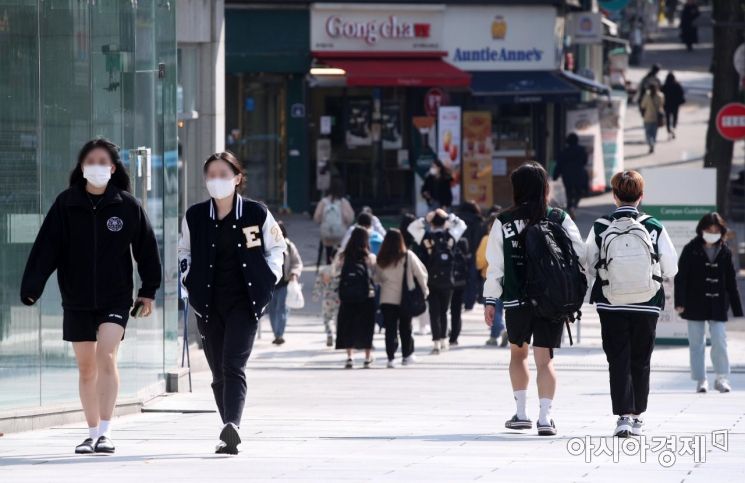
 As the transition to 'With Corona' approaches, major universities are gradually switching to face-to-face classes, bringing some vitality back to campuses and surrounding commercial areas. On the 19th, Ewha Womans University campus in Seodaemun-gu, Seoul, was regaining its liveliness with students./Photo by Hyunmin Kim kimhyun81@
[Asia Economy Reporter Lee Chun-hee] About half of the population believes that the benefits our society will gain from the transition to the 'With Corona' policy outweigh the losses. Additionally, 42% of the public expressed the opinion that 'now is the appropriate time' to shift the COVID-19 response system.
On the 22nd, Professor Yoo Myung-soon’s research team at Seoul National University’s Graduate School of Public Health announced the results of a 'Public Perception Survey on the Transition of the COVID-19 Response System.' This survey was conducted over four days from the 5th to the 8th at the request of the Central Disaster and Safety Countermeasures Headquarters, with the professional research agency Korea Research carrying out the fieldwork. The survey targeted 1,083 adult men and women aged 19 to 69 nationwide. The sampling error margin is ±3.10% at a 95% confidence level.
According to the survey, 53.2% of respondents answered 'the benefits are greater' to the question, 'How do you think the benefits and losses our society will gain from the transition to the With Corona policy compare?' Responses indicating that benefits and losses would be similar accounted for 29.8%, while those who said 'losses are greater' were only 12.8%.
Regarding the timing to shift the direction and strategy of the COVID-19 response system, including With Corona, 41.8% of respondents said 'now is appropriate.' This was followed by 27.5% who said 'now is not appropriate,' and 20.6% who said 'it is already too late.' Related to this, 46.6% responded that 'starting With Corona and making adjustments once certain conditions are met (70% of the adult population vaccinated) is realistic,' while 41.5% said 'waiting until all conditions are maximally met (90% of the adult population vaccinated) before starting is realistic,' showing similar levels of support. Only 5% responded that neither option aligns with their thinking.
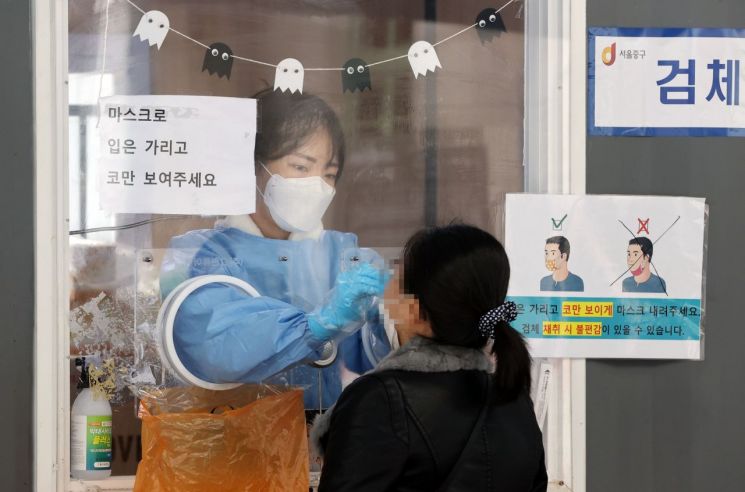 On the 19th, medical staff are collecting specimens at a temporary COVID-19 screening clinic set up at Seoul Station Plaza. [Image source=Yonhap News]
Regarding the potential increase in confirmed cases immediately after the transition to With Corona, 57.1% responded that 'the number of confirmed cases our society can tolerate on a daily average' is between 1,000 and less than 2,000. Next, 21.0% said between 2,000 and less than 3,000. Those who said they could tolerate 3,000 or more confirmed cases accounted for only 22.0% combined.
Regarding deaths, considering the current annual deaths from seasonal flu of 2,000 to 3,000 and the cumulative COVID-19 deaths since the outbreak (as of the 29th of last month) of 2,474, the most common response (58.6%) was that the tolerable annual death toll is between 1,000 and less than 2,000. 28.0% said between 2,000 and less than 3,000, while those who said they could tolerate 3,000 or more deaths accounted for only 13.4% combined.
Among the 'With Corona' policies implemented overseas, the policies that received majority support as appropriate for domestic application were: mandatory vaccination for essential occupations such as healthcare workers, public officials, and teachers (82.7%); presentation of vaccination certificates or PCR negative results (vaccine pass) when entering multi-use facilities such as restaurants (74.9%); home quarantine for mild cases (confirmed patients) and hospitalization for severe cases (75.6%); continued easing of additional restrictions as long as fatality rates do not increase (68.0%); and no closure of public facilities such as schools and libraries unless fatality rates surge (65.5%).
On the other hand, policies such as lifting operating hour restrictions for all multi-use facilities including clubs (61.3%), stopping daily public briefings by the government (70.5%), halting the counting of confirmed cases (73.8%), and lifting indoor mask-wearing requirements (80.3%) were considered inappropriate for domestic introduction by more than half of respondents.
© The Asia Business Daily(www.asiae.co.kr). All rights reserved.












