Recycling Sorting Rate Soars from 55% Last Year to 72% This Year, Achieving Over 420 Million Won in Waste Disposal Cost Reduction and Sales Revenue
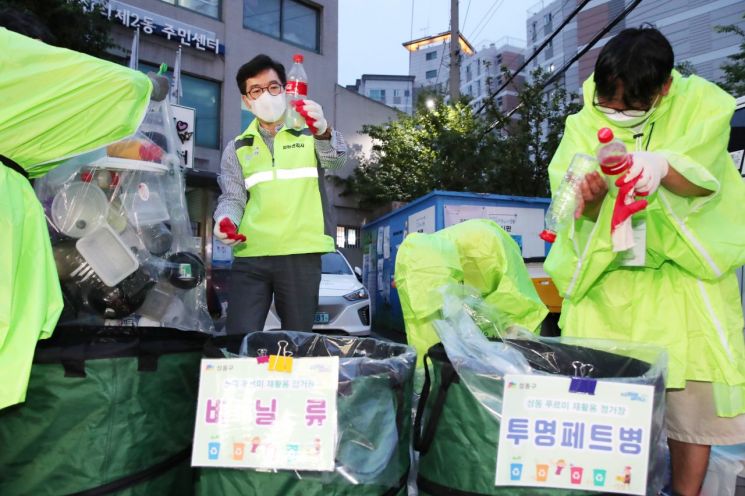 Jung Won-oh, Mayor of Seongdong-gu, is sorting recyclables with resource managers at the Wangsimni 2-dong Purumi Recycling Station last June.
[Asia Economy Reporter Jongil Park] Seongdong-gu (Mayor Jeong Won-oh) is achieving results in waste reduction as the recycling sorting rate has increased by 17% compared to last year.
Compared to the same period last year (as of the end of September 2021), there was a cost reduction of about 230 million KRW in waste disposal fees, and sales revenue of about 190 million KRW was generated from the sorted recyclable collected items, creating a total profit of approximately 426 million KRW.
The rapid rise in the recycling sorting rate from only 55% last year to 72% (as of the end of September 2021) is analyzed to be a direct effect of the Seongdong Purumi Recycling Station project (hereafter Station), which has been operating since last May, along with the district’s multifaceted policies.
Since May, the “Seongdong Purumi Recycling Station,” which has been expanded to general residential areas and fully operated across all 17 neighborhoods, installs separate collection bins at 100 key locations and assigns resource managers to assist residents with proper waste separation.
In operating the Station, the district focused on a differentiated three-step strategy of the “disposal-collection-processing system” for recyclables, emphasizing separation of eight item categories from the disposal stage and their collection and management. Every Thursday and Sunday evening, resource managers provide detailed guidance to residents on how to separate waste at the key locations, while ensuring item-specific collection. At the recycling sorting center, a resource recovery center, separate storage areas for each item category were established to strictly prevent mixing with other collected materials.
The total amount of recyclables collected through the Station until last month reached 200 tons. In particular, transparent PET bottles collected at the recycling station were recognized for top-grade quality by recycling processing companies and sold at high prices, being recycled into high-quality regenerated fibers.
Earlier, the district established a plan to reduce household waste by 7% annually in the first half of this year, aiming for a 50% reduction by 2027. Under the vision of “Seongdong-gu Resource Circulation (Zero-waste) City Creation,” the district is focusing on concrete actions such as suppressing waste generation and increasing recycling rates.
In response to residents’ requests, 10 additional stations will be expanded next year. Furthermore, following the installation of public facilities (benches) made from recycled discarded sewing fabric in the rest area near Exit 10 of Wangsimni Station in Seongdong-gu, the district plans to actively respond to worsening environmental issues through concrete resource circulation practices such as supporting traditional markets with recycled ice packs and promoting coffee grounds recycling projects using innovative technologies from social venture companies.
Jeong Won-oh, Mayor of Seongdong-gu, said, “Environmental pollution and the climate crisis are urgent issues we must solve immediately, and we will concentrate the district’s capabilities on reducing household waste.” He added, “We hope all residents actively participate in saving the environment by practicing feasible measures in daily life.”
© The Asia Business Daily(www.asiae.co.kr). All rights reserved.












